Journal: Gallup Poll on US Public Concerns

03 Economy, 09 Justice, 11 Society, Civil Society, Corruption, Cultural Intelligence

September 10, 2010

Nine Years After 9/11, Few See Terrorism as Top U.S. Problem

One percent see it as the top problem today, down from 46% in 2001

PRINCETON, NJ — Nine years after the terrorist attacks of Sept. 11, 2001, 1% of Americans mention terrorism as the most important problem facing the country, down from 46% just after the attacks.

. . . . . . .

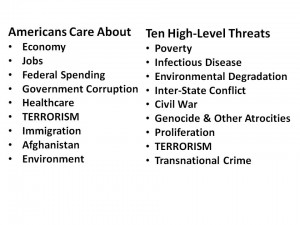
Still, Americans rated economic issues such as the economy, jobs, and federal spending, as well as corruption in government and healthcare, even higher. They rated terrorism as more important than immigration, Afghanistan, and the environment.

US versus Global Cares
See Also:

Journal: Unemployment Up AND Gap in Skills

03 Economy, 04 Education

Skilled worker positions go unfilled, despite high unemployment

Employers cannot find job candidates with the most sought-after ability

By John Schmid of the Journal Sentinel

Sept. 11, 2010 7:06 p.m

EXTRACT 1:  According to Manpower Inc., the global job-placement company, the nation has a gaping disconnect between openings and qualified candidates – a gap contributing to around 3 million unfilled U.S. jobs – which in turn hampers growth.

EXTRACT 2: Talent shortages span a broad scale, from engineers who can contribute to global development teams to electricians, mechanics and other specialized machine-shop skills that have seen waves of retirees exit the workforce in recent years without a commensurate wave of apprenticeships to replace them.

EXTRACT 3: “Notwithstanding all our best efforts in attempting to fix the system with recent improvements in workforce development, the pipeline is broken,” Sullivan said. “The fact that virtually all (kindergarten through 12th grade) education in southeastern Wisconsin is based solely on a college prep curriculum, with no exposure to industrial arts, means we are not feeding the market with the right skill sets.”

EXTRACT 4:  Resigned they might not find the exact candidates they need, even from abroad, employers will begin to abandon the notion of the ideal candidate. Instead, they will seek the most “teachable fit.”  This is a new breed of job candidate – folks who lack some qualifications “but whose capability gaps can be filled in a timely and cost-effective way.” Employers who are willing to set up in-house training academies increasingly will look outside their traditional industries.

SEE LIST OF TEN TOP JOBS LACKING FILLS

Journal: America’s Army–Tough, Isolated, Happy

04 Inter-State Conflict, 05 Civil War, 07 Other Atrocities, 11 Society, Cultural Intelligence, Military, Officers Call, Power Behind-the-Scenes/Special Interests
Marcus Aurelius Recommends

Ladies and Gentlemen:

I suggest to you that this article is a keeper, that David Woods gets it.  While it focuses on the Army, I think it's applicable in significant part to the other

David Wood Biography

DoD military Services, particularly to the Marine Corps, and to one or two non-DoD Federal agencies have been close partners in the national security effort.

V/R,

REDACTED

In the 10th Year of War, a Harder Army, a More Distant America

The U.S. Army now begins its 10th continuous year in combat, the first time in its history the United States has excused the vast majority of its citizens from service and engaged in a major, decade-long conflict instead with an Army manned entirely by professional warriors.

This is an Army that, under the pressure of combat, has turned inward, leaving civilian America behind, reduced to the role of a well-wishing but impatient spectator. A decade of fighting has hardened soldiers in ways that civilians can't share. America respects its warriors, but from a distance.

EXTRAORDINARY BRILLIANT STUFF “MUST READ”

“A lot of us are here because society has no further use for us,” he said. “The Army has become home for a lot of restless souls who can never really go back.

See Also:

Worth a Look: Book Reviews on Corruption
Worth a Look: Book Reviews on Dereliction of Duty (Defense)
Worth a Look: Book Reviews on Poverty
Worth a Look: Book Reviews on War Complex—War as a Racket

CounterPunch on Defense & Economy

03 Economy

What Did the Pentagon Do With That Extra Trillion Dollars?

The Surge in Defense Spending

By WINSLOW T. WHEELER

EXTRACT:  Finally, that $102 billion efficiency drive being pursued by Secretary Gates is over five years. The current Pentagon budget plan is to spend $3.245 Trillion over that period. In other words, the much touted Gates plan would shift from overhead to hardware just 3 percent of the planned spending.

READ ARTICLE ONLINE

+ + + + + + +

The Angelides Commission Squints Back at the Bank Bailout and the Fall of Lehman

Does Our Economy Really Have to Run on Fraud?

By MICHAEL HUDSON

EXTRACT: Given today’s florid emotionalism when it comes to discussing Wall Street finances, it hardly is surprising that the Angelides hearings do not dare venture into such territory as to ask whether the bottom 90 per cent of the U.S. economy might need to be bailed out with debt relief just as Wall Street’s elites were.

READ ARTICLE ONLINE

Journal: A Case Study in Confused Secrecy

09 Justice, 10 Security, 11 Society, Secrecy & Politics of Secrecy
Marcus Aurelius Recommends
Full Story Online

September 9, 2010

Pentagon Plan: Buying Books to Keep Secrets

By SCOTT SHANE

WASHINGTON — Defense Department officials are negotiating to buy and destroy all 10,000 copies of the first printing of an Afghan war memoir they say contains intelligence secrets, according to two people familiar with the dispute.

The publication of “Operation Dark Heart,” by Anthony A. Shaffer, a former Defense Intelligence Agency officer and a lieutenant colonel in the Army Reserve, has divided military security reviewers and highlighted the uncertainty about what information poses a genuine threat to security.

Continue reading “Journal: A Case Study in Confused Secrecy”

Video: Visions of the Gamepocalypse, Possible Futures, Waking Up, Thinking, and Creating a Better World

04 Education, Augmented Reality, Corporations, Cultural Intelligence, Geospatial, Peace Intelligence, Technologies
See the "Long Short" (short video) on gaming and Jesse Schell's presentation

Jesse Schell: Visions of the Gamepocalypse

Hosted by The Long Now Foundation

This is a provoking and entertaining presentation.
After the short video called “Pixels” prior to the presentation, Jesse Schell starts off with what if life becomes, not Orwellian, but Huxleyan (Brave New World) where pleasure achieved through technology grips the whole lives of citizens. Imagine sensors attached to commercial products from toothbrush to television (and electric tattoos linked to Facebook) collecting data + wi-fi connections uploading behavior data to the Web.  People can earn “points” like in a gaming environment depending on their behavior and habits and these points can be used for coupons, deals, and other corporate profit-pursuing conceptions.

Soon the presentation gets into prediction and if the more one practices at predicting the future, the better one can become.  Other parts of the presentation:

  • The upward trend of mobile gaming application sales versus console gaming systems, and how micro-transactions of money (Zynga, Playdom, Playfish, Bigpoint) in connection with social networking will be like peanut butter + chocolate.
  • Dream states (REM sleep) as un-tapped territory that most likely advertisers will reach first.
  • Virtual money such as “Farm cash,” and World of Warcraft gold was mentioned to attract product attention.
  • A stat was shown of commercial ads on television rising from 13% in 1950 to 36% today.
  • “Battlefield of the 21st century” as how you spend your day and carving up those percentages to target your behaviors

Continue reading “Video: Visions of the Gamepocalypse, Possible Futures, Waking Up, Thinking, and Creating a Better World”

noble gold