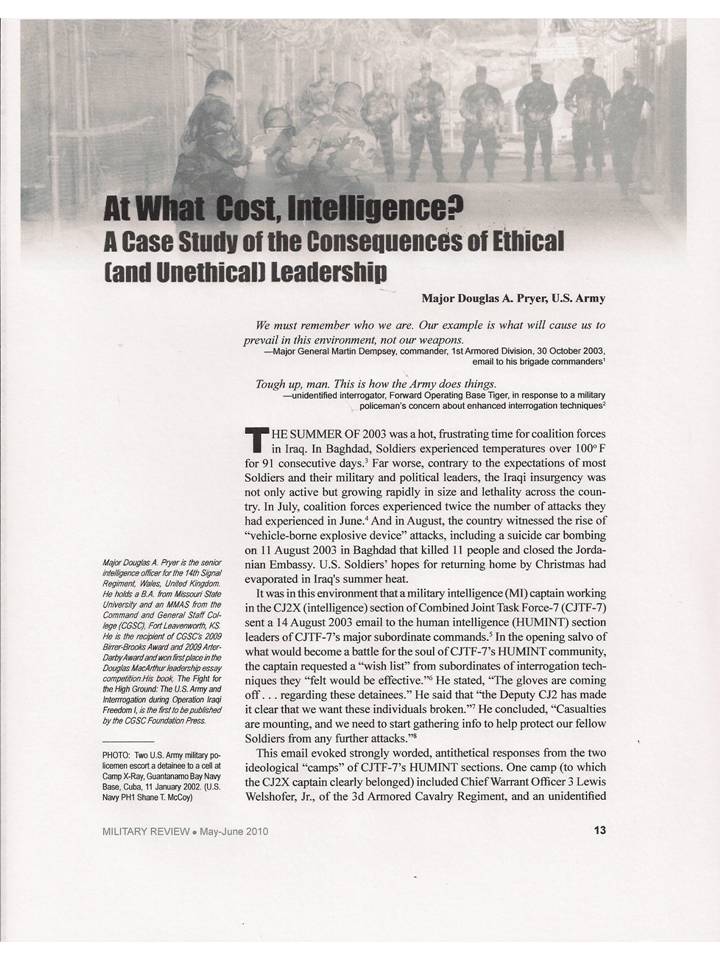
Military Review June 2010 Full Article
Continue reading “Reference (2010): At What Cost, Intelligence? [On Ethics]”

The truth at any cost lowers all other costs — curated by former US spy Robert David Steele.
I will not replicate all that is at www.oss.net and to a much lesser extent, www.earth-intelligence.net, but do want to recognize a handful of extraordinary individuals by isolating their especially meritorious contributiions to the long-running debate about national intelligence reform and re-invention.

by jonl on March 29, 2011
Via Flemming Funch, a review of “Finite and Infinite Games – A Vision of Life as Play and Possibility” by James P. Carse: “A finite game is a game that has fixed rules and boundaries, that is played for the purpose of winning and thereby ending the game….An infinite game has no fixed rules or boundaries. In an infinite game you play with the boundaries and the purpose is to continue the game.”
All finite games have rules. If you follow the rules you are playing the game. If you don’t follow the rules you aren’t playing. If you move the pieces in different ways in chess, you are no longer playing chess.Infinite players play with rules and boundaries. They include them as part of their playing. They aren’t taking them serious, and they can never be trapped by them, because they use rules and boundaries to play with.
Phi Beta Iota: This is a perfect “capstone” commentary from Jon–himself a hacker pioneer–Epoch A is over. Epoch B has begin. Epoch B changes everything, including the rules. It bears emphasis, over and over again, that INTEGRITY is essential for infinite games to create infinite wealth. Corruption is a cancer.
 Well worth the read….
I don't think this is so much about Google as it is about fostering innovation and good overall business practices, taken from the standpoint of a former Google employee.
There are many good nuggets in here — my favorite being the “NIH” (Not Invented Here) Syndrome and the like.
What Larry Page really needs to do to return Google to its startup roots
Posted on March 24, 2011 by slacy
I worked at Google from 2005-2010, and saw the company go through many changes, and a huge increase in staff. Most importantly, I saw the company go from a place where engineers were seen as violent disruptors and innovators, to a place where doing things “The Google Way” was king, and where thinking outside the box was discouraged and even chastised. So, here’s a quick list of things I think Larry could do to bring the startup feel back to Google:
Phi Beta Iota: The post is not only credible, but the comments are spectacularly reinforcing. It is also with sadness that we observe how quickly Google acquired all of the bad habits of its start-up funding partner and continuing co-conspirator in institutionalized ineptitude, the US secret intelligence community. We continue to emphasize that Corruption–and Integrity–are about much more than individual honor or good intent–they are systemic. Corrupt feedback–and losses of integrity in small things–are cumulative.
 Network organisation for the 21st century
Harry Halpin and Kay Summer, Turbulence.org
Will the upsurge in activity around climate change and the food crisis repeat the cycle of the movement of movements over the past decade – momentary visibility then dissolution? Harry Halpin and Kay Summer say ‘yes’, unless different models of organising are embraced.
Phi Beta Iota: This is worth a full reading. Networks are emergent at this time, and they all lack clarity, diversity, integrity, and sustainability, in part because they are all still stove-piped and not part of the whole. Lacking is a strategic analytic model and a global sparse matrix approach to assuring the integration of all information in all languages all the time such that every human has access to “true cost” information on everything they consider touching; and we can connect the billion rich to the five billion poor at the micro (household) level of need. We're getting there, but the movements themselves lack an appreciation for anything other than passion. They don't have the discipline and intellectual integrity needed to form a world brain and play a global game 24/7.
Key messages for political networks
• Encourage people to become hubs
• Develop other hubs, with dense connections to lots of distant nodes
• Hub redundancy is important – don’t worry about duplicating functions
• Let hubs evolve
• Focus on the long tail: have more limited interactions with the greatest number of people and places
Tip of the Hat to Pierre Levy at LinkedIn.
The Pentagon Labyrinth on C-SPAN
Mar 11, 2011
Stewart R. Mott Charitable Trust | Mott House
Three former, high-level Pentagon insiders take a critical look at how the Defense Department operates and where the money it receives goes. The three- Thomas Christie, Franklin Spinney and Pierre Sprey – are contributors to the book, The Pentagon Labyrinth. Danielle Brian, executive director .. Read More
Three former, high-level Pentagon insiders take a critical look at how the Defense Department operates and where the money it receives goes. The three- Thomas Christie, Franklin Spinney and Pierre Sprey – are contributors to the book, The Pentagon Labyrinth. Danielle Brian, executive director of the Project On Government Oversight (POGO), acts as moderator for the discussion.
Watch Video: 1 hour, 2 minutes
See Also + Pierre Sprey's “Seven Rules”:

Posted 31 August 2008 this actually dates back to 2004 coincident with the Democratic Convention. Paul Ray is introduced by Jim Garrison, and presents new information with respect to 87% of the US electorate believing Earth should be treated as a living system.
See Also:
Continue reading “YouTube: Dr. Paul Ray New Political Compass (Green)”

Intelligence Analysis: Behavioral and Social Scientific Foundations
National Research Council, 2011
Intelligence Analysis for Tomorrow: Advances from the Behavioral and Social Sciences
National Research Council, 2011
Phi Beta Iota: There is nothing in either of these that Jack Davis, Stephen Andriole, Andy Shepard, and a whole lot of others do not already know. Going through this stuff, one can only observe that it took them three years to get to the obvious, and that neither book addresses the fact that the US Intelligence Community remains focused on collection inputs, lacks integrity across the board, has no strategic analytic model or modern collection management plan that respects open sources in 183 languages, and relies for analytics on young people without substantive knowledge, US citizens with secret clearances two steps removed from reality, and a total ban on actually engaging with the 90-country minimum it takes to achieve M4IS2.
See Also:
