Yoda: Muslim Rebels and Philippine Government Agree on Peace

01 Poverty, 03 Economy, 05 Civil War, 08 Wild Cards, 10 Security, 11 Society, Civil Society, Cultural Intelligence, Ethics, Government, IO Deeds of Peace, Law Enforcement, Military, Officers Call, Peace Intelligence
Got Crowd? BE the Force!

Good news this is.

Philippines, Muslim rebels agree on peace pact

EILEEN NG, Associated Press, JIM GOMEZ, Associated Press | Sunday, October 7, 2012 | Updated: Sunday, October 7, 2012 8:44pm

MANILA, Philippines (AP) — The Philippine government and the country's largest Muslim rebel group have reached a preliminary peace deal that is a major breakthrough toward ending a decades-long insurgency that killed tens of thousands and held back development in the south.

Philippine President Benigno Aquino III said the “framework agreement” calling for an autonomous region for minority Muslims in the predominantly Roman Catholic nation was an assurance the Moro Islamic Liberation Front insurgents will no longer aim to secede.

The agreement, announced Sunday and to be signed Oct. 15 in Manila, spells out principles on major issues, including the extent of power, revenues and territory of the Muslim region. If all goes well, a final peace deal could be reached by 2016, when Aquino's six-year term ends, officials said.

“This framework agreement paves the way for final and enduring peace in Mindanao,” Aquino said, referring to the southern Philippine region and homeland of the country's Muslims. “This means that the hands that once held rifles will be put to use tilling land, selling produce, manning work stations and opening doorways of opportunity.”

He cautioned that “the work does not end here” and that details of the accord still need to be worked out. Those talks are expected to be tough but doable, officials and rebels said.

Rebel vice chairman Ghadzali Jaafar said the agreement provides a huge relief to people who have long suffered from war and are “now hoping the day would come when there will be no need to bear arms.”

Continue reading “Yoda: Muslim Rebels and Philippine Government Agree on Peace”

Mini-Me: Fukushima Impact on US West Coast – Keeping the Truth Off the Table….+ Fukushima / Nuclear Meta-RECAP

07 Health, 07 Other Atrocities, 08 Proliferation, 08 Wild Cards, 11 Society, Corruption, Government, IO Impotency
Who? Mini-Me?

Huh?

Impact to US West Coast from Fukushima disaster likely larger than anticipated, several reports indicate

Non-naturally occurring radionuclides from the Fukushima-Daiichi nuclear power plant’s triple meltdown last year radioactively contaminated the entire northern hemisphere within days and the US west coast bore a significant brunt of so called hot particles, an independent scientific paper released yesterday claims. Charles Digges, 19/09-2012

US government environmental monitoring agencies have either declared as safe, refused to comment on, or – say several independent researchers – vastly understated what impacts, if any, this could have for America’s western coastal population. Significant omissions in data reporting and hobbling of radioactive monitoring systems, say many, make it seem unlikely that hard government facts will be forthcoming to support evidence presented by independent researchers.

Continue reading “Mini-Me: Fukushima Impact on US West Coast – Keeping the Truth Off the Table….+ Fukushima / Nuclear Meta-RECAP”

Michel Bauwens: Michael Klare on False Oil Boom and True Water Cost

01 Brazil, 03 Environmental Degradation, 05 Energy, 08 Wild Cards
Michel Bauwens

THE BOOK:  Michael Klare, The Race for What's Left: The Global Scramble for the World's Last Resources (Metropolitan Books, 2012)

THE ARTICLE:  The new “Golden Age of Oil” that wasn’t

by Michael T. Klare

Forecasts of Abundance Collide with Planetary Realities

Last winter, fossil-fuel enthusiasts began trumpeting the dawn of a new “golden age of oil” that would kick-start the American economy, generate millions of new jobs, and free this country from its dependence on imported petroleum.  Ed Morse, head commodities analyst at Citibank, was typical.  In the Wall Street Journal he crowed, “The United States has become the fastest-growing oil and gas producer in the world, and is likely to remain so for the rest of this decade and into the 2020s.”

Once this surge in U.S. energy production was linked to a predicted boom in energy from Canada’s tar sands reserves, the results seemed obvious and uncontestable.  “North America,” he announced, “is becoming the new Middle East.”  Many other analysts have elaborated similarly on this rosy scenario, which now provides the foundation for Mitt Romney’s plan to achieve “energy independence” by 2020.

By employing impressive new technologies — notably deepwater drilling and hydraulic fracturing (or hydro-fracking) — energy companies were said to be on the verge of unlocking vast new stores of oil in Alaska, the Gulf of Mexico, and shale formations across the United States.  “A ‘Great Revival’ in U.S. oil production is taking shape — a major break from the near 40-year trend of falling output,” James Burkhard of IHS Cambridge Energy Research Associates (CERA) told the Senate Committee on Energy and Natural Resources in January 2012.

Increased output was also predicted elsewhere in the Western Hemisphere, especially Canada and Brazil.  “The outline of a new world oil map is emerging, and it is centered not on the Middle East but on the Western Hemisphere,” Daniel Yergin, chairman of CERA, wrote in the Washington Post.  “The new energy axis runs from Alberta, Canada, down through North Dakota and South Texas… to huge offshore oil deposits found near Brazil.”

Extreme Oil

It turns out, however, that the future may prove far more recalcitrant than these prophets of an American energy cornucopia imagine.  To reach their ambitious targets, energy firms will have to overcome severe geological and environmental barriers — and recent developments suggest that they are going to have a tough time doing so.

Continue reading “Michel Bauwens: Michael Klare on False Oil Boom and True Water Cost”

Chuck Spinney: Syria, Rebels, Complexity and Foreign (Uninformed) Meddling….Hark Back to Viet-Nam, Central America, Afghanistan….

04 Inter-State Conflict, 05 Civil War, 07 Other Atrocities
Chuck Spinney

According the attached report in the 3 October issue of the New York Times, defections from Assad's army to the Free Syrian Army (FSA) have slowed to a trickle. No major units have defected. The FSA has resulted to trickery and coercion to gain recruits, including drugging and kidnapping.

Moreover, rebel tactics, like suicide bombing and murdering captured soldiers, are beginning to alienate the people.

Also, there is no evidence that rebel forces have materially weakened Assad's army. The Syrian army has changed tactics to rely more on artillery and bombing to strike from a distance and thus preserve its own forces.

All good info, but then the report concludes with at curious statement that the Syrian civil war as transformed from a struggle against a dictator into sectarian war that is being stoked by foreign meddling. This is a very superficial and, I believe, misleading conclusion. It smacks of apologia. The Syrian civil war has always been far more complex than that portrayed by the mainstream media like the NYT. Secular, Jihadi, and foreign influence have been part of this war from the git go. Almost all of the rebel forces are Sunnis, for example. The other ethnic groups have not joined the revolt. Readers interested in a more balanced and nuanced view of this incredibly complex civil war should read the report Syrian Jihadism attached here in pdf format.

By KAREEM FAHIM and HWAIDA SAAD, New York Times, 3 October 2012

Continue reading “Chuck Spinney: Syria, Rebels, Complexity and Foreign (Uninformed) Meddling….Hark Back to Viet-Nam, Central America, Afghanistan….”

Berto Jongman: Two Weak Signals on Infectious Disease

02 Infectious Disease
Berto Jongman

New fatal disease, and new contamination within US laboratory.

Arabian Coronavirus: Plot Thickens But Virus Lies Low

EXTRACT

“It is likely that the patient's infection was acquired in Qatar, as he was in Qatar for the 16 days prior to the onset of his most recent respiratory illness in September,” write researchers from the U.K.'s Health Protection Agency and co-workers.

The man remains on life support in a London hospital after he got infected last month by the previously unknown coronavirus. He can't breathe on his own, so requires treatment called extracorporeal membrane oxygenation, or ECMO, basically an artificial lung. He has also suffered kidney failure.

Read full article.

Rare Fungal Meningitis Outbreak Spreads To Six States

EXTRACTS

It's a troubling story authorities think will unfold over the next month or so. An untold number of Americans who got steroid injections in their spine to relieve back pain may end up with a rare fungal meningitis. The drug was contaminated with the spores of a common leaf mold — nobody knows how.

So far, the Centers for Disease Control and Prevention has recorded 35 cases of the fungal meningitis in six states: Tennessee, North Carolina, Florida, Virginia, Maryland and Indiana. Five patients have died.

. . . . . . .

The contaminated drug came from New England Compounding Center, a company based in Framingham, Mass., that abruptly suspended operations this week, took its main website offline and stopped answering phone calls.

Read full article.

Berto Jongman: Kosovo – Crime without Punishment, Power without Responsibility

06 Genocide, 07 Other Atrocities, Corruption, Government, Law Enforcement, Military
Berto Jongman

Crime without punishment, power without responsibility – Kosovo, international policy and the rule of law

Unless the international community demonstrates it is serious abouthuman rights, restitution and disrupting organised crime and criminality, its current policy of stability in place of justice can only continue to fuel both injustice and instability.

Learn more about the principles of conflict transformation!

TransConflist, 4 October 2012

By James McDonald

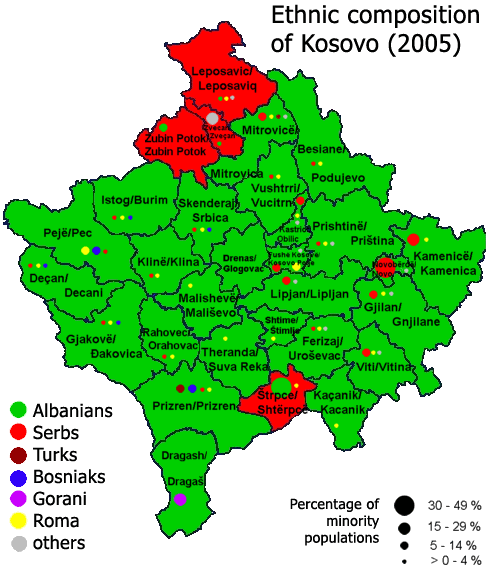
Serbs in Red
Click on Image to Enlarge

On 28 June 1999, Petrija Prljević, a 57 year-old woman in Pristina, was abducted from her apartment by men dressed in KLA uniforms. She was never seen alive again: a year later, her body was exhumed from a cemetery in Kosovo’s capital and positively identified by her son after he recognised items of her clothing. The job of finding out who caused her death was not investigated by the new prosecutors’ office on the basis that she died after the “war” in Kosovo had ended; instead it was investigated by the Eulex Rule of Law Mission. Over ten years later her relatives are still trying to find out what happened to her and who was responsible. Eulex seem no closer to launching an investigation to identify and prosecute her murderers, like the vast majority of the more than 1,000 other cases of murdered Serbs since NATO forces entered Kosovo. Contrast this with the efficient way in which Eulex’s Rule of Law Mission initiated investigations to find the persons responsible for the killing of a member of ROSU in summer 2011. As a recent Amnesty International report made clear, murders continue to be carried out with impunity under the gaze of an international community which seems peculiarly reluctant to investigate them. Indeed, while numerous Yugoslav officials have been tried and convicted for crimes against humanity committed by security forces under their command prior to June 1999, the fact is that of the more than 1,000 Serbs who have been killed since the end of the conflict, almost none have resulted in a prosecution, let alone a conviction. On the contrary, according to the testimony of some international police officials who have worked in Kosovo, there have been active attempts by some elements of the international administration to obstruct investigations, especially when they have threatened to implicate high-ranking Kosovo politicians.

Continue reading “Berto Jongman: Kosovo – Crime without Punishment, Power without Responsibility”

Berto Jongman: Global Factors that Influence Conflict and Fragility

Knowledge, Policies, Threats
Berto Jongman

Global Factors that influence Conflict and Fragility (OECD, Sep 2012)

The risk of conflict and fragility is influenced by both domestic factors (such as political marginalization and the unequal distribution of wealth) and global factors (such as the transnational organized crime and foreign direct investment). Much analysis to date has analyzed the political economy of fragile and conflict affected countries and neglected this global dimension of fragility.

Yet, powerful global influences are at play that, enhanced by the process of globalization, generate strong international constraints and opportunities for national development and the incentives of domestic stakeholders. Fragile states feature a heightened sensitivity and lower resilience to such influences because of their generally weak levels of institutional capacity, the often contested legitimacy of their political settlement, their high levels of inequality and the legacy or threat of violence they face. For the same reasons, they also easily mutate, multiply or transmit such influences, often in unexpected or negative ways. In short, such global factors have a critical influence on conflict and fragility but are underestimated in both the analysis and action.

INCAF’s work on this topic focuses on eight global factors that influence conflict and fragility, and in particular on interconnections between these factors. The aim of this work is to identify concrete entry points for international action that can reduce or mitigate the harmful effects of such global factors.

A Cross-Impact Matrix of Global Factors Influencing Conflict and Fragility, 2012 (pdf)

noble gold