Not familiar with these companies? You should be, because they are plotting the course for the future of internet privacy and how we interact with people and merchants.
Bynamite is just the latest and there is a very good article about them here. In short, Bynamite has (correctly, in my opinion) seen that each time we conduct a search on the internet, the search itself is a transaction because it gives merchants and the search engines more information about our interests, tastes, and needs. Bynamite also thinks that this sort of profile information will in short order play a very real role in the prices we pay for goods and the kinds of coupons we get. I think they are right about that as well – and this by itself is one of the most fundamental changes in the world of commerce to come along in a very long time – a set of one, or many, micro transactions prior to the primary transaction(s) that then inform the price we pay for future transactions – in essence context-rich transactions.
The Ile de Batz is one of three dedicated ships that Alcatel-Lucent uses to lay the submarine fiber-optic cables that carry broadband connectivity across the oceans.
The ship is usually based in Calais, France, but made a stop recently in Greenwich, England, to pick up components from Alcatel-Lucent's factory. The telecommunications infrastructure company invited ZDNet UK to see the factory and the ship, and have a look at a vital part of the global Internet that's normally hidden by miles of water.
The Ile de Batz usually spends between 30 and 40 days at sea on each voyage. It can lay up to 200 kilometers (120 miles) of cable per day, in normal conditions, to a depth of about 8km. That cable and its components are expected to have a lifespan of about 25 years.
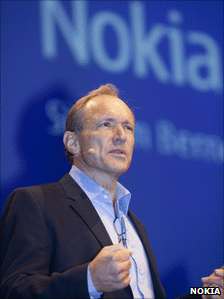
Phi Beta Iota: Sir Tim is on target but misses the critical point, which is that the Internet is already free, what is NOT free is the handheld device needed to access it. Earth Intelligence Network and its 24 co-founders are committed to the idea of free cell phones for the five billion poor, along with national call centers that educate them “one cell call at a time” while also providing access to the kinds of Internet application that the Grameen AppLab is creating.
Ms. Carol Dumaine is one of a very small number of individuals who have sought to pursue what Gifford Pinchot calls “intrapreneurship,” but on a global scale.
She first came to international attention when she pioneered Global Futures Partnership, an analytic endeavor seeking to enhance outreach and cross-fertilization across varied communities of practice.
She received the following recognition from the emergent M4IS2 community in 2002:
Global Futures Partnership, Central Intelligence Agency OSS '02: 21st Century Emerging Leadership Award. Global Futures Partnership, Central Intelligence Agency. Under the leadership of Carol Dumaine with her extraordinary vision, the Global Futures Partnership has created strategic learning forums bringing the rich perspectives of the outside world into the classified environment in a manner never before attempted. This official but revolutionary endeavor nurtures an outside-in channel for integrating a diversity of perspectives. It is a vanguard toward a future in which the lines between national and global intelligence, and between governmental and nongovernmental intelligence, are blurred into extinction.
She is interested in the areas of “knowledge ecosystems,” “ecologies of innovation,” and “collective intelligence” for applicable models, practices and theories which may be useful to prototyping a new capacity for “strategic intelligence” in energy and environmental security.
Carol Dumaine is a graduate of Georgetown University's School of Foreign Service and has a Master's degree from Johns Hopkins University's School of Advanced International Studies.
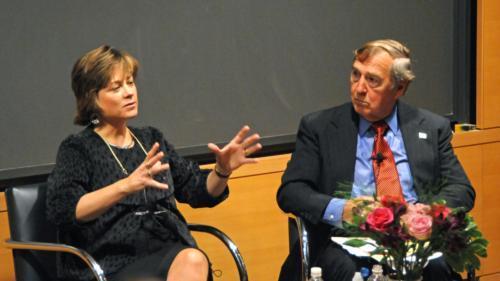
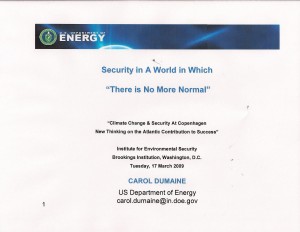
On the left is her May 2009 presentation to the International Security Forum in Geneva, and on the right, a March 2009 presentation at the Institute for Environmental Security of the Brookings Institute.
Carol Dumaine Geneva May 2009Carol Dumaine, March 2009, Brookings
The OpenBTS project was by ‘Camp Papa Legba', named after the Haitian Loa.
“In Haitian Vodou, Papa Legba is the intermediary between the loa and humanity. He stands at a spiritual crossroads and gives (or denies) permission to speak with the spirits of Guinee, and is believed to speak all human languages. He is always the first and last spirit invoked in any ceremony, because his permission is needed for any communication between mortals and the loa – he opens and closes the doorway. In Haiti, he is the great elocution, the voice of God, as it were. Legba facilitates communication, speech and understanding.”