Review: The War On Truth–9/11, Disinformation And The Anatomy Of Terrorism (Paperback)

5 Star, 9-11 Truth Books & DVDs, Censorship & Denial of Access, Misinformation & Propaganda

Amazon Page
Amazon Page

5.0 out of 5 stars Tars CIA & FBI, US, UK, France, with Supporting Terrorists, 9-11 a Pretext,

October 25, 2005
Nafeez Mosaddeq Ahmed
While there is certainly something to be said for this book painting a “worst case” conspiracy theory scenario, I have to say that it is consistent with both my years of experience as a clandestine case officer, anad my extensive reading on national security misadventures. I do agree with one reviewer's observation that we should not over-estimate the competence of the U.S. Government, but I also believe that we cannot under-estimate the incompetence of the bureaucracy nor the lack of ethics of the political ideologues.

Academically, objectively, this book is about as carefully laid out and sourced as one could want. The quotes that it offe

rs from official State Department officers complaining they were ordered to give visas to clearly unqualified terrorists being trained and supported by CIA stand out, as do the retrospective quotes on everything the FBI failed to do against the first World Trade Center bombing. This book is, in brief, everything the 9/11 Commission was not. The two taken together, along with the Aspin-Brown Commission, give us a good sense for reality.

Having been a part of the CIA when it was committing high crimes and misdemeanors in Central America, and having been a youth in Viet-Nam when CIA was in charge of the Phoenix assassination program and learning how to fly drugs and launder money for its warlords, and based on my extensive reading, I am persuaded of the three core propositions in this book:

1) That CIA and FBI managed clandestine relations with those who blew up the World Trade Center for years, and generally concealed and obstructed Justice investigations after 9/11 because of their antecedent mis-behavior;

2) That both the Clinton and Bush White Houses actively supported the Taliban and the secret Enron negotiations with the Taliban to build energy pipelines, not realizing at the time (as we know today) that the extraction and transportation of the energy as envisioned then is actually not supportable; and

3) That the Bush White House was already planning to invade Afghanistan, with all of the operational plans drawn up as early as July 2001, and 9/11 was treated as a Pearl Harbor pretext.

Having read most of what has been written by Brzezinski, Kissinger, and others I find the author's speculation that the U.S., the U.K., and France, among others, have been actively using terrorists, nurturing terrorists, as part of a geopolitical and economic strategy, and that in their naivete, they nurtured a force they cannot control today, to be completely credible.

I recommend this book be read together with Fog Facts: Searching for Truth in the Land of Spin by Larry Beinhart, and The Long Emergency: Surviving the End of Oil, Climate Change, and Other Converging Catastrophes of the Twenty-First Century by James Kuntsler. The first examines information that can be known, as in this book, but that is ignored if not over-shadowed by “spin”; while the second examines the pathological implications of cheap oil and all that cheap oil has made possible, including the creation of huge cities that are unsustainable into the future; the transport of vast quantities of water over long distances to places that will be dry in the near term; and the shipping of very cheap goods over very long distances from China by Wal-Mart.

Bottom line: cheap oil is the fool's gold of this century, only it is toxic and radioactive. The White House, Enron, and a cast of rather poorly-read bureaucrats came together to create a toxic mold called sub-state terrorism. The bureaucrats were following orders or had good intentions–the politicans and their corporate cronies were and are out and out thieves who are looting the Republic for their own selfish gains, firm in the belief that enough people will be fooled until they are out of office and laughing all the way to the Cayman Islands. They are probably right.

EDIT of 11 Dec 07: See also, with reviews:
Vice: Dick Cheney and the Hijacking of the American Presidency
A Pretext for War: 9/11, Iraq, and the Abuse of America's Intelligence Agencies
State of War: The Secret History of the CIA and the Bush Administration
Web of Deceit: The History of Western Complicity in Iraq, from Churchill to Kennedy to George W. Bush
The Looming Tower: Al Qaeda and the Road to 9/11 (Vintage)
Legacy of Ashes: The History of the CIA
Dark Alliance: The CIA, the Contras, and the Crack Cocaine Explosion
9/11 Synthetic Terror: Made in USA, Fourth Edition
Crossing the Rubicon: The Decline of the American Empire at the End of the Age of Oil

and of course the 9-11 DVDs, which I find compelling.

Vote on Review
Vote on Review

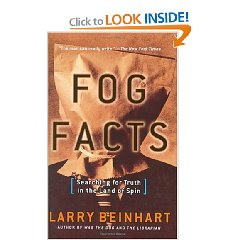
Review: Fog Facts –Searching for Truth in the Land of Spin (Nation Books) (Hardcover)

5 Star, Censorship & Denial of Access, Education (General), Education (Universities), Information Operations, Information Society, Media, Misinformation & Propaganda

Amazon Page
Amazon Page

5.0 out of 5 stars Makes the case for a People's Bank-Union-Intelligence Agency,

October 23, 2005
Larry Beinhart
This is quite an extraordinary book, one of five I picked up while browsing at Barnes & Noble today. It gets a full five stars for elegant writing, logical presentation, and a lovely index. I read it together with Noam Chomsky's Imperial Ambitions: Conversations on the Post-9/11 World (American Empire Project) interviews, and the two complement one another.

“Fog facts” are facts that are out in the open, but “invisible” in the sense that no one acts on them. The stolen Florida election–30,000 plus disenfranchised blacks *and* “overcount” votes where Al Gore was both checked and written, rejected as invalid instead of returned for verification–the specious claims against Iraq; the 9-11 Commission apologia; the list goes on. For myself, the most interesting fog facts dealt with the number of terrorists caught and jailed by France and other nations, as a tiny fraction of the cost of invading Afghanistan and Iraq, and with little to show for it excepts casualties, including significant numbers of US amputations being concealed from the public.

The author “outs” Judith Miller as an agent of Karl Rove in the run-up to the war in Iraq, earnestly selling the Administration's line on weapons of mass destruction, and perhaps one reason she was both favored by Rove in the current Valerie Plume case, and also sought to protect Rove.

THe author gets the jump on the current scandal of the disappearing billions in Iraq–not just the billions for Halliburton in sole source contracts, but the outright theft and squandering of the $19 billion in Iraqi bank credits that Paul Bremer managed to fritter away–and they still do not have running water or electricity.

THe author quotes several times from Mein Kamph in discussing the extremist Republican use of “the big lie” and the comparisons are disconcertingly clear. He weaves a tale of draft-dodging hypocrisy among the Bush Junior and Cheney gang that is all too distasteful when combined with their corruption in favoring Halliburton–his listing of Cheney's ignominious failures as CEO of HAlliburton are fun–and also a sign that Halliburton knew what it was doing in suffering the fool that would deliver the people's treasure. His accounting of Bush Juniors many failures in business, each time living on his father's name and getting bailed out by the forgiving rich that he has repaid many times over with tax cuts and exemptions from asbestos claims, among other loopholes, is dismaying in the extreme. We “know” these things, but we do not act.

On page 82 he repeats what is now perhaps the most famous quote to come out of the Bush Junior White House, where an arrogant aide dismisses a “reality-based” person and says that the U.S. is an empire now, and makes its own reality. That the reality we are making is one of our own destruction escapes this witless aide to the President, so full of himself is he.

The books adds to my understanding of the current Social Security arrangements as a pass through system (each generation funds the next) as opposed to the Administration's proposal for privatization, which converts it to a pension fund that dies with each generation. I am persuaded that we must defend Social Security, it is present form, to the death, and that we must remove the caps and make the wealthy contribute for every dollar, not just up to $90,000.

The author concludes that there is a war today, not between civilizations, but between faith-based and reality-based communities.

I put the book down reflecting to myself that it is time for the American labor union pension funds to lead a revolution. It is time for the people to form their own bank, their own credit card company, their own intelligence agency, and their own media. Although this is happening in fits and starts with the Internet, it is disjointed. We need to marry up money, willpower, and honest information, and we need to out these carpetbaggers and regain control of the commonwealth.

Truth and morality are here to be found, but the question that remains is: will the people act? This is a very fine book for anyone who cares about future generations and resents being robbed.

Ten Other Recommended Books (Five Bad News, Five Good News):
Vice: Dick Cheney and the Hijacking of the American Presidency
Running on Empty: How the Democratic and Republican Parties Are Bankrupting Our Future and What Americans Can Do About It
The Global Class War: How America's Bipartisan Elite Lost Our Future – and What It Will Take to Win It Back
The Working Poor: Invisible in America
American Fascists: The Christian Right and the War On America
A Power Governments Cannot Suppress
The Tao of Democracy: Using Co-Intelligence to Create a World That Works for All
Society's Breakthrough!: Releasing Essential Wisdom and Virtue in All the People
Escaping the Matrix: How We the People can change the world
The Wealth of Networks: How Social Production Transforms Markets and Freedom

Vote on Review
Vote on Review

Review: Influence–Science and Practice (4th Edition) (Paperback)

5 Star, Information Operations

Amazon Page
Amazon Page

5.0 out of 5 stars US-Oriented, Excellent Starting Point, Six Key Methods,

October 20, 2005
Robert B. Cialdini
I disagree with the complaints about this being a repeat of earlier versions. “4th Edition” is quite clear. This is an updated easy to read version of a highly-regarded seminal work whose value has been proven over time.

While intended for students of psychology and for practitioners of the black art of marketing (selling over-priced unnecessary “stuff” to the unwitting), I regard this text as a very helpful reference for the new warriors, the practitoners of Information Operations and within that larger discipline, Strategic Communication & Public Diplomacy.

The six “principles” of influence, reciprocation, consistency, social proof (e.g. canned laughter), liking, authority, and scarcity, each receive their own chapter with annedotes and study questions.

Most interesting to me would be an international variation of this book, one that discussed the nuances of influence in other cultures, inclusive of family ties and prevalent sterotypes.

This book is applicable to business, evangelism, foreign affairs, defense, homeland security, and just about any field where interaction with humans is called for, and the mission demands the elicitation of collaborative behavior from others.

Good index, notes, and illustrations. Well-presented.

Vote on Review
Vote on Review

Review: Ambient Findability–What We Find Changes Who We Become (Paperback)

5 Star, Information Operations, Information Society, Information Technology

Amazon Page
Amazon Page

5.0 out of 5 stars Wow–Core Reference for Large Scale Information Access,

October 20, 2005
Peter Morville
Wow, wow, holy cow….I am rushing to finish up a book on Information Operations: All Information, All Languages, All the Time, and I am so very pleased to have gotten to this absolute gem of a book before closing out. Compared to the other 200 or so books I have reviewed–including such gems at ATTENTION, Real-Time, Early Warning, and so on, this is clearly a “top ten” read in the literature on information art & science.

Halfway through the book I was torn by a sense of anguish (the U.S. Intelligence Community and the beltway bandits that suck money out of the taxpayers pocket through them have no idea how to implement the ideas in this book) and joy (beyond Google, through Wikis and other collective intelligence endeavors facilitated by open source software, relevant findability is possible).

This is a truly gripping book that addresses what may be the most important challenge of this century in a compelling, easy to read, yet intellectually deep and elegant manner.

The author is a true guru who understands that in the age of a mega-information-explosion (not just in quantity, but in languages, mediums, and nuances) the creation of wealth is going to depend on information being useful, usable, desireable, findable, accessible, credible, and valuable (page 109).

Especially important in the first half of the book are the author's focus on Mooers (not to be confused with Moores) who said in 1959 that users will make do with what information they have when it becomes too inconvenient to go after better information. This is key. At the same time, he focuses on the difference between precision and recall, and provides devasting documentation of the failure of recall (1 in 5 at best) when systems scale up, as well as the diminuition of precision. Bottom line: all these beltway bandits planning exobyte and petabyte databases have absolutely no idea how to actually help the end-user find the needle in the haystack. This author does.

The book is without question “Ref A” for the content side of Information Operations. On page 61 I am just ripped out of my chair and on to my feet by the author's discussion of Marcia Bates and her focus on an integrated model of information seeking that integrates aesthetic, biological, historical, psychological, social, and “even” spiritual layers of understanding. This is bleeding edge good stuff, with nuances that secret intelligence world is not going to understand for years.

There is a solid discussion of geocoding and locationally aware devices, and I am very pleased to see the author recognize the work of four of my personal heroes, Stewart Brand, Bruce Sterling, Kevin Kelly, and Howard Rheingold.

Halfway through the book he discusses the capture of life experiences, and the real possibility that beyond today's information explosion might lie an exo-explosion of digital data coming from wired individuals feeding what they see and hear and feel into “the web”. The opportunities for psycho-social diagnosis and remediation, and cross-cultural communication, are just astounding.

The book wraps up with a great review of findability hacks, semantic tricks, and the trends to come in inspired and informed decisions. Like Tom Atlee, the author sees the day of collective intelligence enabled by the web, but I have to say, I thought I knew a lot, after reading this book I have the strongest feeling that my education has just begun.

This is one of those books that could help define an era. It is about as thoughtful, useful, and inspiring a book as I have read in the past several years. DECENT!

Vote on Review
Vote on Review

Review: Influence–Science and Practice (4th Edition) (Paperback)

5 Star, Information Operations, Information Society, Misinformation & Propaganda

Amazon Page
Amazon Page

5.0 out of 5 stars US-Oriented, Excellent Starting Point, Six Key Methods,

October 20, 2005
Robert B. Cialdini
I disagree with the complaints about this being a repeat of earlier versions. “4th Edition” is quite clear. This is an updated easy to read version of a highly-regarded seminal work whose value has been proven over time.

While intended for students of psychology and for practitioners of the black art of marketing (selling over-priced unnecessary “stuff” to the unwitting), I regard this text as a very helpful reference for the new warriors, the practitoners of Information Operations and within that larger discipline, Strategic Communication & Public Diplomacy.

The six “principles” of influence, reciprocation, consistency, social proof (e.g. canned laughter), liking, authority, and scarcity, each receive their own chapter with annedotes and study questions.

Most interesting to me would be an international variation of this book, one that discussed the nuances of influence in other cultures, inclusive of family ties and prevalent sterotypes.

This book is applicable to business, evangelism, foreign affairs, defense, homeland security, and just about any field where interaction with humans is called for, and the mission demands the elicitation of collaborative behavior from others.

Good index, notes, and illustrations. Well-presented.

Vote on Review
Vote on Review

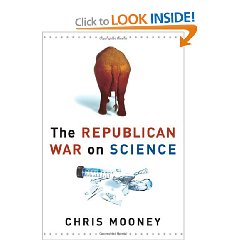
Review: The Republican War on Science

5 Star, Science & Politics of Science

Amazon Page
Amazon Page

5.0 out of 5 stars Best Snapshot of the Ugly Baby–3 Others Needed,

October 19, 2005
Chris Mooney
This is the best snap-shot of the ugly baby called US Science, a baby that is on the one hand coddled and spoiled by a politicized program, and on the other straight-jacketed and abused by those same political hand-cuffs.

Of the four books I have reviewed on this important topic, this is the one that is the most compelling on the perversions of the extremist Republicans (I am a moderate Republican). It does not, however, provide a complete picture. Three other books are helpful:

Science, Money, and Politics: Political Triumph and Ethical Erosion by Daniel Greenberg is the best over-all review, has a strong ethical component, and shows how the competition for money, rather than scientific progress, is diverting scarce resources and frustrating needed advances.

Frontiers of Illusion: Science, Technology, and the Politics of Progress by Daniel Sarewitz is a very useful antidote to the many books (Ray Kurzweil, The Singularity is Near, comes to mind) that claim science will solve all problems and provide authoritative cost-effective solutions to century-old human problems.

Finally, Investing in Innovation: Creating a Research and Innovation Policy That Works, edited by Lewis Bramscomb and James Keller, brings together a range of views crossing the environment within which scientific research takes place, evaluationg specific programs and policy tools, and making recommendations (all of which have been ignored by the current Bush Administration).

I take four bottom lines from these four books together:

1) We are spending too much on military science & research.

2) Neither Congress nor the Executive have a serious strategy for prioritizing problems, finding private sector partners, and providing seed money for innovative solutions.

3) Both Congress and the Executive, as well as the public and the media, are incredibly ignorant about what science can and cannot do, and where all the money is going to generally poor effect.

4) This is all so important that Science, like Intelligence, needs its own Supreme Court. I am persuaded we need a new form of hybid public agency that is fully independent of the Executive, receiving a percentage of the total disposable budget (say 3%) and hence not subject to Congressional pork-barreling and lobbying-financed pressures.

This book by Chris Mooney is the place to start if you want to be angry, or the place to end if you want to see the other three books end on the ugliest note possible–the destruction of reasonable science by unreasonable ideologues.

Vote on Review
Vote on Review

Review: Dogs of God–Columbus, the Inquisition, and the Defeat of the Moors (Hardcover)

5 Star, Empire, Sorrows, Hubris, Blowback, Religion & Politics of Religion

Amazon Page
Amazon Page

5.0 out of 5 stars Historical Evaluation of Money, Religion, State Power, and Evil,

October 19, 2005
James Reston Jr.
There are no doubt many histories that will enlighten us as to the relationship between the rise of the State, its need for money, its use of the Inquisition to rob Jews and raise money, the role of religious intolerance of heresy, and the manner in which evil accompanies conquest. For myself, this book is more than enough, and it provides an elegant easy to read overview of the larger context in which Columbus discovered America.

I am reminded by this book of the arrogance of Spain (where my roots go to Catalan in the 17th century on my mother's side), as Columbus was sent with edicts in Spanish, and it was assumed that any natives that could not understand the Spanish edicts, read in Spanish, were consequently heathen and fair game for enslavement. So did Columbus bring to America not just slavery, but genocide as well.

The author excels at showing the human side of history, the manner in which craven banal human weaknesses wreak havoc on civilizations, tribes, and nations. There is one point in which I am reminded of the power of courtiers, and another in which the same courtier uses homosexuality as a means of subduing a king–both are all too close to reality today. In short, this book has lessons for us today, both in seeing how dangerous our fundamentalist religious extremists are in waging armed crusades lacking in contextual balance, how dangerous courtiers with too much power can be; how vulnerable nominally powerful rulers can be when they suffer from deep and unresolved inner conflicts (e.g alcoholism and nascient homosexuality), and how deeply the historical antipathies might lie within Islam against the West.

The relationship between evil, intolerant religion, weak kings and powerful courtiers, and suffering peoples of all faiths, is compelling depicted in this book–history is brought forward in a truly excellent manner. We learn, or we repeat.

Can anyone justify the Inquisition or the Crusades? Is it possible to denounce individual terrorists while embracing 44 dictators, many of them practicing genocide, others supporting the looting of their entire commonwealths? Could we not have spent the last trillion of our common wealth more wisely?

I put this book down thinking to myself, like Old Man River in Porgey and Bess, life and history move on, while the powerful continue to hold sway over the fortunes of their peoples. It is somewhat depressing to realize how little humanity has learned about relations among peoples since the 1500's.

Vote on Review
Vote on Review
noble gold