5.0 out of 5 starsExtraordinary, Compelling, Urgently Applicable to All
October 19, 2005
Dan Korem
I am utterly astonished to not see this book at the top of the charts and being absorbed by every school principal, every small town mayor, every police chief, and every counter-terrorism expert. This book is extraordinary, it is compelling, and it is utterly and urgently applicable to every single person who wishes to “defuse” potentially deadly “random actors.”
Although it is a thick book packed with details, you do not have the read the whole thing to extract value. Suffice to say that armed with this book, communities and organizations will have all they need to know to achieve early warning of potentially threatening “random actors.”
This is not a book full of psycho-babble. If anything, it is solidly grounded in practical case studies going back twenty years, and I for one, as a 30-year veteran intelligence professional, including clandestine service with constant exposure to bad boys and girls, find the book credible, useful, and easy to understand.
The bottom line, without seeking to simplify the book, is avoid de-personalization, prevent bullying, open up to individuals and empower them, and above all, be alert for any sense that they see teachers or other authority figures as “CONTROLLING” and rules as “INAPPLICABLE.”
The author's finding that terrorism is a rich kid's game, and that most US-based random actors will come from upper middle class families in small towns, are consistent with my own research and practical experience with revolutionaries.
Sadly, the underlying theme across the book is that of societal collapse. The major institutions, from school to church to sports to social clubs are all degenerating and failing to provide the inclusiveness and alternatives to boredom and alienation that they once represented. The threat of “random actors” imposing catastrophic fatal acts on their communities is very real.
This book is an important reference work, and one that I would recommend be bought in bulk, and discussed in a structured manner by every school staff and every local police department…and of course by parents!
I've witnessed the phenomenon of bright people falling for propaganda, hook, line, and sinker, on numerous occasions. I'm sure I'm taken in by much of it as well, but even I can't be fooled all the time.
Still, the answer is not to simply give up. On a few topics, I actually am well enough informed so that (while I still may be susceptible to propaganda myself) I can recognize the symptoms of others falling for it. And this is definitely a phenomenon one ought to look for in others if one wants to cure oneself! I do think we ought to try to become so informed about at least a few topics that we can recognize nonsense. On these topics, we ought to listen, but we also ought to be unafraid to state facts and make judgments. On other topics, we ought to be much more careful.
Perhaps the most dramatic examples for me have been some truly amazing statements about the Arab war on Israel made by some rather well-educated and generally skeptical people. It makes me wonder why those who are ready to challenge all sorts of claims in so many other areas accept some extremely dubious, afactual, and illogical nonsense about this topic without question, and repeat it to me. Are they unaware that they are making statements that may well be false? Are they unable to discuss this issue without making very controversial comments as if they were not only accepted and indisputable facts, but relevant facts as well?
On one occasion, when I suggested to a colleague that I happened to know quite a bit about the Arab war against Israel, hoping to politely give him a way to defer to me, temporarily, on a couple of facts, I merely got an outraged reply. Was I not aware that my colleague was a highly intelligent and well-informed person? What made me think that I knew something he didn't? I was more than a little surprised by such a reaction: normally if a person claims to know something better than we do, we listen, even if we disagree.
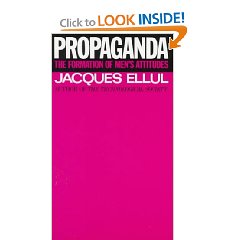
This book, written over four decades ago, helps explain a little of what is going on. It shows how intellectuals can be so horribly susceptible to propaganda. As both the book and Konrad Kellen's preface to it state, intellectuals absorb a great deal of second-hand and unverifiable information. They often feel a need to have an opinion about such information. In addition, they consider themselves so smart that they can “judge for themselves.” And they seriously underestimate their susceptibility to propaganda given that they can see mere idiots reject some of it with ease.
The truth, as Ellul explains, is that high intelligence, a broad culture, constant use of critical faculties, and access to and use of sources of information are indeed the best weapons against propaganda. They simply aren't used often enough.
Ellul shows how propaganda can have a powerful effect if one is saturated with it. It is useful, he explains, to have someone from one's own frame of reference come up with it. The German National Socialists were careful to put Englishmen on their radio. Anti-Zionists, by the way, are very proud to have Jews state their case, although we should all know that there is no objective reason to trust every Jew, any more than there is to trust every person.
We readers see how propaganda is most useful when it reinforces earlier biases and misconceptions. And how it becomes extremely powerful once a person makes an active commitment to a cause: that person finds it very tough to recant.
The book also shows how propaganda gets one to come up with strange ideas about what is relevant material to support one's arguments. That has the effect of precluding dialog with those who disagree with you. That's why my colleague “knew” better than to take anything I said seriously or reply to it coherently. And it is why careful and cautious statements on my part sounded not merely like admissions that truth was fiction, and vice-versa, but evidence that I was hopelessly biased, impervious to reason, and hooked on rather wild propaganda myself.
This book is fascinating. It made me realize that propaganda is indeed more effective than most of us might realize. And that it is dangerous. Ellul implies that propaganda may well be the most serious threat we humans face. And I think we ought to treat it as such.
Admiring of Grunts, Deep Between the Lines Slam on Washington,
October 3, 2005
Robert D. Kaplan
Most important in this book is Kaplan's documentation of the fact that transformation of the U.S. military is NOT taking place–Washington is still enamored of multiple layers of rank heavy bureaucracy, the insertion of very large cumbersome task forces in to every clime and place; an over-emphasis on technology; and a lack of appreciation for the urgency of providing security, food, water, and electricity IMMEDIATELY so as to start the cycle of counter-insurgency information collection from volunteers. The author is brutal in his indictment of the bureaucracy for failing to provide the linguistic skills, four years after 9/11, that are far more important to transformation than any weapons system. He is also brutal on the delays in approving operations in the field that are associated with layered bureaucracies that come with joint task forces, and completely detrimental to fast moving tactical success at the A Team level.
Key here is the conclusion that American power can only be exercised in a sustained way through discreet relationships at every level from neighborhood and village on up to provinces and tribes. The emphasis here is on discreet, humanitarian, tangible goods and services including security. When America introduces major forces, it spikes resistance and delays the achievement of its very objective. What jumps out is the need to change how the US achieves its presence around the world. The author recommends a change in the State Department model of embassies focused on countries–State tends to be co-opted country by country and loses sight–if it ever had it–of regional or tribal nuances. The author also recommends a sustained peaceful presence at the provincial and village level around the world, through a combination of modern civil affairs and humanitarian assistance cadres and retired military given leave to choose a place they get to know and stay there to finish out their careers and then be “on tap” for retired reserve plus up.
A third theme in this book, one that Ralph Peters also makes in “NEW GLORY,” is that a lot of these countries are NOT countries and should not be countries. Many borders imposed by colonialism are simply lunatic when taking into account historical and geographic and related ethnic realities. It *makes sense* to have regional summits that re-locate borders in a manner that respects historical, geographical and cultural realities, and to do so with a massive Berlin Airlift/Marshall Plan application of the benefits of peace. Ceding southernmost Thailand and the insurgent southern part of the Philippines to Malaysia, and establishing an Indonesian-Malaysian Muslim Crescent, makes sense. Similarly, in Africa and in the Middle East, there is good that could come of a deliberate recalculation of borders.
A fourth theme, and I share his admiring view of Special Operations and the Marine Corps, is that of the separation of the military ethos of service and dedication to mission, from that of the Nation at large, where Tom Friedman in “The World is Flat” declares that we are suffering from a new generation that is, in a word, apathetic. We need to return to universal service, with options for serving in the Peace Corps or the local constabulary at home. America has lost its civic integrity.
A fifth theme, one that corrected a misimpression I have shared, was of the rather special nature of the National Guard elements of the U.S. Special Forces and the Army civil affairs teams. They come out in this book as being among the best of the best.
Sixth, I found the author's field appreciation of citizen militia in Iraq, Afghanistan, the Philippines, and elsewhere to be quite illuminating. Washington is wrong to rush the transition to a centralized Army in places where tribes and militia still hold sway and can be used to provide provincial stability. We ignore the possibilities of unconventional indigenous forces at our peril.
Seventh, as on page 230, the author highlight those occasions when our unconventional warriors point out that Toyotas are better than Humvees, commercial cell phones are better than military communications alternatives. Across the book, a few good men and women with independent authority and cash resources to do instant compensation and instant aid authorization come across as vastly superior to Washington-style contracting and major joint force insertions.
Eighth, throughout the book, force protection mania is killing us and gutting our counter-insurgency potential. This comes out especially strongly in Colombia, where A Teams are forbidden to go tactical with the forces they are training, and are limited to training within safe encampments only. Force protection is a modern variation of the Soldier's Load-we are so nuts about force protection and heavying up that we are shackling our troops and our small unit leaders and completely avoiding the military value of “fast and furious.”
Ninth, national and military intelligence are not meeting needs of front-line grunts. Bottom-up intelligence collection, including passive collection from observant civil affairs teams and foot patrols, is what is really working. We appear to need a whole new concept of operations and a whole new doctrine for field intelligence, one that floods areas with non-official cover and overt personnel, one that puts analyst and translators heavy-up into the front lines.
Sidenotes include great admiration for SOUTHCOM, accustomed as it is to getting along with the short end of the stick; and derision for PACOM, “twenty years behind the times, afraid of messy little wars and of a transparent humanitarian role for SF.” The author regards the Global War on Terror (GWOT) as a convenient “set up” for a future war with China, not something I agree with but evidently a perception within the military that has specific outcomes from day to day. Other side notes include a brutal indictment throughout of “Big Army” and also of the US Air Force which is obsessing on more super-bombers and unwilling to fund what really works well, long-haul transports, AC-130 gunships (Puff the Magic Dragon), and more air controllers in the field with the grunts.
Super book! NOTE: I have the sense that some in the SF community have taken an intense dislike to Kaplan, and vote against the review as a way of voting against Kaplan. Fair enough, but for what it's worth, the review is a good summary intended to be helpful to all in appreciating what I take to be some pretty useful themes.
Extraordinary largely for showing contractors as the weak link ,
September 28, 2005
Christopher Andrew
This is, like the first book, an extraordinary piece of scholarship. While it can be tedious in both its detail and in the drollness of the “accomplishments” that enjoyed so much Politburo attention and funding, it joins books such as Derek Leebaert's The Fifty-Year Wound: How America's Cold War Victory Has Shaped Our World in documenting the insanity and waste that characterized much of the so-called “secret wars” between the US Intelligence Community (within which the CIA is a $3 billion a year runt against the larger defense budget approaching $50 billion a year) and the KGB and GRU.
For those who have the patience or speed to get through this entire book, the single most important revelation and documentation concerns the ease with which the Russians were able to recruit traitors within the US defense community contractors. Ralph Peters has written about this in New Glory : Expanding America's Global Supremacy but speaks mostly of legal treason–corruption and waste. This book carefully addresses the sad reality that DoD is totally penetrated by foreign spies (one would add, Third World and allied spies including France, Germany, and Israel, never mind China and Iran) via the contracting community.
One day someone will do a careful calibration of both the good and the bad of secret intelligence. When that day comes, this book will be as good a place as any with which to start.
It takes a great deal of education, experience, and faith to write a book such as this. Originally a series of lectures, the author has developed some useful, and calmly articulated, thoughts on both why there is a disconnect between the “West” and “the Rest,” and why the West is on a downward spiral to oblivion in practical terms, with the triple whammy of declining birth rates (non-replenishment), increased longevity (generally among those who are not necessarily productive in their older years), and substantial apathy among the self-absorbed, self-righteous, and largely clueless teen-agers and 20-30 “me me me” generation.
There are many books that I have reviewed here for Amazon that support this author's personal reflections, and his citations of those books that did stimulate him are more than adequate. A few themes made by the author strike me as worthy of emphasis, for they provide a road-map for any Western society that wishes to survive into the 22nd century:
1) Morality matters. It is a historical force. Will and Ariel Durant emphasized this in their “Lessons of History,” and many strategic confrontations have borne out the point. Tribes and nations that become amoral ultimately decline and fall.
2) Western myopia cannot be understated. The ignorance of the West regarding global realities and the relationship between Western behavior (inclusive of US support for 44 dictators, immoral and predatory capitalism, virtual colonialism, and the general view of others that the West is “barbaric” in sexual and other matters of fidelity and integrity) and how others view is simply unrealistic.
3) The West fails to understand that the rest of the world, where faith and integrity and loyalty to the family and tribe are often all that keeps the entire society from disintegrating in the face of more primitive environments that we ourselves experience, wants to be modern but not Western–modern with cultural cohesion, not modern with the commoditization of the individual, which both the author of Lionel Tiger (“The Manufacture of Evil”) credit with destroying family, community, tribe, and nation.
4) The author excels at discussion how Western individuals today have lost the context of history, the reverence for tradition, the utility of specified morality. Westerners are “out of touch” with the lessons of history, out of touch with the implications of our selfish decisions in the present that have implications for the future generations.
5) The author discusses competing concepts of legitimacy, and here he goes into nuances all too often lacking in “objective” Western analysis of competing social models. He sees the value of personal versus impersonal authority in the context of societies where bureaucracy is not yet developed and kinship remains the foundation for trust.
6) The author, educated at Oxford, would agree with Philip Alcott, brilliant Cambridge scholar and author of “Health of Nations,” in dismissing most nations as false constructs inconsistent with their tribal and religious networks and beliefs. This is as true of the “Nine Nations of North America” (Joel Garreau) as it is of most of Africa, where colonialism heritage is that of inevitable genocide.
The author concludes, as one would expect of a Christian moralist, that “Nothing less than a massive cultural reversal is necessary. We need to rejoin the rest of the human race.” He focuses on the renewed relevance of religious and moral vision, and here he would find common cause with David Johnson, distinguished author of books on “Faith-Based Diplomacy” and the vital role of religion in fostering reasoned dialog between West and East.
Apart from restoring the role of morality within our over-all culture, the author concludes that we must become informed–like it or not, our lives are bound up with those of everyone else all over the world. Here he is in tight agreement with both President David Boren (former Senator) of the University of Oklahoma, and David Gergen, advisor to multiple Presidents of the United States (most of whom did not listen too well). We must internationalize and modernize our educational system, restore the importance of history and international studies, and give life to the finding of E. O. Wilson from “Consilience,” to wit, that the sciences demand the humanities if they are to be in the service of humanity.
This is a most thoughtful book, reverent in its arguments, one that reminds us all of the value that can be had from listening to or reading the careful reflections of a man of the cloth, born in Wales, educated in England, and now speaking to all of us.
Simpler way to absorb ideas from Leadership and the New Science,
September 25, 2005
Margaret J Wheatley
Margaret Wheatley is addictive. After reading “Leadership and the New Science” I have bought the rest of her books, and also those that she recommends by contributing a foreword.
This book has a great deal of white space, lots of photos, is double-spaced, but by no means is it simplistic. To play on the title, it is a “simpler way” to absorb the large deep ideas that are documented in “Leadership and the New Science.” If her primary writing were a trilogy, this is the entry-level book, “Finding Our Way” is the intermediate volume, and “Leadership” is the graduate course. However, I recommend they be read in reverse order, because the simpler books are more clearly appreciated if one has the deeper background.
What I find most compelling about this book is the manner in which it captures core ideas from a wide variety of works that have been bubbling into human consciousness in the past 20 years. The bibliography is quite good although by no means all-inclusive (missing Kurzweil, E. O. Wilson, and Stephen Wolfham, as well as Tom Atlee and Bill Moyers, among others).
Among the core ideas in this book that are presented with elegance are the absurdity of thinking that life can have a boss–or that rigid ideas and identities will lead to anything other than rigid non-adjustable organizations. The author stresses the value of diversity, passion, connectedness, humanity and humanness, and tieing it all together, the role of information and of ethics as facilitators for “being.”
There is a very useful discussion of bacteria and the manner in which human attempts to impose machine and medical solutions are ultimately defeated by bacteria. Although Howard Bloom's “Global Brain” is not in the bibliography, everything the authors discuss here is consistent with his concerns about bacteria winning the inter-species war with humanity.
Taking this a step further, I would contrast this book, and the varied books on collective intelligence, wisdom of the crowd, ecological economics (Herman Daly) and so on, with a book I recently reviewed about the National Security Council, aptly titled “Running the World.” The stupidity and arrogance of that title reveals all that we need to know about why U.S. foreign policy is failing, and how desperately we need to take the ideas from this book and apply them to how we manage ourselves and our relationships with other nations, other tribes, other religions, other communities.
As I finished this book and dealt with my teen-ager who at 16 is quite certain that even the great schools of Fairfax County are largely boring and dysfunctional, still teaching by rote and testing memory rather than the ability to discover, it occurred to me that this book is in fact a handbook for both educating the world, and for reforming education. Instead of the current didactic form of instruction (one-way lectures) we should be teaching, at every level, interactive discovery. It's not what you can remember from the past, but what what you can discover in tandem with others, and apply constructively!
EDIT of 12 Dec 07: Lots has happened since I reviewed this book, and it was a delight to discover that this long buried insight actually found itself manifested in the new non-profit, the Earth Intelligence Network, whose 24 co-founders recognize that we need an EarthGame where we all play ourselves, and that to save the planet, we must educate the five billion poor “one cell call (or conversation) at a time,” something we can do by giving out free cell phones and recruiting 100 million volunteers with Internet access who among them cover the 183 languages we do not speak–that will create infinite wealth (see books at bottom of this review).
As someone who has been trained to be dysfunctional, overly reliant on “command and control” and predictability, I can certainly see how this book would cause discomfort and inspire disbelief among the mandarins of industry and government, but I can also see this book sensibly defines the only path likely to lead to collective intelligence and collective consensus solutions.
Context, hospitable spaces, questions that matter, encouraging everyone's contribution, cross-pollination of diverse perspectives, listening for patterns, cultivating collective intelligence and insight through dialog instead of debate–this book has it all.
My last annotation in the book is “Wiki!” As smart people like Jock Gill and Howard Rheingold start to think about how to create a global Wiki that enables a World Cafe with a space for every topic, every challenge, every zip code, every neighborhood, I have a strong feeling that “bottom up people power” may at last be in the offing.
This book is very serious, very valuable. It is worth reading and it is worth sharing with others. It is part of our “Collective Intelligence” and leads straight to Peace Intelligence and Commercial Intellligence. In the next ten years I plan nothing less than the reduction of the secret budget of $60 billion a year, to $12 billion, with the savings redirected toward national education and connection the five billion poor to knowledge so they can create infinite stabilizing wealth.


 A classic work that is relevant today