Although I know the CIA better than I do the FBI, I have spent time in the past ten years with law enforcement officers from over 40 countries including the US, and the bottom line is that the FBI bureaucracy (Supervisory Special Agents and the politically-motivated upper tiers of FBI management) are a worse threat to US security than individual terrorist groups, for the simple reason that as long as the FBI leadership remains in denial, in secret, and ineffective, the entirety of our homeland defense is incapacitated.The earlier version of this book focused on the decades of historical enmity between CIA and FBI–in the early years, Edgar J. Hoover was clearly to blame for a culture of hostility between the two agencies and between the FBI and military intelligence–in one instance he actually suppressed early knowledge of Japanese intentions on Pearl Harbor obtained from a German agent tasked to fulfill their targeting requirements.
In later years the CIA took on more responsibility for shutting out the FBI, consistently refusing to brief them in to either internal counterintelligence failures, or foreign operations with a strong domestic counterintelligence matter.
What the author has done in the aftermath of 9-11 is update the book and make it even more relevant to every citizen and every elected official and every bureaucrat. The earlier edition made me very angry about how the senior FBI bureaucracy can sacrifice the national interest at the altar of its own selfish agenda of self-preservation and aggrandizement–from Special Agent Rowley to Special Agent Robert Wright, the FBI leadership consistently spends more time censoring and punishing its own people for honesty, than it does chasing terrorists. This new improved edition should make every citizen, every voter angry, and they should instruct their elected representatives that the time has come for a National Security Act that finally reforms national foreign intelligence, military intelligence, and law enforcement intelligence, and in passing, creates the homeland security intelligence act to create a federated system of state and local intelligence and counterintelligence cadres that operate under the jurisdiction of governors and mayors rather than the federal government.
Pogo had it right: we have met the enemy and he is us.
Of the three books read and reviewed on the role of the university within a nation, this is the best, with Derek Bok's volume on universities in the marketplace being the runner up.With a new preface written in 2001, and a pattern over the course of five editions of each time updating, correcting, and commenting on differences between past predictions and actual outcomes, this book appears to be the best available on this topic.
The author is alarmed by the possibilities that universities, which were nurtured by post-World War II federal funding and state funding that is now vanishing, could begin to fail in almost catastrophic terms. Between aging and unrepentent faculty, the vanishing of liberal arts (or even quality education) for undergraduates, and the prostitution of graduate education to commercial purposes, there does appear to be a crisis.
After noting that America appears to spend more on prisons than on universities, the author makes several recommendations, all of which appear sensible. They include a new emphasis on university support to primary and secondary education, a rationalization of information technology within communities to better link businesses with members of the university family, the exploration of distance learning alternatives (as much to reach the drop-outs inexpensively as for any other reason), and the resurrection of mid-career education or continuing education as a mainstream expectation for personal as well as business advancement.
The author, who clearly has a very strong ethical perspective, quotes Alfred North Whitehead, who concluded that any society that “does not value trained intelligence is doomed” and adds his own view, that “the university that does not fully dedicate itself above all else to the continuing advancement of trained intelligence is also doomed.”
This is a really fine book that should be in the library of anyone seeking to understand “national intelligence” as Thomas Jefferson understood it when he said “A Nation's best defense is an educated citizenry.”
Spend-Thrift Intelligence Reduces National Security,
June 16, 2003
Tim Weiner
I know the author personally, from his time as the New York Times investigative journalist responsible for covering the US national and military intelligence programs, and I consider him one of the most balanced, thoughtful, and well-intentioned reporters in the intelligence field.His book remains very, very important because the Pentagon is in the process of reconstituting the “Yellow Fruit” organization, with the same blank check black budget, and the same mind-sets that previously led to enormous ineffectiveness, waste, and some outright corruption and theft of government funds. Known as Gray Fox, this new incarnation of Yellow Fruit has Richard Secord, one of the leaders or the Iran-Contra scandal for which several top personalities were indicted and some convicted, as a primary player.
Tim Weiner's book is important, it is relevant, and it should be read by those responsible for the oversight of military intelligence budgets and capabilities–and by citizens who might wish to question their elected representatives on this important topic.
It took me over a month to do justice to this book, and I have taken into account the thoughts of other reviewers. A book of this importance would indeed have benefited from an international advisory board of public health, medical, insurance, and policy experts; it would certainly have benefited from greater structure, firmer editing, and a foreword by someone like a former Surgeon General of the United States. As it is, it appears to have overcome these deficiencies with hyped-up marketing and sweetheart reviews, and this in some ways counterproductive because this book could have, should have, become a mainstream topic in the Presidential campaign. It failed to do so for several reasons, not least of which is the propensity of both candidates and their advisors to avoid serious thinking, but also because the book is not helpful to a popular understanding of the very real global and domestic threats to the health of our children today and in future generations. Having said all this, I commend the book for its content and do not recommend it as avocational reading. There are some very important points that the book brings out, and I will itemize these in order of importance: 1) Public health is about detection and prevention, medicine is about remediation. In the long run, investments in public health are vastly cheaper and more effective than after-the-fact medical intervention; 2) The insurance industry in the developing world has failed to support public health investments, and in a remarkable collusion with the pharmaceutical, hospital and managed health care industries, has created a very expensive and increasingly ineffective system focused on drugs (to which diseases are increasingly resistant) and hospitals; 3) Hospitals are no longer reliable in terms of protecting patients from both error and secondary infection from other patients. People are coming out of hospitals, in many cases, with more diseases than when they went in; 4) The health of our nation depends on the health of all other nations-not only does a collapse of public health in Africa lead to failed states and forced migrations, but it also is but an airline flight away from infecting Kansas; 5) Clean drinking water, uninfected food, and good environmental and occupational health conditions are at risk in many parts of the United States and Europe, not only in Russia and the rest of the world; 6) The United Nations, and the World Health Organization in particular, are in disarray and ineffective-in large part because of a lack of support from member nations-at dealing with the public health commons. There is no question but that the author has hit a “home run” in terms of describing the harsh reality of epidemics in India and Africa, the collapse of public health in Russia, the rapid migration of many diseases from Russia through Germany to the rest of Europe and the U.S., and the severe costs in the U.S. of a retreat from the collective good with respect to public health. Unfortunately, it is a home run hit in isolation, not a game-winning home run, because it fails to drive home, to the only audience that matters-the U.S. voter-exactly what political and economic initiatives are required to achieve three simple objectives: 1) re-establish the public health infrastructure in the U.S.; 2) redirect the entire health care industry toward preventive measures-including water and food quality controls-instead of remedial prescriptions; and 3) provide compelling incentives to the rest of the world for cleaning their own house (this presumes that we are able to clean our own first, a very questionable assumption at this point in time). This is a valuable book, a five in terms of intent, a three in terms of execution, and I am glad that I took the time to read it. It provides a wonderful foundation for enjoying, at an intellectual and policy level, the medical and public health novels by Robin Cook.
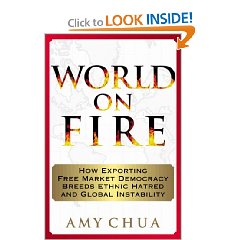
This book is a solid five stars in part because the author ably bring forward a well-documented (solid notes, good index) case for suggesting that both Western democracy and unbridaled (that is to say, uncontrolled) capitalism, are not only harmful to lesser developed countries, but also ultimately, through their creation of instability and the export of terrorism, harmful to the very proponents of unbridled democracy and capitalism.She is on strong ground. Robert Kaplan has written many books examining failed states and lower tier nations and come to the same conclusion with respect to democracy, while George Soros has published “The Crisis of Global Capitalism.” More subtly, Thomas Stewart, in “The Wealth of Knowledge”, slams much of what passes for effective industrial and corporate organization as archaic and inappropriate to the new environment.
What I found most intersting, having spent much of my life in Asia and Latin America, and been close to some Chinese elements in Singapore, was that much of the author's case is based on Chinese examples, not American. This makes the book especially valuable to Americans, because when she speaks of a world on fire and the dangers of ethnic conflict coming out from under market-dominant minorities, she is speaking about Chinese examples, not American examples. As the Godfather would say, “This is not personal, this is business.”
The author ends with a number of recommendations that appear sensible, but that at this point have no hope of every being considered by the US or other Western powers–or in China. The author's recommendations require an educated public exercising its political power in the pursuit of both global stabilization and national prosperity as seen through a long-term lens. It may take another 9-11, the meltdown of Arabia, and several more genocides in Malaysia and Indonesia, the utter chaos in the Congo, the Ivory Coast, Sudan, and Burundi, to name just four failed states that are testing the United Nations, before the public ultimately realizes that what is exported overseas “in their name” ultimately comes home on fire. The book is well-titled, the author's thesis is important, and those who do not like this book are well-qualified to represent the problematic organizations that the author is discussing.
Ben Franklin & James Madison Would Have Praised This Book,
May 26, 2003
Ziauddin Sardar
The heart of this book is not why people hate America, but rather on how Americans have lost touch with reality.This book joins three others books I have reviewed and recommend separately, as the “quartet for revolution” in how Americans must demand access to reliable information about the real world. They are Bill McKibben on “The Age of Missing Information” (a day in the woods contrasted with a year reviewing a day's worth of non-information on broadcast television); Anne Branscomb's “Who Owns Information” (not the citizen); and Roger Shattuck, “Forbidden Knowledge.” These are the higher level books–there are many others, both on the disgrace of the media and the abuse of secrecy by government, as well as on such excellent topics as “Who Will Tell the People: The Betrayal of American Democracy” by William Greider, and “The Closing of the American Mind” by Allan Bloom.
Here are a few points made by this book that every American needs to understand if we are to restore true democracy, true freedom of the press, and true American values to our foreign policy, which has been hijacked by neo-conservative corporate interests:
1) “Patriotism is the last refuge of the scoundrel.” Dr. Samuel Johnson said this in 1775, on the eve of US revolution from British tyranny. When patriotism is used to suppress dissent, to demand blind obedience, and to commit war crimes “in our name,” then patriotism has lost its meaning.
2) According to the authors, Robert Kaplan and Thomas Friedman are flat out *wrong* when they suggest that “they” hate us for our freedoms, the success of our economy, for our rich cultural heritage. Most good-hearted Americans simply have no idea how big the gap is between our perception of our goodness and the rest of the world's perception of our badness (in terms set forth below).
3) According to the authors, a language dies every two weeks. Although there are differing figures on how many languages are still active today (between 3,000 and 5,500), the point is vital. If language is the ultimate representation of a distinct and unique culture that is ideally suited to the environment in which it has flourished over the past millenium, then the triple strikes of English displacing the language, the American “hamburger virus” and city planning displacing all else, and American policy instruments–inclusive of the World Trade Organization and the International Monetary Fund–eliminating any choices before the Third World or even the European policy makers, then America can be said to have been invasive, predatory, and repressive. At multiple levels, from “hate” by Islamic fundamentalists, to “fear and disdain” by French purists, to “annoyance” by Asians to “infatuation” by teenagers, the Americans are seen as way too big for their britches–Americans are the proverbial bull in the china shop, and their leaders lack morals–the failure of America to ratify treaties that honor the right of children to food and health, the failure of America to respect international conventions-the average of two military interventions a year since the Cold War (not to mention two countries invaded but not rescued), all add up to “blowback.”
4) According to the authors, America is “out of control” largely because the people who vote and pay taxes are uninformed. The authors of this book are most articulate. Consider the following quote: “And the power of the American media, as we repeatedly argue, works to keep American people closed to experience and ideas from the rest of the world and thereby increases the insularity, self-absorption, and ignorance that is the overriding problem the rest of the world has with American.”
5) According to the authors, the impact of America overseas can be best summed up as a “hamburger virus” that comes as a complete package, and is especially pathological. McDonalds “serves” rather than “feeds”. The “hamburger culture” is eradicating indigenous cultures everywhere, and often this is leading, decades later, to the realization that those cultures had thrived because they were well suited to the environment–the “hamburger culture” assumes that electricity will provide for air conditioning, that everyone can afford a car once the cities have been paved over, etcetera. When this turns out to not be the case, the losses that have occurred over decades cannot be turned back, and poverty, as well as ethnic strife, are the result.
6) Finally–and the authors have many other points to make in this excellent book, but this is the last one for this “summative” evaluation of their work–according to the authors the USA is what could be considered the ultimate manifestation of the “eighth crusade”, with Christopher Columbus and the destruction of the native American Indians (both North and South) having been the seventh crusade. The authors are most interesting as they define the predominantly Catholic edicts from the Pope and from Kings and Queens, that declared that anyone not speaking their language (and therefore not able to understand their edicts) was a savage, an animal, and therefore suitable for enslavement. In the eyes of much of the world, America is a culturally-oppressive force that is enslaving local governments and local economies for the benefit of a select wealthy elite that live in gated compounds, while demeaning, demoting, and destroying the balance of power and the balance with nature and the balance among tribes, that existed prior to the arrival of American “gunboat diplomacy” and “banana capitalism.”
There you have it. According to the authors:
1) Americans are uninformed about the real world
2) Americans are not in charge of their own foreign policy
3) What is done in the name of all Americans is severely detrimental to the rest of the world, and Americans will pay a heavy price if they allow this “hamburger/gunboat imperialism” to continue.
May God have mercy on our souls, for we know not what we do.
… I hope that my review will provide a more balanced appreciation of this extraordinary book by an extraordinary former American of Jordanian extraction who, as a Princeton-educated professional, married to the King of Jordan, is able to summarize her life's work of building better bridges between the Arab world and the west.I note as a preface that I am aware of the Jordanian hospital for terrorists recovering from combat wounds, that there are many things still running against the people in Jordan. However, what I find in this double-spaced book–by no means a work of scholarship–is a personal story that is rich with wisdom, integrity, and insights into differing perspectives.
The true beginning of the book comes on page 32, when the author, then a student at Princeton, learned of the death of four students and injury of nine students at Kent State University at the hands of an undisciplined Ohio National Guard armed with real bullets. Most Americans over 40 will never forget the photo of the young woman kreening over one of the dead. That shooting leads to the following sentence in the book: “It was a seminal moment in shaping my view of American society. While I loved my country, I found my trust in its institutions badly shaken.”
The value of the book for me is in the author's credible discussion of what she calls “a fundamental lack of understanding in the West, especially in the United States, of Middle Eastern culture and the Muslim faith.” I took the entire book on faith myself–while rabid Jews may not agree, I am prepared to believe that Queen Noor has not been brainwashed, and that she is offering all readers a personal perspective on Arabs, Muslims, Israel, the Gulf War, the impact of US policies in creating millions of refugees and tens of thousands of dead, and so on. If anything, the book, one of hundreds I have read in the past several years, confirms my growing sense of ignorance. Every additional book I read in this area seems to confirm how little any one person can know, and how duplicitious and misleading most official accounts, or media stories, are. We have a long way to go in truly understanding one another, and we can all start by a) reading and b) discussing. Attacking this book, and this Queen, is not helpful.
Although I was was somewhat aware of the fact that Israel is in violation of United Nations resolutions calling for a separate and equal Palestine state, as well as compensation to the Palestinians driven from their lands and also are of the somewhat rocky start in the area from British mandates and Israeli terrorism utilized to drive the British from the area, I was unaware of Mahatma Ghandi's statement, “Palestine belongs to the Arabs in the same sense that England belongs to the English or France to the French. What is going on in Palestine today cannot be justified by any moral code of conduct.”
The bulk of the book is less about affairs of state than it is about the loneliness of a Queen whose husband is public property and who never has any privacy. It is, none-the-less, an absorbing personal account of many specific people and their ethics–one comes away dismayed that Barbara Bush would send word to Queen Noor that she was a traitor to America, and pleasantly surprised to find that Prince Charles proved to be the only balanced courteous English leader at a critical time.
At the end of the book, and this no doubt explains the hysterical Jewish attacks against this Queen, mother, and author, I was persuaded of three things: 1) the US public and the US government does not have a good grip on Arab politics, culture, or needs; 2) the combination of Jewish power within US policy; Arab inattention to playing US politics from within; and the Zionist “myths” that take on a life of their own, are a major reason why US policy is ineffective and unsustainable in the long run within this vital area; and 3) Queen Noor was as good a queen as the Jordanian people could have hoped for, given the circumstances. This book was well worth my time, and I recommend it to every citizen who wishes to reduce conflict, increase understanding, and obtain a better return on how the U.S. taxpayer dollar is spent.