Review: Losing America–Confronting a Reckless and Arrogant Presidency

5 Star, Congress (Failure, Reform), Democracy, Empire, Sorrows, Hubris, Blowback, Executive (Partisan Failure, Reform)

Amazon Page
Amazon Page

5.0 out of 5 stars Spine of Iron,Brain to Match–Voice Against Theft of Power,

July 28, 2004
Robert C. Byrd
Edit of 20 Dec 07 to add links.

This author has a spine of iron and a brain to match. What I see here is a unique combination of Senatorial seniority (seen it all), an acumen with regard to Constitutional history, a deep burning angst over the failure of the Senate to honor its heritage in the run up to the unjust and unjustified war on Iraq, and a relatively careful documentation of specific lies and misdeeds carried out by the Executive in its evidently unprecedented campaign to rob Congress of both the power of the purse and the power to declare war.

The book offers up some real gems, including a devastating “character” analysis of George W. Bush (p. 19, p. 107, p. 146), a useful comparison between Herbert Hoover who helped bring on the Great Depression, and George W. Bush (pp. 30-31), a helpful comparison of how Congress tries to balance the Executive while having only 31,033 employees versus 2,673,100), a brutally accurate comparison of how John Ashcroft chose to spend his time, avoiding testimony, substituting news conferences calling on Congress to pass the law without review (p. 47), the return of the multi-billion dollar Presidential slush fund (p. 68), the importance of independent information to Congress in confronting deceitful Executive officers (p. 70), a troubling catalog of the billions in funding for homeland security that the Executive has refused, seemingly wanting to “starve the beast.” (pp. 10-114); special reference to Eisenhower, his warnings of the military-industrial complex, and a very troubling page of what the trade-offs are, such as buying a single destroyer versus building new homes for 8,000 people (pp. 141-142), an examination of Don Rumsfeld's prevarication when being questioned about the bio-chemical weapons that Rumsfeld helped supply to Iraq during the Reagan Administration (p. 149), and an absolutely BRUTAL, RIVETING comparison of the billions the current Administration has asked to spend in Iraq, where Halliburton can steal it, versus in the US for the same kinds of things: $4.6 billion for Iraqi water and sanitation, only $3.1 billion for the USA–the list goes on and it is DAMNING (p. 202).

Despite the author's clear fury over the misbehavior of the Executive, he gives George W. Bush credit where credit is due, and particularly in relation to the inaugural and the national appearances in the immediate aftermath of 9-11.

The end of the book offers several speeches from the eighty that were delivered on the floor of the Senate, and I remember watching them on C-SPAN and thinking to myself that this was one of the only real men left in the Senate–truly a man of integrity and gravitas.

The book is well put together, and integrates in a very important fashion a deep understanding of the separation of powers and how the Constitution relates to our liberty; a deep understanding and ability to articulate and document the “shell game” that has been placed by the Administration with its tax cuts for the rich, deficits for the poor and unborn, and “transfer authorities” for stealing money approved for one thing in order to do another, and finally, a devastating dissection of the naked boy that would be Emperor yet in comparison with ten other Presidents known to the author, the senior Senator from West Virginia, is but “ineptitude supreme” (p. 107).

Senator Byrd saw the future. The other Senators were cowards and fools.

See also, with reviews:
Vice: Dick Cheney and the Hijacking of the American Presidency
Blood Money: Wasted Billions, Lost Lives, and Corporate Greed in Iraq
Weapons of Mass Deception: The Uses of Propaganda in Bush's War on Iraq
Crossing the Rubicon: The Decline of the American Empire at the End of the Age of Oil
Twilight in the Desert: The Coming Saudi Oil Shock and the World Economy
Blood and Oil: The Dangers and Consequences of America's Growing Dependency on Imported Petroleum
Blood Money: Wasted Billions, Lost Lives, and Corporate Greed in Iraq

Vote on Review
Vote on Review

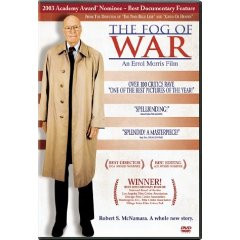
Review DVD: The Fog of War – Eleven Lessons from the Life of Robert S. McNamara

6 Star Top 10%, Biography & Memoirs, Decision-Making & Decision-Support, Empire, Sorrows, Hubris, Blowback, Insurgency & Revolution, Military & Pentagon Power, Power (Pathologies & Utilization), Reviews (DVD Only), War & Face of Battle

Amazon Page
Amazon Page

5.0 out of 5 stars Every Miltary Person, and Ideally Every Citizen, SHould View,

June 21, 2004
Robert McNamara
This is the only documentary film to make it on to my list of 470+ non-fiction books relevant to national security & global issues. It is superb, and below I summarize the 11 lessons with the intent of documenting how every military person, and ideally every citizen, should view this film.As the U.S. military goes through the motions of “transformation” while beset by the intense demands of being engaged in a 100-year war on six-fronts around the world, all of them against asymmetric threats that we do not understand and are not trained, equipped, nor organized to deal with, this film is startlingly relevant and cautionary.

LESSON 1: EMPHATHIZE WITH YOUR ENEMY. We must see ourselves as they see us, we must see their circumstances as they see them, before we can be effective.

LESSON 2: RATIONALITY WILL NOT SAVE US. Human fallibility combined with weapons of mass destruction will destroy nations. Castro has 162 nuclear warheads already on the island, and was willing to accept annihilation of Cuba as the cost of upholding his independence and honor.

LESSON 3: THERE'S SOMETHING BEYOND ONESELF. History, philosophy, values, responsibility–think beyond your niche.

LESSON 4: MAXIMIZE EFFICIENCY. Although this was McNamara's hallmark, and the fog of war demands redundancy, he has a point: we are not maximizing how we spend $500B a year toward world peace, and are instead spending it toward the enrichment of select corporations, building things that don't work in the real world.

LESSON 5: PROPORTIONALITY SHOULD BE A GUIDELINE IN WAR. McNamara is clearly still grieving over the fact that we firebombed 67 Japanese cities before we ever considered using the atomic bomb, destroying 50% to 90% of those cities.

LESSON 6: GET THE DATA. It is truly appalling to realize that the U.S. Government is operating on 2% of the relevant information, in part because it relies heavily on foreign allies for what they want to tell us, in part because the U.S. Government has turned its back on open sources of information. Marc Sageman, in “Understanding Networks of Terror”, knows more about terrorism today than do the CIA or FBI, because he went after the open source data and found the patterns. There is a quote from a Senator in the 1960's that is also compelling, talking about “an instability of ideas” that are not understood, leading to erroneous decisions in Washington. For want of action, we forsook thought.

LESSON 7: BELIEF & SEEING ARE BOTH OFTEN WRONG. With specific reference to the Gulf of Tonkin, as well as the failure of America to understand that the Vietnamese were fighting for independence from China, not just the French or the corrupt Catholic regime of Ngo Dinh Diem, McNamara blows a big whole in the way the neo-cons “believed” themselves into the Iraq war, and took America's blood, treasure, and spirit with them.

LESSON 8: BE PREPARED TO RE-EXAMINE YOUR REASONING. McNamara is blunt here: if your allies are not willing to go along with you, consider the possibility that your reasoning is flawed.

LESSON 9: IN ORDER TO DO GOOD, YOU MAY HAVE TO ENGAGE IN EVIL. Having said that, he recommends that we try to maximize ethics and minimize evil. He is specifically concerned with what constitutes a war crime under changing circumstances.

LESSON 10: NEVER SAY NEVER. Reality and the future are not predictable. There are no absolutes. We should spend more time thinking back over what might have been, be more flexible about taking alternative courses of action in the future.

LESSON 11: YOU CAN'T CHANGE HUMAN NATURE. There will always be war, and disaster. We can try to understand it, and deal with it, while seeking to calm our own human nature that wants to strike back in ways that are counter-productive.

For those who dismiss this movie because McNamara does not apologize, I say “pay attention.” The entire movie is an apology, both direct from McNamara, and indirect in the manner that the producer and director have peeled away his outer defenses and shown his remorse at key points in the film. I strongly recommend the book by McNamara and James Blight, “WILSON's GHOST.” In my humble opinion, in the context of the 470+ non-fiction books I have reviewed here, McNamara and Bill Colby are the two Viet-Nam era officials that have grown the most since leaving office. He has acquired wisdom since leaving defense, and we ignore this wisdom at our peril.

Vote on Review
Vote on Review

Review: Endgame–The Blueprint for Victory in the War on Terror

1 Star, Empire, Sorrows, Hubris, Blowback, Executive (Partisan Failure, Reform), Military & Pentagon Power, Misinformation & Propaganda

Amazon Page
Amazon Page

1.0 out of 5 stars THE Most Ignorant Book of 1080+ Books I Have Reviewed,

May 15, 2004
Thomas McInerney

Edited 20 Dec 07 to promote from third most ignortant to THE most ignorant, and also the most dangerous. Lunatics in power believe this.

Better books (and two DVDs), with reviews:
Vice: Dick Cheney and the Hijacking of the American Presidency
Blood Money: Wasted Billions, Lost Lives, and Corporate Greed in Iraq

Fiasco: The American Military Adventure in Iraq
Legacy of Ashes: The History of the CIA
The Sorrows of Empire: Militarism, Secrecy, and the End of the Republic (The American Empire Project)
The Unconquerable World: Power, Nonviolence, and the Will of the People
Breaking the Real Axis of Evil: How to Oust the World's Last Dictators by 2025
Running on Empty: How the Democratic and Republican Parties Are Bankrupting Our Future and What Americans Can Do About It
Why We Fight
The Fog of War – Eleven Lessons from the Life of Robert S. McNamara

Edited 23 August 2007 after a visit to the Middle East, and additional reflection on how Nations turn stupid. FOX News is, as we speak, leading a massive campaign to deceive Americans into thinking that we must attack Iran. Iran is Persian. They are running circles around us as our Army hollows out and our four carriers steam within range of Iranian Sunburn missiles. Adding two images and several hot links to books that make it quite clear that this book is by, of, and for idiots.

Edited after over a year to reflect the deep impression that “Civilization and Its Enemies” by Lee Harris has made on me. Amazon does not allow edited reviews to increase the star level, so I will say that after Harris, I would raise this book to two stars with the following obervation: having the right instincts–wanting to go after Iran in particular, and Syria–does not justify lying to the public or failing to do your homework.

Of the 3,000 or so volumes in my current library, I have only reviewed 950. I do not write negative reviews as a rule. This is my third exception to the latter rule. The most ignorant book was one on predicting revolution, the second most ignorant book was one on sources of conflict, and this is the third.

The authors, who demonstrate how far one could get in the Cold War military without reading or thinking, call this a military assessment. It is not. It is a one-track discourse on why we need to use our heavy metal military to wipe out Syria and Iran and intimidate Libya and Pakistan. It avoids discussing Saudi Arabia, Indonesia, Central Asia, Muslim Africa, and Muslim Pacifica. This is not analysis, this is flim-flam.

By way of context in my specific criticism of this book, let me just note that the bibliography does not reflect any appreciation for strategy, e.g. Colin Gray's “Modern Strategy”, or Col Dr. Max Manwaring and Ambassadors Corr and Dorff's “The Search for Security”, or Willard Matthias “America's Strategic Blunders” or Adda Bozeman's “Strategic Intelligence & Statecraft” or Jonathan Schell's “Unconquerable World.” I looked in vain for any sign the authors might comprehend the strategic context in which their specific beliefs and recommendations can only be seen as ill-advised. For example, a reference to Shultz, Godson, and Quester (at least one of whom is a neo-conservative), “Security Studies for the 21st Century”, or Robert McNamara and James Blight “Wilson's Ghost”, or Dean Jeffrey Garten's “The Politics of Fortune”, or Republican and conservative Clyde Prestowitz's “Rogue Nation”, or Ambassador Mark Palmer's “Breaking the Real Axis of Evil”. No cognizance of Kissinger, even.

Never mind all those *democratic* thought leaders, like Senator David Boren et al (and including Bob Gates), “Preparing America's Foreign Policy for the 21st Century”, or Joesph Nye on “The Paradox of American Power” or William Shawcross (a Brit) on “Deliver Us From Evil: Peacekeepers, Warlords and a World of Endless Conflict”, or Paul Krugman's “The Great Unraveling.”

I did not expect to find, but mention as a final setting of the stage for a very critical review, just a sampling of books relevant to getting the war on terror right: books like Chalmer's Johnson, “The Sorrors of Empire” or Derek Leebaert's “The Fifty Year Wound: The True Price of America's Cold War Victory” or Ziauddin Sardar and Merry Wyn Davies on “Why Do People Hate America” (which could be sub-titled, most relevantly for the authors under review, “and why doesn't America understand the real world”), or any of the last 100 non-fiction books on national security that I have reviewed here, generally to very favorable judgements by Amazon visitors.

Finally, I contrast this book with Richard Clarke's book “Against All Enemies: Inside America's War on Terror” which I recommend very highly. Clarke is real, these people are not.

I finally figured it out. This is a puff piece of, by, and for FOX Cable News viewers.

There are no footnotes in this book. It is a rambling opinion piece. Let us not confuse rank with brains, or opinions with thought. This is a double-spaced book that could probably be distilled to 30 pages of core reading, all summed up as “we're always right, no matter the cost.” This book also adopts the Richard Perle neoconservative game plan of using terrorism as a pretext to invade Syria and Iran. I assure each and every one of you, a universal draft is planned for after the election. Your sons and daughters will be sacrificed to the lack of strategic thinking that this book represents.

The book ends on two false notes. Although the authors demonstrate a semblance of balance in calling for better public diplomacy and especially the restoration of the US Information Agency, they continue to emphasize money for guns and the early use of the military in expeditionary mode, rather that a truly transformative strategy that begins with understanding the full range of threats facing us (bacteria are more dangerous than terrorists), devising a strategy for dealing with those threats by using *all* of the instruments of national power, and then a balanced budget that achieves all of that without sacrificing the earning potential of future generations.

Finally, we have thirteen pages of photographs where the authors proudly display their field trip photos, and what leaps out to the veteran's eye is that they were always in air-conditioned rooms and cars and never broke a sweat. As my good friend Robert Young Pelton likes to say (he is author of “The World's Most Dangerous Places”–you should all read it), these guys live and think in a bubble–they don't get into the gutter, they don't smell the shit, and they have no idea how close their fantasy world is to destruction from forces that are beyond their comprehension.

Iraq, and the planned war on Syria and Iran, are indeed a recurrence of Vietnam in the sense that ignorance and arrogance among the elite in power, and apathy among the public and within Congress, are creating a most costly global quagmire that will shortly explode in Australia, Thailand, Central Asia, Latin America, and Africa. The authors have learned nothing from history nor from the many non-partisan American strategists and scholars available to advise them.

I don't think this book is worth the purchase price, except as an example of the kinds of books, and kinds of people, that place loyalty to ideology above and apart from the public interest.

The authors have one thing right: this is a battle of wills. They do not appear to realize that there are not enough guns on the planet to execute their strategy, and that legitimacy is an intangible value that was lost to America from 2001 to date. This book is a blueprint for a nuclear winter in which America self-immolates. An Israeli tactical nuclear attack on Iran will kick off the end of the American Empire, and that may well be the best thing that could happen, to awaken the somolent Republic. We must indict and impeach Dick Cheney, Donald Rumsfeld, Rudy Gulliani, and we must indict and sentence to death Larry Silverstein for his role in the controlled demotion of the World Trade Center including WTC 7 which was not hit by anything, it was also brought down to destroy evidence and complete the highly profitable elimination of asbestor at the cost of thousands of NYC lives. I am quite certain the insurance companies were part of the scam, because I have read and viewed more than enough evidence to be certain all the buildings were brought down by Larry Silverstean and his despicable little band of murderers.

Vote on Review
Vote on Review

Review: The Choice–Global Domination or Global Leadership

4 Star, Diplomacy, Empire, Sorrows, Hubris, Blowback, Military & Pentagon Power, Misinformation & Propaganda, Strategy

Amazon Page
Amazon Page

4.0 out of 5 stars End of An Era–And About Time….,

April 29, 2004
Zbigniew Brzezinski
Zbigniew Brzezinski is considered by the Chinese to be one of America's top strategists (along with Steve Metz from the Army War College), and that is entirely his due. He is brilliant when it comes to state-centric strategy, but falls short with respect to emerging threats, sub-state threats, intelligence reform, and the roles of non-governmental organizations including religions, and civil networks instead of government-driven “command and control.”While it used to be fashionable, when confronted with a choice between, say, market economies and controlled economies, to cleverly say “some of each” and earn the top grade, today things have changed and the answer is more often than not, “none of the above.” This estimable author, whose wisdom must certainly be taken into account at all times, does not actually present a choice, only an opinion as to how a state-centric system–largely irrelevant in the 21st Century–might best be managed.

Especially troubling to me was the almost complete lack of attention to substantive books published in the last ten years, including those, most recently, of George Soros (abusive capitalism), William Greider (immoral capitalism), Herman Daly (ecological economics), Jonathan Schell (unconquerable world), Howard Rheingold (Smart Mobs), Thomas Stewart (the wealth of knowledge as an alternative to violence), and so on. The author is not alone in this oversight–Joseph Nye, whose book on Soft Power I am also reviewing today, bases his work on Op-Eds, many of them not written by the people signing them, and has almost no substantive references either. The think tank culture has lost touch with true scholarship.

The author's claim that Washington, D.C. is the center of the earth (pages 131-132) reflect in my view the last gasp of the Reagan-Smart Bush-Clinton era. While the author alludes to New York as the “other center”, I and my colleagues think instead of a loose network on “nodes”, some financial (Tokyo, London, Kuala Lumpur), some religious (Jerusalem, Rome, Salt Lake City, points in India), and so on. The author's emphasis on the Trilateral Commission and the now-dying World Economic Forum (Davos) as the bastions of a global elite that is in agreement struck me as being astonishing insular and inaccurate. The author says that “This elite is fostering the emergence of a global community of shared interest in stability, prosperity, and perhaps eventually democracy.” I do not think so. All the other books I have reviewed for Amazon suggest that this elite is doing all it can to plunder the world by enriching micro-elites through corruption, while disenfranchising the broader publics (e.g. Canadian companies displacing villages in Peru to loot the gold, French companies buying up the water in Brazil to increase charges to the public for the water they used to own, etc.).

The author is to be commended for at least recognizing that America is losing its moral standing in the world, and this is an intangible value that cannot be easily purchased nor replaced.

In passing, footnote 4 on page 38 is inadvertently incorrect. There are 175 violent internal political conflicts, not 38. There are also 32 countries engaged in complex emergencies, 66 with millions of displaced refugees, 59 with plagues and epidemics, 33 with massive starvation, and 18 genocides now on-going.

The book ends somewhat quietly, suggesting a transatlantic convention and what one other reviewer very appropriately called “baby steps.” My bottom line: Brzezinski is a solid citizen with a big mind and an old framework. He *must* be consulted for his wisdom as we move forward, but it falls to others now to define the bold new steps–faith-based diplomacy, ecological economics, public intelligence, global accountability of leaders–that are essential is we are save the world for our children.

Vote on Review
Vote on Review

Review: The Mission–Waging War and Keeping Peace with America’s Military

5 Star, Empire, Sorrows, Hubris, Blowback, Military & Pentagon Power, War & Face of Battle

Amazon Page
Amazon Page

5.0 out of 5 stars Ground Truth Reading About Failure of US Policy Process,

February 14, 2004
Dana Priest
I did not buy this book at first, having read and thoroughly enjoyed the many long articles the author contributed through The Washington Post, all of which comprise the middle two thirds of the book. However, at the recommendation of a retired Army Special Forces Colonel, I finally did buy it, and I am glad I did.Unlike the articles, which focused on the questionable use of Special Forces to train forces within repressive regimes around the world, from Colombia to Indonesia to Central Asia, the book more properly focuses on the complete lack of a US inter-agency planning process, the complete lack of a US means of coordinating actions and spending by all US agencies, and consequently, the complete lack of a US national security and global engagement strategy that is so vital to protecting America from attack and protecting American interests in a coherent and sensible fashion.

While many critics read the book as if it were a glorification of the theater Commanders-in-Chief (CINC), and complain about the militarization of US foreign policy, a proper reading of this book clearly documents that the militarization occurs by default, as a consequence of the abject failure of the White House and the Department of State, neither of which, under either Clinton or Bush, are serious about global engagement.

The military *works* (when it's not being frittered away by elective wars and occupations). What I see in this superb book is a solid foundation for thinking about three essential reforms to American national security: 1) the creation of a Presidential level inter-agency strategic planning and operational coordination process–no, the National Security Council is *not* capable of doing that; 2) the redirection of theater commands and staffs to become truly inter-agency, with men of the caliber of Bob Oakley and Mark Palmer serving as Peace CINCs with military four-star deputies; and 3) the doubling of the Special Operations Forces through the creation of a “white hat” “armed peace corps” that can deliver sewing machines, water purification, and the myriad of other things, including law enforcement under combat conditions.

The book also does for Marine Corps General Tony Zinni what Ron Suskind's book “The Price of Loyalty” does for Secretary of the Treasury Paul O'Neil–it gives us some deep insights into Tony Zinni as one of the most extraordinary men to ever serve the American people, and a man who is clearly well-qualified to be one of the top five to ten people in any future Administration. Although I am a former Marine and know Zinni's reputation among Marines as both a warrior's warrior and a thinking general (there are very few of those, even in the Marine Corps), I had not realized the depth and breadth of his brilliance until I read this book. In particular I was moved by his intuitive demand for tribal-level intelligence, his focus on nuances and context at all times, and his insistence that a major aspect of US national security policy must be on the delivery of water, electricity, and the kinds of basics that can rescue failed states, legitimize governments, and create future democracies.

I recommend that this book be read together with Kissinger's book on “Does America Need a Foreign Policy”, Boren's edited book on “Preparing American Foreign Policy for the 21st Century”, and Halperin's 1980's but still relevant book on “Bureaucratic Politics & Foreign Policy.” Bob Oakley's edited work on “Policing the New World Disorder” and Mark Palmer's recent book on “Breaking the Real Axis of Evil” (44 dictators), and Joe Nye's two most recent books, will round out any intelligent person's feel for what needs to be done. This is a very high quality book, fully meriting five stars, because it explains both the harsh world we must engage, and the failure of our national policy process–regardless of who is President–in this regard.

Vote on Review
Vote on Review

Review: Secrets and Lies–Operation “Iraqi Freedom” and After: A Prelude to the Fall of U.S. Power in the Middle East?

Congress (Failure, Reform), Empire, Sorrows, Hubris, Blowback, Executive (Partisan Failure, Reform), Intelligence (Government/Secret), Iraq, Military & Pentagon Power, Misinformation & Propaganda, Voices Lost (Indigenous, Gender, Poor, Marginalized), War & Face of Battle

Amazon Page
Amazon Page

4.0 out of 5 stars Most Scholarly Documentation of Bush-Blair Deceit,

February 13, 2004
Dilip Hiro
In some ways, this book is a great deal more distressing than the various pundit books slamming Bush (Moore, Hightower, Frankel, Krugman, Carville, etc.) because there is not a single caustic turn of phrase, not a single line of satire, not a single double entendre in the entire work. This is a brutally straight-forward, earnestly researched, ably footnoted, totally credible review of all of the secrets and lies that led to the war in Iraq.It did not quite bring me to tears, it did very nearly make me want to throw a chair through the garden window.

According to this book, and its incontrovertible documentation, we were lied to. We were deceived. Untold fighting men and women, not just from the US but also from other countries, have died and been wounded and according to this book the number of wounded is CLASSIFIED. It is a secret, an official secret from the American public, how many of their sons and daughters have died to support this ideological conquest, this extremist religious crusade. We must also acknowledge the thousands of dead Iraqis and the hundreds of thousands of displaced and impoverished Iraqis.

Another official secret from the American public are the results of the open survey by the Department of State of how the Iraqis feels about the US invasion and occupation–classified AFTER we discovered that Chalabi had lied to Cheney and there were no hearts and flowers, only hostility.

Yet another official secret from the American public is the estimate of the damage done by US forces to the Iraqi infrastructure, and how much it will cost the US taxpayer to pay for this mindless destruction in the heart of the Middle East.

Not discussed by the author, but very much on my mind, is the jungle drum word from the retired veterans with access to Bethesda and other military hospitals—on the basis of the 250,000 disabled veterans from Gulf 1, and the “word” filtering out from the wards, we are looking at upwards of 25,000, perhaps as many as 100,000 disabled veterans from this war–all from depleted uranium, a killer of our own making. Worse, this disability is multi-generational and will lead to blind and maimed children among those veterans who are able to have children.

This book is a cold-hearted look–so cold-hearted it ignites a flame of righteous anger in any careful reader–at how America has destroyed its credibility and its ability to have a positive influence in the Middle East.

If I have one small criticism, it is that the author, a stellar authority with solid sources to call upon, did not do an appendix that laid out an entire timeline of what Bush and Blair said that was false, and then the counter-vailing truth. Although the author makes a number of these points clear throughout the book, for example, the UN never passed a resolution calling for the removal of Saddam Hussein from power, an opportunity has been lost here.

Truth matters. Paul O'Neil is correct to speculate that we will heal ourselves, and equally correct to point out that this will happen only if we speak and hear the truth about these grievous circumstances in which great evil was done “in our name.” This book, more so than the others that I cited above, is perhaps the first serious building block toward righting our ship of state.

Vote on Review
Vote on Review

Review: Charlie Wilson’s War–The Extraordinary Story of the Largest Covert Operation in History

5 Star, Empire, Sorrows, Hubris, Blowback, Insurgency & Revolution, Intelligence (Government/Secret)

Amazon Page
Amazon Page

5.0 out of 5 stars CIA, Jihad, Congress, Texas Socialites, & Dumb US Policies,

February 9, 2004
George Crile
Edit of 20 Jan 08 to add links and comment on movie/DVD

Comment on movie: 4 stars for being good enough, three stars for not covering all that could be covered. See the movie, then read the book. The movie captures the idiocy of US Government funding war but not peace, and the sophmoric manner in which CIA bureaucrats play at war (but see JAWBREAKER and First In for “done right,” but it does not capture the war between the US diplomats and the spies, nor does it capture the extraordinary complexity of Pakistan, its own spy service, and the unconquerable Waziristan region (which could, however, be useful nuked). Links at end of review.

I was wrong to dismiss this book when it first came out, and I stress this because the hype about a hard-drinking womanizing “loose cannon” of a Congressman is precisely what the Washington bluebloods want us to think. This is one of my “top five” for understanding Washington. In alphabetical order, here are the key points.

Admin: Constant reference to case officers as “agents” is irritating.

Agency for International Development: featured as “the other Agency” whose feats on the humanitarian front are vital.

Analysis: CIA analysis was constantly flawed because of its reliance on technical collection or foreign liaison reporting. Examples of actual human observation of Egyptian arms failures made the point that there is no substitute for the human case officer in the field.

Bureaucracy: CIA bluebloods were timid–“bureaucratic cowardice” is a term seen several times–and so were the AID leaders, the Pentagon, the State Department, and even the White House. CIA did not want more money for Afghanistan, was at war with the State Department, did what it could to slander and undermine Congressman Wilson, was slow in every respect (“what we did with Charlie in one month would have taken us nine years to accomplish [through normal channels].”

Central America. Although not the main thrust of the book, the comparisons between the secret success in Afghanistan and the public failure of the CIA in Central America are useful.

Congress. The book is a case study of how Congressional power really works, where less than 25 Members on the House side actually matter when it comes to defense appropriations. Pages 79-80, on the various Congressional fraternities, are quite useful.

Corruption. The main character in the book other than Charlie Wilson, Gust Avrakotos, gets high marks for cutting the cost of arms and ammo in half by out-smarting the black market, and for devising clever ways to monitor for corruption, such as technical beacons in the arms shipments that can be monitored from satellites.

Cost of War. $165 for an AK-47, $1,050 per man per year for ammunition, cost of keeping 100,000 holy warriors firing for one year comes to $100 million. That is without providing for all other costs such as anti-air weapons, anti-tank weapons, food, communications, medical, and logistics. At least $1.5 billion in US funds was being spent at the height of the war, with Saudis matching this amount.

Covert Action: The US did not really get credit from the warriors being armed, because it was all done through Pakistan. Assassination and other dirty tricks are indeed a part of CIA's repertoire, they just get the British and Egyptians and Pakistanis to do the work for them, thus circumventing US laws and internal regulations.

Education. The role that Congressman Wilson played in educating other Members cannot be under-estimated. The bureaucracy cannot be trusted to properly educate Members, and that in the absence of a strong and sustained educational endeavor, Members will continue to be oblivious to reality overseas.

Foreign Countries. China, Egypt, India, Saudi Arabia, and the United Kingdom are featured players, apart from Pakistan. The impoverishment of the British secret service, begging the Americans for a few mine-detectors, is of note.

Israel. Israel is in a class by itself. American Jews funded Charlie Wilson's survival and Israel empowered him in multiple ways. It is a real irony of this book that Israel was the key factor in creating the armed Islamic jihad movement, with consequences no one anticipated.

Lawyers. Page 165 and throughout the book document the essential castration of the CIA by its own lawyers. As Avrakotos is quoted in the book: “If I asked them they would have jerked off for three months trying to figure out why we couldn't do it.”

Liberals. Paul Tsongas and Charlie Wilson, both liberals, supported the Afghanistan effort long before any conservatives were willing to step up to the plate.

Lobbying. The book is a handbook on both domestic lobbying through Texas socialites associated with the extreme right, and foreign lobbying of Members by both foreign governments and very rich extreme rightists who use Parisian aristocracy and others to push through programs that go against all the bureaucratic instincts of CIA, the Pentagon, and the State Department.

Operations. The book documents some severe shortfalls in CIA's operational capabilities, including a great quote: “Out of twenty-five hundred [case officers]…maybe five percent are super, twenty percent good, and five percent shot.” [Note: this leaves 70% in a dead zone.] The incompetence of the CIA's covert procurement process is of special concern.

People. Book damns the Ivy League bluebloods, Stansfield Turner (who not only killed operations, but fired mostly the blue collar ethnics that were actually good on the street). It honors the CIA “untouchables”, the worker bees, mostly people of color with high school educations, that keep the place going. It documents how Mike Vickers, a GS-11 that masterminded the victory, gave up on CIA and left for the Wharton school because there was no future for him at the agency.

Trade-Offs. The book explicitly documents how the White House gave Pakistan its blessing on continuing with an Islamic nuclear bomb, as the quid pro quo for supporting the jihad against the Soviets.

Tribal Knowledge. The book documents the CIA's abysmal lack of understanding, which continues today, of tribal personalities and power relationships, history, and context.

Variables. Training and communications made a huge difference, and together with anti-aircraft weapons, took the war against the Soviets from a “fool's errand” level (CIA providing Enfield rifles and limited ammunition) to a “real war” level.

White House. The book provides a reminder of how easily the White House neophytes fall for thieves and liars. The discussion of the damage done by Manucher Ghorbanifar is so like that done by Chalabi's access to Cheney that the comparison is chilling. CIA blacklisted both for very good reasons, and the White House still embraced them.

This is gripping non-fiction, better than any spy novel.

CIA Done Right:
First In: An Insider's Account of How the CIA Spearheaded the War on Terror in Afghanistan
Jawbreaker: The Attack on Bin Laden and Al Qaeda: A Personal Account by the CIA's Key Field Commander

CIA Normal:
Legacy of Ashes: The History of the CIA
Web of Deceit: The History of Western complicity in Iraq, from Churchill to Kennedy to George W. Bush
None So Blind: A Personal Account of the Intelligence Failure in Vietnam
Who the Hell Are We Fighting?: The Story of Sam Adams and the Vietnam Intelligence Wars

Policy Evil:
Vice: Dick Cheney and the Hijacking of the American Presidency
A Pretext for War : 9/11, Iraq, and the Abuse of America's Intelligence Agencies
9/11 Synthetic Terror: Made in USA, Fourth Edition

Semiunal Non-Fiction (Damns Spending $60B/year on the 4% we can steal:
On Intelligence: Spies and Secrecy in an Open World

Vote on Review
Vote on Review