[ Editor's note: Corporpate media earned some new stripes in the past week for being in the bag 0f someone's intelligence agency when they want to herd the rest of us like lemmings to the sea.
The attempt to tag Assad with an anonymous single source mega-atrocity is being laughed at worldwide.
Intelligence people are wondering how could CNN have been suckered into to this when they had to know that the story was just unbelievable.
The attached BBC report/video by John Simpson describing Afghan attitudes toward the US/UK exit struck me as bizarre. The weight of Simpson's gist is that most Afghans do not want us to leave. But the report based most of its information on interviews in Kabul and only a short part (the wobbly part) on the countryside where the vast majority of Afghans live — i.e., Helmand. Simpson did not mention of Taliban strongholds in Kandahar and the border areas with Pakistan,nor did he mention the western areas like Herat, or the Northern areas. So I asked an Afghan friend who follows events in Afghanistan closely for his take on this report. Attached below the video link is my friend's reaction and a NYT piece with yellow highlights.
(BBC) The BBC's world affairs editor John Simpson visited Kabul, a city he knows well, to discover what shape Afghan government forces are in and whether the Taliban could take over after UK and American troops leave.
———–
Email from Mr. X
(a highly educated Afghan — ethnic Pashtun — an expat living in Europe)
Is Big Brother watching us? Every day, street cameras monitor our movements and phones give our location and other information about us away.
New York artist Adam Harvey is working with surveillance, fashion and privacy, with a view to using fashion to help keep our lives more private.
He demonstrates how make-up can prevent facial recognition systems from seeing us, how clothes can foil a heat sensor looking for body heat and how a smart holder for your phone can prevent it giving away information about you.
Phi Beta Iota: The extremely wealth who are also extremely well informed appear to be investing in clothing including scarves and hats, all with high content of special metals to block harmful electromagnetic radiation.
JOHN V. WALSH | Tuesday, January 28, 2014, 11:31 Beijing
China has stated its goals quite unambiguously. “A moderately prosperous society by 2020” is the first goal and “a strong socialist nation by 2049” as the second. But this may be simplified: China’s leadership wants its people to have a standard of living equal to that of the developed nations of the West.
And that, along with restoring and preserving sovereignty, has been the main part of the Chinese program since 1949 – at least. China’s great historical achievement is to lift hundreds of millions out of poverty, accounting for most of the eradication of poverty in the recent past. This achievement is rarely mentioned in the West.
Consider the simple consequences of that fact. China has a population of 1.36 billion and the United States has a population of 320 million. So if China is to have a per capita GDP equal to that of the United States, its total GDP must be more than four times the size of the US economy. Four times.
As we have known at least since Thucydides military power flows from economic power. That is also true of “soft” power, scientific discovery and technological achievement and capacity. (This week USA Today carries a story on the rapid growth of new and original patents in China., alarming the Pentagon.) Growth in China’s economic power therefore closes the door on US global hegemony.
In this new work, Michel continues to propose powerful ideas that not only demonstrate his capacity for synthesis, but more importantly, his capacity to articulate ideas that facilitate points of convergence between broad sectors that are sympathetic to the ideas of production based on the commons.
Michel Bauwens sent us a work that will soon be published, in which he summarizes and clarifies what he sees as the possible evolution of the means of monetization in a world in which the P2P mode of production has gained strength.
[D]emonetization will be a good thing in many sectors under a regime of civic domination, we will also need new forms of monetization, and restore the feedback loop between value creation and value capture.
Michel Bauwens
Netarchic capitalism, the direct result of recentralization, has established a new model of value, in which capital extracts it as an intermediary in the creation of platforms for P2P interaction between individuals, gradually renouncing its role of directly controlling information production.
So, cognitive capitalism can be said to be suffering a severe “value crisis,” in which the use value of production grows exponentially, but its exchange value grows linearly, and is almost exclusively captured by capital, giving rise to exacerbated forms of labor exploitation, especially with respect to the new informational proletariat:
It could be said that this creates a sort of “hyper-neoliberalism”… in classical neoliberalism, wages stagnate; in hyper-neoliberalism, salaried workers are replaced by isolated, and mostly precarious, freelancers.
For example, Bauwens cites preliminary studies that indicate that the average hourly wage of “digital workers” doesn’t exceed two dollars an hour, citing as a prototype of this phenomenon aggregation services like TaskRabbit, in which workers can’t communicate with each other, unlike clients.
If you are a regular reader of this blog, you know that I have a slight obsession with 3D printers. I wish I had one to play with! But this article tells us that the next step in 3D printing is here with multiple materials and textures. That's a huge step forward! Read on!
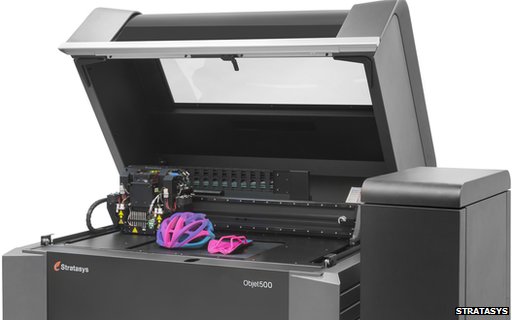
The world's first multi-material full-colour 3D printer has been launched by Stratasys, the owner of the MakerBot range of printers.
It features “triple-jetting” technology that combines droplets of three base materials, reducing the need for separate print runs and painting.
The company said the Objet500 Connex3 Color Mutli-material 3D Printer would be a “significant time-saver” for designers and manufacturers.
It will cost about $330,000 (£200,000).
By incorporating traditional 2D printer colour mixing, using cyan, magenta and yellow, the manufacturer says multi-material objects can be printed in hundreds of colours.
While the base materials are rubber and plastic, they can be combined and treated to create end products of widely varying flexibility and rigidity, transparency and opacity, the company said.