Berto Jongman: David Ignatius Pimps “Fresh Approach” by Second String Prefects

Corruption, Government, Ineptitude
0Shares
Berto Jongman
Berto Jongman

A fresh approach to looking at foreign threats

By ,

Washington Post, December 6, 2013

The chairs of the House and Senate intelligence committees stated last weekend that the world was getting more unsafe. A few days later, the Pew Research Center reported that 52 percent of Americans think the U.S. should “mind its own business internationally,” the highest such total in the nearly 50-year history of that query. Taken together, these two items symbolize a serious emerging national problem. The crackup ahead lies in the mismatch between the challenges facing America and the public’s willingness to support activist foreign policy to deal with them. Simply put: There is a splintering of the traditional consensus for global engagement at the very time that some big new problems are emerging

. . . . . . . .

A modest proposal is that Obama should convene a younger group of American leaders: strategists, technologists, professors. It would be a learning exercise — to understand how the country should deal with the problems of the next 10 years without making the mistakes of the past 10. What has America learned from its struggles with Islamic extremism? What lessons do we take from our painful expeditionary wars? How can Americans too young to remember the Iranian revolution of 1979 engage that country, but also set clear limits on its behavior?

Happily, a new generation of thinkers could form the bipartisan group I’m imagining. If you don’t know their names yet, you should: Marc Lynch of George Washington University, known to his online fans as “Abu Aardvark”; David Kilcullen, one of the architects of counterinsurgency success in Iraq and author of “Out of the Mountains,” an iconoclastic new book on future urban conflicts; Michèle Flournoy, a clear-eyed former undersecretary of defense; and Jared Cohen and Alec Ross, two technological wizards who advised the State Department under Hillary Clinton and are now with Google and Johns Hopkins University, respectively. I’d add the administration’s own Salman Ahmed , Tony Blinken , Ben Rhodes , Wendy Sherman and Jake Sullivan .

What encourages me is that the same American public that wants the United States to mind its own business internationally also registers a two-thirds majority in favor of greater U.S. involvement in the global economy, according to the Pew poll. Young respondents were even more internationalist on this issue than their elders.

Read full opinion.

Continue reading “Berto Jongman: David Ignatius Pimps “Fresh Approach” by Second String Prefects”


Penguin: Fabuius Maximus on Failure to Learn

Cultural Intelligence, Ethics, Government, Peace Intelligence
0Shares
Who, Me?
Who, Me?

PART I: Keep fighting! We must not learn from our wars.

Summary:  We were ejected from Iraq, gaining nothing we sought. No oil, no ally against Iran, no unsinkable aircraft carrier in the Middle East. All but the mad hawks realize we gained nothing in Afghanistan. Now comes the post-game show, as our military’s boosters attempt to fog our vision and erase our memories, preparing us for more wars. The truth is out there, if only we would make an effort to see.

Contents

  1. We lose because we’re ignorant of history and refuse to learn
  2. Bitter fruit from our failure to learn
  3. The history of counterinsurgency by foreign armies, a history of failure
  4. A more detailed explanation of why foreign armies fail at COIN
  5. For More Information
  6. A closing note from Friedrich Schiller

PART II: Well-funded organizations inciting us to hate & fear, again. How gullible are we?

Summary: Today we examine yet another example of agitprop by well-funded organizations inciting hatred of Muslims in America.  Will we fall for this, again? A divided and fearful people are an easily led flock, a gift to their rulers. Please push back against this propaganda, and those that believe it. Being sheep is a choice.

Continue reading “Penguin: Fabuius Maximus on Failure to Learn”

Stephen Aftergood: Defense Warning Network

Ethics, Government, IO Impotency, Military
0Shares
Steven Aftergood
Steven Aftergood

THE DEFENSE WARNING NETWORK

The structure and functions of the Defense Warning Network were outlined in a new directive issued yesterday by the Department of Defense.

The mission of the Defense Warning Network is to provide notice “of potential threats posed by adversaries, political and economic instability, failed or failing states, and any other emerging challenges that could affect the United States or its interests worldwide.”  See The Defense Warning Network, DoD Directive 3115.16, December 5, 2013.

Continue reading “Stephen Aftergood: Defense Warning Network”

Stephen Aftergood: White House Sets New Goals for Open Government

Governance
0Shares
Steven Aftergood
Steven Aftergood

WHITE HOUSE SETS NEW GOALS FOR OPEN GOVERNMENT

In a new Open Government National Action Plan that was released today, the White House affirmed its support for open government values, and set an agenda for the remainder of the current Administration.

“The new plan includes a wide range of actions the Administration will take over the next two years, including commitments that build upon past successes as well as several new initiatives,” the Plan stated. “The Administration will work with the public and civil society organizations to implement each of these commitments over the next two years.”

With respect to national security secrecy, the Plan includes a new commitment to “transform the security classification system” based on the principle that “classification must… be kept to the minimum required to meet national security needs….”

Continue reading “Stephen Aftergood: White House Sets New Goals for Open Government”

Mini-Me: How Many Countries in Africa?

Africa
0Shares
Who?  Mini-Me?
Who? Mini-Me?

Huh?

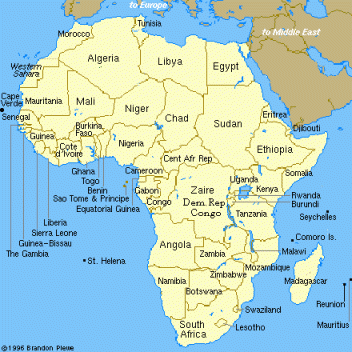
How many countries in Africa? How hard can the question be?

Africa is one continent but how many countries? we were asked last week. The answer is more complicated than you might think but, simply put, there are 55 states that are recognised by either the AU or the UN or both.

Researched by Ruth Becker

“How many countries does the continent have in its entirety?” asked a message sent to us last week by a group of information security advocates.

Click on Image to Enlarge

The sender, @Infosecafrica, noted that Africa’s regional political organisation the African Union has 54 members but had seen a report claiming the continent is home to 57 countries.

So how many countries does Africa have? The AU claims to represent all African countries. So are there 54 or 57? How hard – we thought – can the question be?

Continue reading “Mini-Me: How Many Countries in Africa?”

Jean Lievens: The Circular Sharing Economy — Profitable Beyond Measure?

Economics/True Cost, Innovation, Manufacturing, Materials, P2P / Panarchy, Resilience
0Shares
Jean Lievens
Jean Lievens

ANALYSIS: Circular and sharing, when two become one?

If there is one thing the sustainability movement appears to want ownership of, it is the word ‘economy'. A circular version has been doing the rounds for some time, but it could be under threat from a new kid on the block, equally as caring, but perhaps, well, more sharing.

A circular economy. Or a sharing economy. Which would you put your money on? The first would claim to have more gravitas as it involves a seismic shift in not only how business works, but how resources are utilised. It is also potentially worth big bucks to corporations – hundreds of billions within the EU alone, according to the Ellen MacArthur Foundation. Some would also argue that a true sharing economy could not exist unless a circular economy was already in place.

Continue reading “Jean Lievens: The Circular Sharing Economy — Profitable Beyond Measure?”