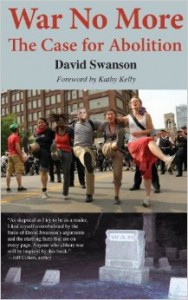
This article is the Introduction to the new book War No More: The Case for Abolition, published in October 2013.
As I write this, in September 2013, something extraordinary has just happened. Public pressure has led the British Parliament to refuse a prime minister's demand for war for the first time since the surrender at Yorktown, and the U.S. Congress has followed suit by making clear to the U.S. president that his proposed authorization for war on Syria would not pass through either the Senate or the House.
Now, this may all fall apart in a week or a month or a year or a decade. The forces pressing for a war on Syria have not gone away. The civil war and the humanitarian crisis in Syria are not over. The partisan makeup of the Parliament and the Congress played a role in their actions (although the leaders of both major parties in Congress favored attacking Syria). Foreign nations' intervention played a role. But the decisive force driving governments around the world and U.S. government (and military) insiders to resist this war was public opinion. We heard the stories of children suffering and dying in Syria, but we rejected the idea that killing more Syrians with U.S. weapons would make Syria better off.
Those of us who believe that we should always have the right to reject our government's arguments for war should feel empowered. Now that it's been done, we cannot be told it's impossible to do it again … and again, and again.
In the space of a day, discussions in Washington, D.C., shifted from the supposed necessity of war to the clear desirability of avoiding war. If that can happen once, even if only momentarily, why can it not happen every time? Why cannot our government's eagerness for war be permanently done away with? U.S. Secretary of State John Kerry, who led the unsuccessful marketing campaign for an attack on Syria, had famously asked, many years earlier, during what the Vietnamese call the American War, “How do you ask a man to be the last man to die for a mistake?” We have it within our power to make war a thing of the past and to leave Secretary Kerry the last man to have tried to sell us a dead idea.
(An argument will be made that the threat of war aided diplomatic efforts to disarm the Syrian government. It should not be forgotten that when Kerry suggested that Syria could avoid a war by handing over its chemical weapons, everyone knew he didn't mean it. In fact, when Russia called his bluff and Syria immediately agreed, Kerry's staff put out this statement: “Secretary Kerry was making a rhetorical argument about the impossibility and unlikelihood of Assad turning over chemical weapons he has denied he used. His point was that this brutal dictator with a history of playing fast and loose with the facts cannot be trusted to turn over chemical weapons, otherwise he would have done so long ago. That's why the world faces this moment.” In other words: stop getting in the way of our war! By the next day, however, with Congress rejecting war, Kerry was claiming to have meant his remark quite seriously and to believe the process had a good chance of succeeding.)
In this book I make the case outlined in the four section titles: War can be ended; War should be ended; War is not going to end on its own; We have to end war.
Continue reading “David Swanson: Beginning the Ending of War (Again)”



 WELCOME TO SCIENCE AND NONDUALITY (SAND)