
Tip of the Hat to Berto Jongman

The truth at any cost lowers all other costs — curated by former US spy Robert David Steele.
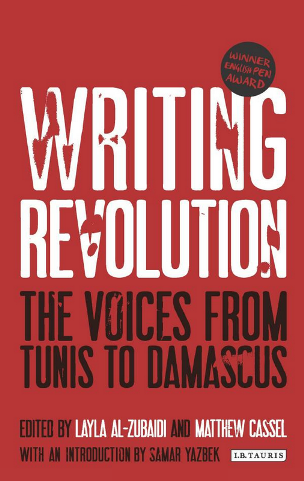 Recommended by Berto Jongman
Description
From Cairo to Damascus and from Tunisia to Bahrain, Layla Al-Zubaidi and Matthew Cassel have brought together some of the most exciting new writing born out of revolution in the Arab world. This is a remarkable collection of testimony, entirely composed by participants in, and witnesses to, the profound changes shaking their region. Situated between past, present and future – in a space where the personal and the political collide – these voices are part of an ongoing process, one that is at once hopeful and heartbreaking. Unique amongst material emanating from and about the convulsions in the Arab Middle East, these creative and original writers speak of history, determination and struggle, as well as of political and poetic engagement with questions of identity and activism. This book gives a moving and inspiring insight into the Arab revolutions and uprisings: why they are happening and what might come next.
Table of Contents
Introduction by Samar Yazbek
1. Greetings to the Dawn: Living through the Bittersweet Revolution (Tunisia) by Malek Sghiri
2. Cairo, City in Waiting (Egypt) by Yasmine El Rashidi
3. Bayou and Laila (Libya) by Mohamed Mesrati
4. We Are Not Swallows (Algeria) by Ghania Mouffok
5. The Resistance: Armed with Words (Yemen) by Jamal Jubran
6. Coming Down from the Tower (Bahrain) by Ali Aldairy
7. Wishful Thinking (Saudi Arabia) by Safa Al Ahmad
8. And the Demonstrations Go On: Diary of an Unfinished Revolution (Syria) by Khawla Dunia
About the Editors
Matthew Cassel is a journalist and photographer covering the Middle East for Al Jazeera English. Cassel first learned about the region through his human rights and media work in Palestinian refugee camps. Over the past decade he has worked in the occupied Palestinian territories, Lebanon, Egypt, Turkey, Syria, Jordan, Bahrain and elsewhere. Formerly Assistant Editor of the The Electronic Intifada online journal, he is connected to activists, journalists, writers, artists and others at the forefront of the movement for change in the region.
Nemonie Craven Roderick is a literary agent. She has contributed to Sight & Sound, Roads & Kingdoms and The Blackwell Encyclopedia of Literary and Cultural Theory, amongst other publications.
Layla Al-Zubaidi is Director of the Heinrich Böll Foundation in South Africa, and was previously based in Beirut and Ramallah. She has published on cultural resistance and freedom of expression, and is co-editor of Democratic Transition in the Middle East: Unmaking Power (Routledge, 2012). She is also on the Executive Committee of Freemuse — World Forum on Music and Censorship.

There are some interesting and provocative materials on counter-insurgency and 4th generation warfare at two very different websites.
The Fabius Maximus website has an essay, with many important links, titled “How I learned to stop worrying and love Fourth Generation War. We can win at this game.” Find it at http://fabiusmaximus.com/2013/
George Kenny's very different and diverse website at electricpolitics.com has an interview with a thinker in the Army, Col. Gian Gentile. It addresses the various fallacies of the Petraeus/COIN dogma that resulted in the surge in Iraq (the action that allowed some in the US to pretend that “we won” there and the catastrophe now occurring there is some sort of separate event) and that has prolonged the agony in Afghanistan (while we pretend we are preserving something worth preserving). While this interview starts slowly, it becomes very interesting and thought provoking, I believe. Find it at http://www.
I highly respect all the discussants in these two pieces and I defer to much of their knowledge on the subject, which is deeper than mine. However, there is an element on which I dissent. They focus much of their energy on how to “win” these conflicts. I am not at all sure that is the correct focus. These conflicts (call them whatever you want) occur mostly in very alien societies with massively corrupt, wantonly un-empathetic, and/or grotesquely incompetent governments. Not only is “helping” the government side the equivalent of pushing a very wet string, but also why is it that we feel compelled to take a side in those conflicts where one side is repulsive and the other is hideous? Trying to win by taking one of those sides is a fool's errand, and it has proven our undoing since the end of World War II — and especially in recent years. That we pretend ourselves to be superior to the culture in these countries, and behave accordingly, does not exactly help either.
The situation in Syria, where we side with one of the many insurgents, is merely a variation on these themes.
There are alternatives; we should be exploring them.

The author is one of the best journalists in the Middle East.
Jonathan Cook
Counterpunch:, 2013-09-18
Nazareth.
President Barack Obama may have drawn his seemingly regretted “red line” around Syria’s chemical weapons, but it was neither he nor the international community that turned the spotlight on their use. That task fell to Israel.
It was an Israeli general who claimed in April that Damascus had used chemical weapons, forcing Obama into an embarrassing demurral on his stated commitment to intervene should that happen.
According to the Israeli media, it was also Israel that provided the intelligence that blamed the Syrian president, Bashar Al Assad, for the latest chemical weapons attack, near Damascus on August 21, triggering the clamour for a US military response.
It is worth remembering that Obama’s supposed “dithering” on the question of military action has only been accentuated by Israel’s “daring” strikes on Syria – at least three since the start of the year.
It looks as though Israel, while remaining largely mute about its interests in the civil war raging there, has been doing a great deal to pressure the White House into direct involvement in Syria.
That momentum appears to have been halted, for the time being at least, by the deal agreed at the weekend by the US and Russia to dismantle Syria’s chemical weapons arsenal.
To understand the respective views of the White House and Israel on attacking Syria, one needs to revisit the US-led invasion of Iraq a decade ago.
Israel and its ideological twin in Washington, the neoconservatives, rallied to the cause of toppling Saddam Hussein, believing that it should be the prelude to an equally devastating blow against Iran.
Israel was keen to see its two chief regional enemies weakened simultaneously. Saddam’s Iraq had been the chief sponsor of Palestinian resistance against Israel. Iran, meanwhile, had begun developing a civilian nuclear programme that Israel feared could pave the way to an Iranian bomb, ending Israel’s regional monopoly on nuclear weapons.
The neocons carried out the first phase of the plan, destroying Iraq, but then ran up against domestic opposition that blocked implementation of the second stage: the break-up of Iran.
The consequences are well known. As Iraq imploded into sectarian violence, Iran’s fortunes rose. Tehran strengthened its role as regional sponsor of resistance against Israel – or what became Washington’s new “axis of evil” – that included Hizbollah in Lebanon and Hamas in Gaza.
Israel and the US both regard Syria as the geographical “keystone” of that axis, as Israel’s outgoing ambassador to the US, Michael Oren, told the Jerusalem Post this week, and one that needs to be removed if Iran is to be isolated, weakened or attacked.
But Israel and the US drew different lessons from Iraq. Washington is now wary of its ground forces becoming bogged down again, as well as fearful of reviving a cold war confrontation with Moscow. It prefers instead to rely on proxies to contain and exhaust the Syrian regime.
Israel, on the other hand, understands the danger of manoeuvring its patron into a showdown with Damascus without ensuring this time that Iran is tied into the plan. Toppling Assad alone would simply add emboldened jihadists to the troubles on its doorstep.
Continue reading “Chuck Spinney: Israel Still Angling for Attacks on Syria and Iran”

A Lament for the State of Analysis Tech in Economics
It seems like state-of-the-art analysis tools would be a priority in the data-rich field of finance. That’s why it is startling to learn that the technology being used by economic analysts and consultants seems to be stuck in the era of Windows 95. About Data shares a data-loving former economist’s lament in, “Bridging Economics and Data Science.”
Blogger Sam Bhagwat majored in economics because he was intrigued by innovative uses of data in that field; for example, a professor of his had gleaned conclusions about European patent law from a set of 19th century industrial-fair records. As he progressed, though, Bhagwat came to the disappointing realization that his field still relies on technology for which “outdated” is putting it mildly. He writes:
“When I graduated, the questions had changed, but the fundamental tools of analysis remained constant. Half of my classmates, including me, were headed to consulting or investment banking. These are ‘spreadsheet monkey’ positions analyzing client financial and operational data.
“In terms of relationship-building, this is great. Joining high strategy or high finance, you walk through the halls of power and learn to feel comfortable there. But in terms of technical skill-set, not so great. You begin to specialize in spreadsheets, a tool which hasn’t significantly improved since 1995.
“For someone like me, who wants to solve the most interesting problems out there, dealing with gigabytes and terabytes of data, realizing this was bitter medicine. Computational data analysis has changed a lot in the last twenty years, but my career track — economics, consulting, finance — hadn’t.”
So that is how one inquiring mind decided to make the leap from economics to data science. Bhagwat says he taught himself programming so he could pursue work he actually found challenging. I wonder, though—will he use his dual expertise to help bridge the gap between the two disciplines, or has he moved on, never to look back?
Cynthia Murrell, September 18, 2013
Sponsored by ArnoldIT.com, developer of Augmentext

MicroMappers: Microtasking for Disaster Response
My team and I at QCRI are about to launch MicroMappers: the first ever set of microtasking apps specifically customized for digital humanitarian response. If you’re new to microtasking in the context of disaster response, then I recommend reading this, this and this. The purpose of our web-based microtasking apps (we call them Clickers) is to quickly make sense of all the user-generated, multi-media content posted on social media during disasters. How? By using microtasking and making it as easy as a single click of the mouse to become a digital humanitarian volunteer. This is how volunteers with Zooniverse were able to click-and-thus-tag well over 2,000,000 images in under 48-hours.
We have already developed and customized four Clickers using the free and open source microtasking platform CrowdCrafting: TweetClicker, TweetGeoClicker, ImageClicker and ImageGeoClicker. Each Clicker includes a mini-tutorial to guide volunteers. While we’re planning to launch them live next month, these Clickers (described below) can be used right now if need be. When a disaster strikes, we can automatically upload tweets to the TweetClicker, for example. These tweets are pre-filtered for keywords and hashtags relevant to the disaster in question. We can also automatically identify multimedia content posted to Twitter and upload this to the ImageClicker to tag pictures that show damage, for example.
Continue reading “Patrick Meier: MicroMappers: Microtasking for Disaster Response”
Enabling Crowdfunding on Twitter for Disaster Response
Twitter is increasingly used to communicate needs during crises. These needs often include requests for information and financial assistance, for example. Identifying these tweets in real-time requires the use of advanced computing and machine learning in particular. This is why my team and I at QCRI are developing the Artificial Intelligence for Disaster Response (AIDR) platform. My colleague Hemant Purohit has been working with us to develop machine learning classifiers to automatically identify and disaggregate between different types of needs. He has also developed classifiers to automatically identify twitter users offering different types of help including financial support. Our aim is to develop a “Match.com” solution to match specific needs with offers of help. What we’re missing, however, is for an easy way to post micro-donations on Twitter as a result of matching financial needs and offers.
This is where my colleague Clarence Wardell and his start-up TinyGive may come in. Geared towards nonprofits, TinyGive is the easiest way to accept donations on Twitter. Indeed, Donating via TinyGive is as simple as tweeting five words: “Hey @[organization], here’s $5! #tinygive”. I recently tried the service at a fundraiser and it really is that easy. TinyGive turns your tweet into an actual donation (and public endorsement), thus drastically reducing the high barriers that currently exist for Twitter users who wish to help others. Indeed, many of the barriers that currently exist in the mobile donation space is overcome by TinyGive.
Continue reading “Patrick Meier: Enabling Crowdfunding on Twitter for Disaster Response”
