Naam is a professional technologist who helped create two of the most widely used pieces of software in the world: Microsoft’s Internet Explorer and Microsoft Outlook. He is currently the CEO of Apex Nanotechnologies, which develops software for nanotechnology researchers. He also serves on the advisory board of the Institute for Accelerating Change, is a Senior Associate of the Foresight Institute, and is a member of the World Future Society. He is the recipient of the 2005 H. G. Wells Award for Contributions to Transhumanism.
As everyone should know by now, not quite two weeks ago the latest nugget from Edward Snowden via Glenn Greenwald and co-authors was revealed, and was that the NSA and its UK counterpart the GSHQ “have successfully cracked much of the online encryption relied upon by hundreds of millions of people to protect the privacy of their personal data, online transactions and emails.” The measures used to accomplish this include covertly controlling the setting of encryption standards, more powerful brute force code-cracking, and inserting backdoors into commercial encryption software.
This is very bad, and has led more than one observer to declare that the internet as we know it is dead as a secure medium of communication. That of course leads to the question of what is to be done about it.
Most of those taking part were skeptical about that possibility, but none of them has as bleak a vision of Uzbekistan’s future as Maryam Ibragimova, a Tashkent-based political scientist, whose article concludes the current series (http://www.fergananews.com/articles/7860). In an 800-word letter to the editor, she argues that her “beautiful and unhappy land” likely faces “either a military dictatorship or a civil war.”
As “a professional political scientist,” Ibragimova writes, she says she has no choice but to add her voice and that in her view there is no possibility of any “velvet” revolution in Uzbekistan. Instead, she continues, what lies ahead is “a bloody dismantling” of the existing dictatorship “or a prolonged civil war accompanied by the disintegration of the country.”
The Tashkent scholar gave five reasons for her explanation.
Phi Beta Iota: The CIA has a long history of using drugs to make people do terrible things. We now know that anti-depressants are unstable medications, and life insurance companies have begun to deny life insurance to people known to be taking anti-depressants. A broad literature has emerged that shows the pharmaceutical industry — and ignorant doctors that do not do their homework — to be terribly irresponsible, ignorant, and ultimately liable for malpractice.
STEVE HARGREAVES – CNN MoneyThis is not sustainable, it is creating a permanent underclass. Social unrest and the corruption of democracy must follow inevitably.
Years after the Great Recession ended, 46.5 million Americans are still living in poverty, according to a Census Bureau report released Tuesday.Meanwhile, median household income fell slightly to $51,017 a year in 2012, down from $51,100 in 2011 — a change the Census Bureau does not consider statistically significant.
But taking a wider view reveals a larger problem: income has tumbled since the recession hit, and is still 8.3% below where it was in 2007.
“We've had [economic] growth, but it hasn't really reached everyday Americans,” said Elise Gould, an economist at the left-leaning Economic Policy Institute. “It's a lost decade, maybe more.”
This long-term decline in income is troubling to economists, especially as the middle and lower classes have fared considerably worse than the rich. Since 1967, Americans right in the middle of the income curve have seen their earnings rise 19%, while those in the top 5% have seen a 67% gain. Rising inequality is seldom a sign of good social stability.
Americans were the richest in 1999, when median household income was $56,080, adjusted for inflation.
Who is earning the most: Young people continued to struggle last year, with those under the age of 35 seeing slight drops in income while those 35 and made some gains.
Women made 77% of what men made, unchanged from the year before but up from 61% in 1960. Over one million men found full time work last year, as the economy recovered. Some have dubbed the most recent recession the “mancession,” as large numbers of men have left the workforce.
Asians had the highest household income ($68,600), followed by whites ($57,000), Hispanics ($39,000) and blacks ($33,300).
How the poorest are faring: The recession also pushed many more people into poverty. In 2010, the poverty rate peaked at 15.1%, and has barely fallen since then. This is the first time the poverty rate has remained at or above 15% three years running since 1965.
Those making $23,492 a year for a family of four, or $11,720 for an individual were considered to be living in poverty.
While the ranks of the poor are still elevated from the recession, overall poverty is remains far below the 22.4% it was at in 1959 when the Census first began tracking the data. Over the last 25 years, the poverty rate has averaged just over 13%.
Why is the U.S.A. so unequal?
The official poverty rate reported Tuesday does not include things like government benefits and the effects of medical and work expenses on the cost of living. It is also not adjusted for regional differences in housing costs.
The Census Bureau puts out another poverty index later this year that takes those things into account and is considered a more accurate measure. Last year, that separate measure put the poverty rate at 16.1%.
China-Jordan: The Foreign Ministry also said that on Tuesday, Yang met with King of Jordan Abdullah II ibn Al-Hussein on bilateral ties, the Syria situation and the Middle East peace process.
King Abdullah II is paying a state visit to China from 15 to 18 September, at the invitation of Chinese President Xi Jinping.
Comment: Jordan is looking for Chinese help with refugees and its economic burdens. China is in a position to advance its interests and influence because of the ripple effects of the Syria crisis, along with Russia. China has welcomed the UN inspection report on Syria, but has not commented about who executed the 21 August sarin attack.
Syria:Special note. The UN inspectors judged that one of the two rockets they examined was an M14 140mm rocket, which is fired from a BM-14 multiple rocket launcher. NightWatch checked the web today to try to determine whether the Syrian Arab Army still fields or keeps in inventory or storage BM-14s. The BM-14 is a an old system, a variation of the Soviet World War II BM-13 towed or truck-mounted, 16-round Katyusha multiple rocket launcher.
One reason for the search is that this weapon system is more than 70 years old and was replaced in most Soviet-equipped armies decades ago. Usually it was replaced by the BM-21 122-mm multiple rocket launcher. Syria can make these rockets.
A second reason for the search is that the BM-14 is an area saturation weapon. An army rocket unit usually would not fire it singly or in small numbers for a tactical mission. Each salvo should launch at least 16 rockets.
Global Security posts to the web detailed inventories of military equipment fielded by most national armies, including that of the Syrian army. Its charts show the Syrian army fields large numbers of BM-21s, but no BM-14s. They also show no rocket launcher that fires a rocket with a diameter of 330-mm. The UN inspectors found parts of such a rocket, but could not match it to any systems they knew. Our search found that Iran's Fajr-5 333-mm rocket is the closest in diameter, but it is 18 feet long.
Global Security's information might be incomplete and the numbers are estimates. However, the site has proven to be a reliable source of detailed military information. Its list of the types of major items of equipment that the Syrian army fields is reliable. The list does not include the BM-14.
The question for Feedback is where did the M-14 rocket come from? Who is still using this system in Syria? Does Syria still have stocks of long outdated rockets? Did the opposition capture any?
Russia:On Monday, President Putin announced that Russia is set to reopen a military base on the Arctic's Novosibirsk Islands, which it closed in 1993 with the collapse of the Soviet Union. Putin pointed to efforts to create a northern coast global shipping route and to defend Arctic energy resources as reasons for reinstating operations on the base. The islands are off the coast of eastern Siberia.
Comment: Russia announced that it has begun patrolling the Arctic Ocean sea lanes which are now passable in summer months. The Northern Fleet flagship, the guided missile cruiser Peter the Great led a ten ship flotilla on a 2,000 mile patrol to the Islands, which arrived last Thursday. Russia announced they have returned to Siberia to stay. Russia also intends to rebuild airfields and other infrastructure in the Arctic region. Strategic air deployments to the Arctic might resume.
One reason is the Northern Sea Route cuts two weeks off shipping time and that cuts shipping costs to Europe. Another is that receding ice sheets have made exploitation of sea and seabed resources cost effective and practical.
Tip of the Hat to Contributing Editor Berto Jongman.
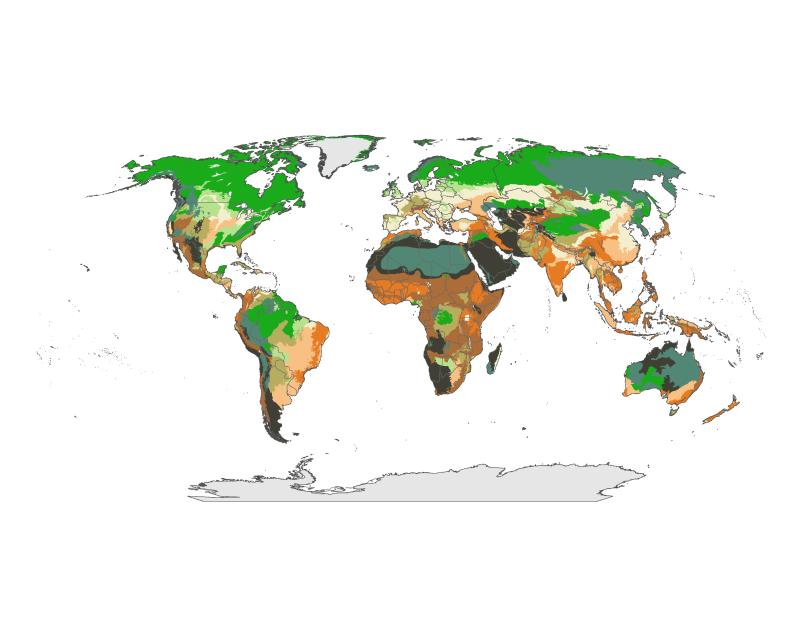
Phi Beta Iota: The color scheme is badly selected. In this graphic, green is bad, cream the worst. However, green is also where prosperity is virtually assured for the next quarter century — the new frontier.