Extracting content from a Web page can be a maddening process, requiring specialized scripts and time spent coding them. Taking a look at available tools, Softpedia touts “FMiner Pro 7.05.”FMiner Pro is advertised as a reliable application that allows users to easily handle Web content without scripts. The software can pull data from any page type, including https, plugins, JavaScript, and even complete data structures.
After the data is extracted much can be done with it:
“Extracted results can be saved to csv, Excel(xls), SQLite, Access, SQL Server, MySQL, PostgreSQL, and can specify the database fields’ types and attributes(eg, UNIQUE can avoid duplication of the extracted data). According to the setting, program can build, rebuild or load the database structure, and save the data to an existing database. Professional edition support incremental extraction, clear extraction and schedule extraction.”
FMiner Pro is available for a free fifteen-day trial to see how well it can perform. After viewing the specs, FMiner Pro is worth a shot. It can probably save coders hours by not having to write scripts and organizing Web content is a tedious job no one likes to do. Having a program to do it is much more preferable.
As part of QCRI’s Artificial Intelligence for Monitoring Elections (AIME) project, I liaised with Kaggle to work with a top notch Data Scientist to carry out a proof of concept study. As I’ve blogged in the past, crowdsourced election monitoring projects are starting to generate “Big Data” which cannot be managed or analyzed manually in real-time. Using the crowdsourced election reporting data recently collected by Uchaguzi during Kenya’s elections, we therefore set out to assess whether one could use machine learning to automatically tag user-generated reports according to topic, such as election-violence. The purpose of this post is to share the preliminary results from this innovative study, which we believe is the first of it’s kind.
My colleague Hemant Purohit at QCRI has been working with us on automatically extracting needs and offers of help posted on Twitter during disasters. When the 2-mile wide, Category 4 Tornado struck Moore, Oklahoma, he immediately began to collect relevant tweets about the Tornado’s impact and applied the algorithms he developed at QCRI to extract needs and offers of help.
A little-known plant with a truly bizarre name is now making headlines as a cancer killer, with the compound of the plant vanishing tumors in mice with pancreatic cancer.
Known as the ‘thunder god vine’ or lei gong teng, the Chinese plant is actually integrated into Chinese medicine and has been used for ages in remedying a number of conditions including rheumatoid arthritis.
According to the new research out of the University of Minnesota’s Masonic Cancer Center, the thunder god plant compound led to no signs of tumors after a 40 day period — even after discontinuing the treatment. Published in the journal Science Translational Medicine and funded by the National Institutes of Health, even the scientists working on the project were stunned by the anti-cancer properties of the compound. Known to contain something known as triptolide, which has been identified as a cancer fighter in previous research, it is thought to be the key component that may be responsible for the anti-tumor capabilities.
Study leader and vice chairman of research at the Cancer Center explained to Bloomberg how he was blown away by the effects of the simple plant:
“This drug is just unbelievably potent in killing tumor cells,” he said. – See more.
Click on Image to Enlarge
And just like with numerous other powerful substances like turmeric and ginger, mainstream science is still slowly confirming what many traditional practitioners have known for their entire lives. This is, of course, due to the fact that there is simply no money for major corporations in researching the healing powers of natural herbs and compounds such as the compound found in the thunder god vine. Turmeric and ginger, for example, have been found to be amazing anti-cancer substances that are virtually free compared to expensive and dangerous cancer drugs.
Nevertheless, the Big Pharma sponsored corporate scientists have managed to ignore these spices as much as possible. In fact, they have even been caught time and time again faking thousands of studies to fraudulently demonstrate the supposed value of pharmaceutical drugs pushed by major pharma juggernauts — many of which are later forced to pay millions in fines which only slightly stack up against their billions in profits.
Profits that are threatened by the many real studies that were performed by scientists examining the rejeuvenating power of cheap ingredients like turmeric, which has been found by peer-reviewed research available on PubMed to positively influence over 590 conditions.
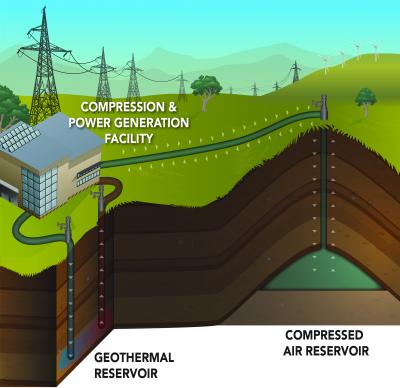
Study IDs 2 compressed air energy storage methods, sites for the Northwest
RICHLAND, Wash. – Enough Northwest wind energy to power about 85,000 homes each month could be stored in porous rocks deep underground for later use, according to a new, comprehensive study. Researchers at the Department of Energy's Pacific Northwest National Laboratory and Bonneville Power Administration identified two unique methods for this energy storage approach and two eastern Washington locations to put them into practice.
Compressed air energy storage plants could help save the region's abundant wind power – which is often produced at night when winds are strong and energy demand is low – for later, when demand is high and power supplies are more strained. These plants can also switch between energy storage and power generation within minutes, providing flexibility to balance the region's highly variable wind energy generation throughout the day.
Click on Image to Enlarge
“With Renewable Portfolio Standards requiring states to have as much as 20 or 30 percent of their electricity come from variable sources such as wind and the sun, compressed air energy storage plants can play a valuable role in helping manage and integrate renewable power onto the Northwest's electric grid,” said Steve Knudsen, who managed the study for the BPA.
Geologic energy savings accounts
All compressed air energy storage plants work under the same basic premise. When power is abundant, it's drawn from the electric grid and used to power a large air compressor, which pushes pressurized air into an underground geologic storage structure. Later, when power demand is high, the stored air is released back up to the surface, where it is heated and rushes through turbines to generate electricity. Compressed air energy storage plants can re-generate as much as 80 percent of the electricity they take in.
David Feitler, PhD, Senior Program Manager, NineSigma
As White Queen remarked in Lewis Carroll’s immortal story Through the Looking Glass, “…it takes all the running you can do to keep in the same place. If you want to get somewhere else, you must run at least twice as fast as that!” We all run after innovation just as fast as we can and sometimes we feel that it’s all we can do just to stay even with the competition. Sometimes it is good to pause for a moment and reflect on the role of innovation, what we’re doing currently and what we might do differently. The State of Ohio did exactly that in creating the Ohio Third Frontier’s Open Innovation Incentive, which they launched last year.
Open innovation (OI) is the systematic inclusion of parties outside your four walls and outside your existing networks. Companies practice open innovation because they want to reduce the time it takes to get to market, avoid getting trapped by their own thinking, and pursue with agility new opportunities outside their core expertise. Frequently the examples given for open innovation success are things like the iPod™, which wasn’t invented internally at Apple, or the Swiffer™ cleaning system that P&G acquired in its original form from a Japanese company. Those examples can cause one to lose sight of the value OI brings to non-consumer goods companies and to organizations smaller than Apple and P&G.
That was the thinking of the Ohio Third Frontier team when they considered what they could do to support economic growth in the State of Ohio. They recognized that open innovation is an important tool and a way to accelerate economic development in Ohio. The state also recognized that very large companies (greater than $1 billion in annual revenues) were doing this already, while companies in the $10 million to $1 billion range likely needed additional direction and support. They surmised that the expertise needed to incorporate these external technology searches didn’t reside in firms this size and that reliable partners were needed in the form of intermediaries with proven open innovation methods and processes. Thus was born the Ohio Third Frontier Open Innovation Incentive.
The Connecticut legislature has sent to the governor to sign a bill that would create a commission to develop a plan for, among other things:
“the diversification or conversion of defense-related industries with an emphasis on encouraging environmentally-sustainable and civilian product manufacturing. On or before December 1, 2014, the commission shall submit such report to the Governor and, in accordance with the provisions of section 11-4a, to the joint standing committee of the General Assembly having cognizance of matters relating to commerce.”
The commission “shall Advise the General Assembly and the Department of Economic and Community Development on issues relating to the diversification or conversion of defense-related industries” among other things.
According to Peace Action, sponsor State Senator Toni N. Harp from New Haven has said,
“The proposed Futures Commission will set up a framework that allows us to convert many of our military related jobs and infrastructure into non-military industries.”
This is a remarkable breakthrough that didn't just come out of nowhere:
“In November 2012, a ballot referendum passed in New Haven that called for moving the money from war to jobs rebuilding our infrastructure and human needs. This referendum won support nearly 6 to 1! This winter in Connecticut, the US Peace Council, No Nukes No War, the City of New Haven Peace Commission with the support of the state AFL-CIO and International Association of Machinists worked to get SB619 introduced in the state legislature calling for a Futures Commission whose goals is to investigate how to convert the weapons manufacturing industries to producing civilian, green products and retain and develop manufacturing in the state. The Commission that this bill creates will include representatives of labor, peace and environmental organizations.”