Abstract: Societies have been increasingly disintegrating, despite improving prerequisites for social integration. For Durkheim, the society integrates in a mechanical and in an organic way. Individuals in their interactions gradually habituate new rules. These are institutionalised into system structures and so integrate society mechanically from the bottom up. When new rules are imposed they restrict behaviours from the top down. Structuralist explanation (Giddens) is circular and does not err in a description of a process that is circular in nature. However, it fails to explain what connects mechanic and organic integration, where they meet and how they really produce the integrative result.
In an attempt to fill this gap, integration problem is the first reorganised from dual to triadic concept. This is needed to accommodate the problem in a mesoscopic context. Meso is the perspective from where the modelling of social processes is the most tractable “a priori” (Easterling, Kok, 2002). The case is illustrated with evaluation of the national energy program's impact on the territorial cohesion of Slovenia. Three measures of social integration are derived. A strong balance is a measure of the mechanical integration which controls for system's stability between its internal oppositions. Weak cohesion is a correlative measure of organic integration and reflects sustainability of cooperative achievements in the society.
In social research, the relative comparisons are often more expressive than absolute ones. So it makes sense also to distinguish when cooperation achievements are due to the one-sided and alienated efforts, like on the market, or by altruist, from situations when they results from shared and mutually beneficial contributions of all parties involved. The balanced cohesion appears more productive for social integration compared to asymmetrically achieved cohesion with winners and losers on ever perfecting market. So the third component of social integration is weak balance which describes mutuality of organic relations. Circular interpretation is not rejected here. We only propose it is conceptualised in a triadic frame with a central meso category, which is of soft logic, intermediary by its function but radical in its transformative consequences.
Actually, story is reasonably well known within USG in DC area. Scott Carmichael, DIA CI SA, wrote pretty good (and approved) book on case. But unfortunate facts remains that (1) DGI recruited her and ran her in place for a long time using reasonable standard of tradecraft and (2) she beat polygraph. DIA has now joined CIA and NSA in requiring polygraphs for all employees or assignees with staff-like access.)
Ana Montes has been locked up for a decade with some of the most frightening women in America. Once a highly decorated U.S. intelligence analyst with a two-bedroom co-op in Cleveland Park, Montes today lives in a two-bunk cell in the highest-security women’s prison in the nation. Her neighbors have included a former homemaker who strangled a pregnant woman to get her baby, a longtime nurse who killed four patients with massive injections of adrenaline, and Lynette “Squeaky” Fromme, the Charles Manson groupie who tried to assassinate President Ford.
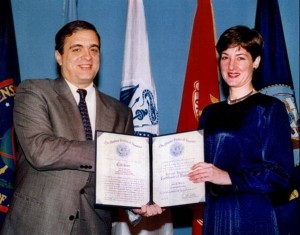
George “Slam Dunk”Tenet and His Cuban Counterpart
But hard time in the Lizzie Borden ward of a Texas prison hasn’t softened the former Defense Department wunderkind. Years after she was caught spying for Cuba, Montes remains defiant. “Prison is one of the last places I would have ever chosen to be in, but some things in life are worth going to prison for,” Montes writes in a 14-page handwritten letter to a relative. “Or worth doing and then killing yourself before you have to spend too much time in prison.”
Like Aldrich Ames and Robert Hanssen before her, Ana Montes blindsided the intelligence community with brazen acts of treason. By day, she was a buttoned-down GS-14 in a Defense Intelligence Agency cubicle. By night, she was on the clock for Fidel Castro, listening to coded messages over shortwave radio, passing encrypted files to handlers in crowded restaurants and slipping undetected into Cuba wearing a wig and clutching a phony passport.
‘Investigative journalism has never been this effective!' Publico The Kissinger Cables are part of today's launch of the WikiLeaks Public Library of US Diplomacy (PlusD), which holds the world's largest searchable collection of United States confidential, or formerly confidential, diplomatic communications. As of its launch on April 8, 2013 it holds 2 million records comprising approximately 1 billion words. WikiLeaks' publisher Julian Assange stated: “The collection covers US involvements in, and diplomatic or intelligence reporting on, every country on Earth. It is the single most significant body of geopolitical material ever published.”
I received an interesting bit of commission work earlier today – would I help someone plow up a bunch of astroturf. It sounded like an interesting test of my expanding social network analysis skills, so I agreed to take on the task.
I was given a list of six Twitter accounts. One had 2,000+ friends, two had 1,000+ friends, one had 500+ friends, and then there were two very small accounts that were suspected to be coordinators or handlers. Numbers like that are clearly beyond the query limits for Maltego, so the solution would have to be Gephi. I recently published my savetwit shell script, which exercises the python twitter package in order to collect as much information as possible on Twitter accounts. The process kicks out a couple of csv format files suitable for use as edge files in Gephi.
The accounts in question proved to have 4,300 friends and 5,200 links. This is labeled ‘anonymous’, it isn’t anything to do with Anonymous, it’s just a group that I don’t want to spook by mentioning their names.
. . . . . .
Click on Image to Enlarge
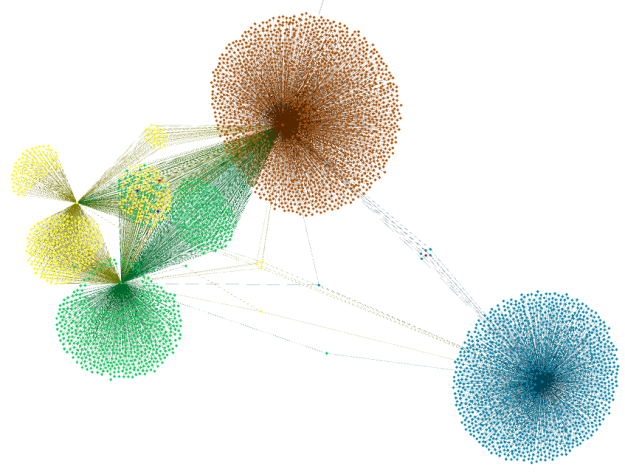
And here we have it – the tricolor battleground, with yellow/green on one side, and red on the other. The single red and two blue dots are what modularity shows us. I suspect that if these accounts were isolated, entered into Maltego, and manually colored for allegiance that this would be a three way tussle, and that the names in this portion of the graph are the ones that are lobbing verbal grenades at each other on a nightly basis.
Mary Ellen brings her lively and practical approach to how info pros can most effectively support the research efforts within their organizations and best leverage their econtent. This webinar, sponsored by Springer, was presented on April 18, 2013.
Mary Ellen presents her favorite super-searcher secrets and tips. This presentation was given at Computers in Libraries on April 8, 2013 in Washington, DC.
Mary Ellen shows how to get the most out of social media searching. This presentation was given at Computers in Libraries on April 7, 2013 in Washington, DC.
Mary Ellen surveyed business owners in the Association of Independent Information Professionals about their businesses. How much do they make? How many hours do they work? What is their biggest challenge? This 60-page report provides insight into info-entrepreneurship, and offers a benchmarking tool for both new and long-time business owners.