Penguin: Bandi Mbubi at TED – Demand a Fair Trade Cell Phone

02 Diplomacy, 05 Civil War, 07 Other Atrocities, 08 Wild Cards, 11 Society, Civil Society, Commerce, Commercial Intelligence, Corruption, Government, IO Deeds of War, Liberation Technology
0Shares
Who, Me?

Your mobile phone, computer and game console have a bloody past — tied to tantalum mining, which funds the war in the Democratic Republic of the Congo. Drawing on his personal story, activist and refugee Bandi Mbubi gives a stirring call to action. (Filmed at TEDxExeter.)  Bandi Mbubi would like to make sure that you are using a fair trade cell phone.

Bandi Mbubi grew up in the Democratic Republic of the Congo, formerly Zaire, experiencing first hand the political unrest and oppression which have since worsened there. As a student activist, Bandi suffered persecution and fled the country, seeking political asylum in the U.K. But Mbubi has kept his home country on his radar, noting how the mining of tantalum — a mineral used in cell phones and computers — has fueled the ongoing war there in which 5 million have died.

While Mbubi sees the cell phone as an instrument of oppression for this reason, he knows that phones can also bring great freedom. And so he has formed CongoCalling.org, a campaign to inspire both the public and companies that make electronics to pay attention to how tantalum used in consumer electronics is mined and traded.

Mbubi is also the Director of the Manna Society, a center for the homeless in South London, and a Trustee of Church Action on Poverty.

TED Video (9:22)

Eagle: Oil Lies, Oil Spills – Technology Sucks, Human Intelligence Rules

05 Energy, Commerce, Corruption, Earth Intelligence, Government
0Shares
300 Million Talons…

1)  All stakeholders in the Keystone Pipeline are lying to the public.  There are THREE sucking chest wounds in the Keystone Pipeline proposal:  a)  Canada cannot afford to use clean water it is running out of, to flush tar sands no one needs; and the USA does not need any more oil.  b)  The pipeline will NOT create jobs and it will be a curse to every community anywhere near it, externalizing costs to everyone along the way.  c)  The legacy refineries are lying in order to get the public to pay the cost of delivering very dirty crude that they will refine for EXPORT.

2)  Technology does NOT work as claimed.

3)  Human intelligence rules again.  What is LACKING is integrity at all points of the compass.

Few Oil Pipeline Spills Detected by Much-Touted Technology

InsideClimate News analysis of a decade of federal data shows general public detected far more spills than leak detection technology.

EXTRACT:

Between 2002 and July 2012, remote sensors detected only 5 percent of the nation's pipeline spills, according to data from the Pipeline and Hazardous Materials Safety Administration (PHMSA).

The general public reported 22 percent of the spills during that period. Pipeline company employees at the scenes of accidents reported 62 percent.

Anthony Swift, an attorney who has spent years researching pipeline safety for the Natural Resources Defense Council, was taken aback by the findings. Swift's organization opposes the Keystone XL, and he said he had always known that leak detection systems didn't catch most of the spills. But “the fact that 19 out of 20 leaks aren't caught is surprising, and certainly runs counter to a lot of rhetoric we hear from the industry,” he said.

Read full article.

Reference: Drafting the Shape of Cyber-Warfare

Advanced Cyber/IO
0Shares
Online PDF

Moving Towards Tallinn: Drafting the Shape of Cyber Warfare

Ashley S. Boyle, September 2012

Introduction

On September 3, 2012, the NATO Cooperative Cyber Defence Centre of Excellence1 (CCD COE) released a draft of the Tallinn Manual on the International Law Applicable to Cyber Warfare.2 The document was written at the request of the CCD COE by an International Group of Experts (IGE) comprised of legal and technical experts from academic and professional backgrounds.

The resulting 215-page draft is a peer-reviewed but unofficial document that examines whether and how
existing international legal frameworks governing the use of interstate force apply in the cyber environment.

Read full document.

From Contributing Editor Berto Jongman.

Jennifer Sims: The Future of Intelligence (3 Videos)

Movies
0Shares
Dr. Jennifer Sims

Interview: The future of intelligence (5:29)

In this first video (5 mins), Dr Sims looks at the information revolution – how the rise of the internet has fundamentally altered intelligence-gathering techniques, bringing challenges and opportunities in a globalised security environment.

The future of intelligence (part 2) (4:07)

In part two of my interview with world renowned intelligence expert and Visiting Professor at Georgetown University's Center for Security Studies Dr Jennifer Sims, we discuss the close relationship between internet penetration and government instability.

Dr Sims presents her theory about how the spread of ‘viral' ideas, through improved internet/communication mediums, can lead to rapid mobilisation of these ideas across the citizenry, which may force government instability. Dr Sims looks at examples in the Middle East and Africa, where internet penetration has quickly moved from 15% to 40% of the population, which she calls ‘the critical period where political instability can happen'. The rapid spread of communications is empowering to people and can be for good, says Dr Sims, but governments need to take notice.

The future of intelligence (part 3) (5:21)

Dr Sims talks about the tremendous change in intelligence studies in the US, with a significant number of well-known women reaching senior levels in the field. It is a testament to the national security studies programs at universities across the US, says Dr Sims, which are becoming ‘increasingly female in their composition' — not because they are looking at gender statistics but because they are ‘looking for who is good' when searching to bring people into programs.

Women are increasingly occupying key security and intelligence positions in the US, and Dr Sims encourages women in Australia who are interested in national security studies to pursue it as a career.

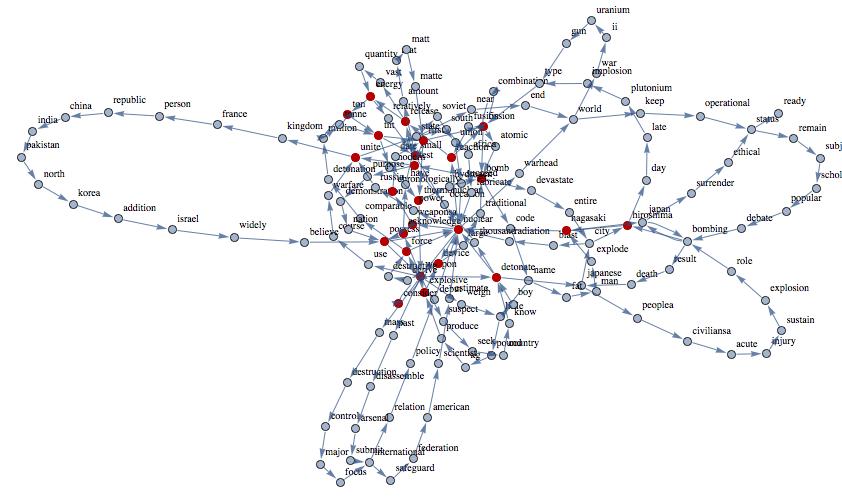
Graphic: Graph Entropy

Analysis, Balance, Collection, Graphics, ICT-IT, Innovation, Processing
0Shares
Click on Image to Enlarge

Source

Phi Beta Iota:  This would be even more interesting if citation analytics and disciplinary dictionaries could be cross-referenced, that would potentially identify MISSING words and concepts, and POTENTIAL relationships between disciplines now operating in isolation from one another.  There are many information pathologies buried within all existing texts and images, there appears to be no serious research on this aspect of basic research.

See Also:

Graphic: Information Pathologies

Graphic: Web of Fragmented Knowledge

Internet Economy Meta Language (Pierre Levy)

Robert Steele: Itemization of Information Pathologies

Michel Bauwens: Difficult Birth – the Financial Transaction Tax

Economics/True Cost, Innovation, Knowledge, Politics
0Shares
Michel Bauwens

Brilliant and funny video on the Tobin Tax  Via Willy De Backer

Video “Difficult Labour” for the financial transaction tax of Oxfam Germany with Heike Makatsch, Mark Waschke, Stephan Grossman & Rike Eckermann.

YouTube (2:08)

More info at: http://www.oxfam.de/schweregeburt

Music: The Communards – Don't Leave Me This Way

See Also:

A Tax Revolution – Replace All Taxes On Few with One Tiny Tax on All Transactions Including Stock and Currency Trades
….1 21st Century Governance Revenue (Plain English)
….2 21st Century Governance Revenue (Business-Speak)
….3 21st Century Governance Revenue (Economist-Speak)
….4 Dr. Edgar Feige, Professor of Economics
….5 References on Government Revenue and Economy
….6 Discussion of the APT Tax

Jon Lebkowsky: Bad Pharma – Lacking Intelligence AND Integrity

Commerce, Corruption, Economics/True Cost, Government, IO Impotency, Knowledge
0Shares
Jon Lebkowsky

According to Cory Doctorow at bOING bOING, physicians often prescribe drugs that are ineffective or harmful because pharmaceutical companies provide misleading data, according to an article by Ben Goldacre in the Guardian, “The drugs don’t work: a modern medical scandal.” Goldacre is the author of the forthcoming book Bad Pharma: How Drug Companies Mislead Doctors and Harm Patients. Summary from the caption on the photo above Goldacre’s article: “Drugs are tested by their manufacturers, in poorly designed trials, on hopelessly small numbers of weird, unrepresentative patients, and analysed using techniques that exaggerate the benefits.”

It’s a tough problem: you depend on your physician’s authority, and the authority of the healthcare establishment, to guide your decisions about health. Even if you trust your physician, can you trust the voices persistently whispering in his ear, especially if those voices are motivated by profit as a priority. Do pharma companies place their profit above your health? Don’t assume an easy answer – it’s complicated, though Goldacre’s book blurb suggests a belief that pharma uses the complexity as a cloak (“All these problems have been protected from public scrutiny because they’re too complex to capture in a sound bite.”)

Continue reading “Jon Lebkowsky: Bad Pharma – Lacking Intelligence AND Integrity”