Theophillis Goodyear: 1992 Explicit Warning Ignored by USA and Others

Earth Intelligence
0Shares
Theophillis Goodyear

World Scientists' Warning to Humanity (1992)

Union of Concerned Scientists

Some 1,700 of the world's leading scientists, including the majority of Nobel laureates in the sciences, issued this appeal in November 1992. The World Scientists' Warning to Humanity was written and spearheaded by the late Henry Kendall, former chair of UCS's board of directors.

INTRODUCTION

Human beings and the natural world are on a collision course. Human activities inflict harsh and often irreversible damage on the environment and on critical resources. If not checked, many of our current practices put at serious risk the future that we wish for human society and the plant and animal kingdoms, and may so alter the living world that it will be unable to sustain life in the manner that we know. Fundamental changes are urgent if we are to avoid the collision our present course will bring about.

THE ENVIRONMENT

The environment is suffering critical stress:

The Atmosphere
Stratospheric ozone depletion threatens us with enhanced ultraviolet radiation at the earth's surface, which can be damaging or lethal to many life forms. Air pollution near ground level, and acid precipitation, are already causing widespread injury to humans, forests, and crops.

Water Resources
Heedless exploitation of depletable ground water supplies endangers food production and other essential human systems. Heavy demands on the world's surface waters have resulted in serious shortages in some 80 countries, containing 40 percent of the world's population. Pollution of rivers, lakes, and ground water further limits the supply.

Continue reading “Theophillis Goodyear: 1992 Explicit Warning Ignored by USA and Others”

DefDog: Bottom Up Sharing of Books – A New Model?

Crowd-Sourcing, Knowledge, P2P / Panarchy
0Shares
DefDog

Further to the comment on Owl's previous post, “displacing the advertising model of book publishers; and those who pay for localized printing will be incentivized to donate the books to their local library….” it may be that the official libraries, too few and limited as they are, will be displaced as well.

The man who turned his home into a public library

By Kate McGeown

BBC News, Manila, 19 September 2012

If you put all the books you own on the street outside your house, you might expect them to disappear in a trice. But one man in Manila tried it – and found that his collection grew.

Hernando Guanlao is a sprightly man in his early 60s, with one abiding passion – books.

Click on Image to Enlarge

They're his pride and joy, which is just as well because, whether he likes it or not, they seem to be taking over his house.

Guanlao, known by his nickname Nanie, has set up an informal library outside his home in central Manila, to encourage his local community to share his joy of reading.

The idea is simple. Readers can take as many books as they want, for as long as they want – even permanently. As Guanlao says: “The only rule is that there are no rules.”

It's a policy you might assume would end very quickly – with Mr Guanlao having no books at all.

But in fact, in the 12 years he's been running his library – or, in his words, his book club – he's found that his collection has grown rather than diminished, as more and more people donate to the cause.

Read full article with photos.

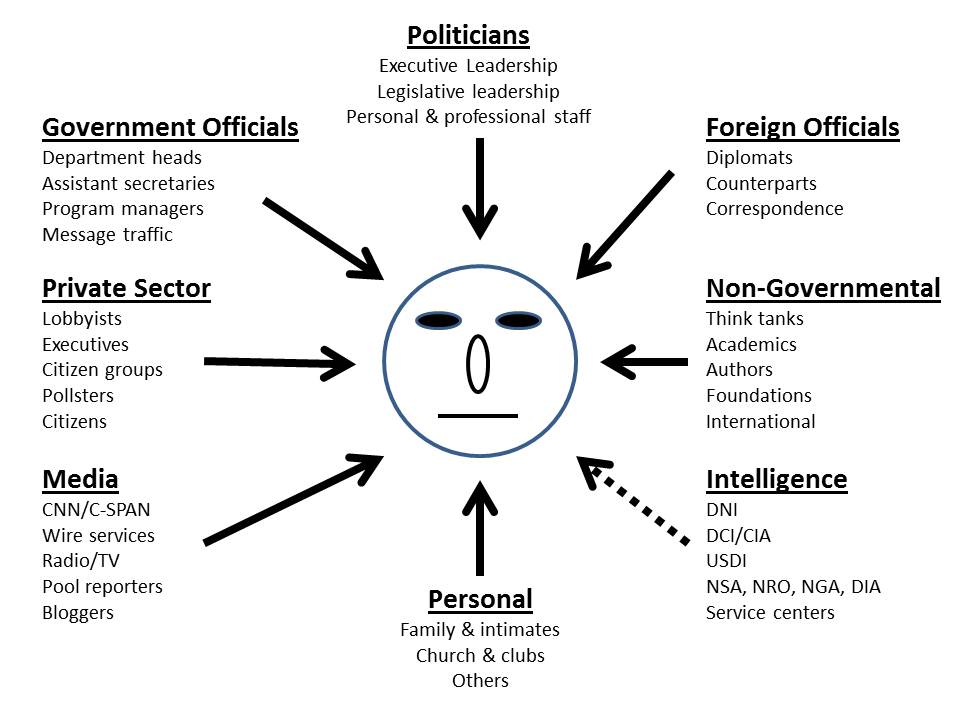
Graphic: Competing Influences on Policy, Acquisition & Operations – Intelligence Marginalized, Easy to Ignore

Corruption, Graphics, Political, Tribes
0Shares
Click on Image to Enlarge

Download as slide (ppt):Ā  Competing Influences

Credit:Ā  Jack Davis

2000 in Book (p. 53): ON INTELLIGENCE: Spies and Secrecy in an Open World (AFCEA, 2000)

2008 in Chapter (p. 100):Ā  Open Source Intelligence (Strategic) in Loch Johnson, Strategic Intelligence Volume II (Praeger, 2006)

Graphic: Top Ten Threats to Humanity – Relevance of Open Sources & Methods

Advanced Cyber/IO, Graphics, IO Deeds of Peace, Threats, United Nations & NGOs
0Shares
Click on Image to Enlarge

Download as ppt: Ā Ten Threats and Open Source

Original appearance:Ā  2008 Open Source Intelligence (Strategic)

Ten threats from:Ā  High-Level Panel on Threats, Challenges, and Change, A More Secure World: Our Shared Responsibility (United Nations, 2004)

Steven Aftergood: CRS on Poverty and on Intelligence

01 Poverty, 03 Economy, 06 Family, 11 Society, Congressional Research Service, IO Impotency
0Shares
Steven Aftergood

POVERTY IN THE UNITED STATES, AND MORE FROM CRS

“In 2011, 46.2 million people were counted as poor in the United States, the same number as in 2010 and the largest number of persons counted as poor in the measure's 53-year recorded history,” according to a timely new report from the Congressional Research Service.Ā  See Poverty in the United States: 2011, September 13, 2012.

Other new and newly updated CRS reports that have not been made publicly available include the following.

Intelligence Authorization Legislation: Status and Challenges, updated September 18, 2012

Latin America and the Caribbean: Fact Sheet on Leaders and Elections, updated September 17, 2012

Phi Beta Iota:Ā  The juxtaposition of a report from the Congressional Research Service (CRS) on poverty in America – a hot issue being kept under wraps at this time – with a report on the intelligence authorization bill by two experienced analysts new to the account (Richard Best finally retired and Al Cumin is on assigment elsewhere), is encouraging.Ā  In the latter instance, Richard F. Grimmett (CRS International Security analyst) and Rebecca S. Lange (an Air Force Fellow) demonstrate intelligence with integrity in tackling the militarization of intelligence and the excessive focus of intelligence on defense targets to the exclusion of all others (Whole of Government).

See Also:

Graphic: Intelligence Requirements Definition for the 21st Century

2008 Rebalancing the Instruments of National Power–Army Strategy Conference of 2008 Notes, Summary, & Article

DefDog: The Truth About Afghanistan – A Book, “No Worse Enemy”

Corruption, Cultural Intelligence, Government, Media, Military
0Shares
DefDog

Author Q&A

Afghanistan: ā€œIt’s Just Damage Limitation Nowā€

Briton Ben Anderson is a documentary filmmaker (the BBC, HBO, the Discovery Channel), but he turns to the written word in No Worse Enemy: The Inside Story of the Chaotic Struggle for Afghanistan. The book offers a gritty – and grim — assessment of the war.

Anderson embedded with U.S. and British troops for months in the southern part of the country from 2007 to 2011. He details corruption, incompetence, fear — by both allied troops and Afghan civilians — and a Groundhog Day kind of existence., where a battle fought for days has to be fought again, later. Most distressingly, he argues that the American and British publics are getting a misleading picture of progress on the ground. Battleland conducted this email chat with Anderson last weekend.

Amazon Page

Why did you write No Worse Enemy: The Inside Story of the Chaotic Struggle for Afghanistan?

I’d been travelling to Helmand for five years, first in 2007 with the Brits, then later mostly with the U.S. Marines, covering every major operation since the war in the south was taken seriously.

Despite new troops, extra resources and new polices, it kept getting worse.

It was more dangerous for me and the troops I was with, Afghan security forces didn’t seem to be improving, and perhaps most importantly, locals were not being won over but instead were complaining of civilian casualties, damage to their homes, being inconvenienced andĀ disrespected, or preyed upon by the Afghan police.

Yet in the second half of 2010, statements from Kabul, Washington and London kept talking of progress, goals being met and the Taliban being on their last legs.

This was the exact opposite of what I had been seeing, so I felt that I had to write this book.

Read full interview.

Continue reading “DefDog: The Truth About Afghanistan – A Book, “No Worse Enemy””

Owl: Expresso Book Machine Coming to CVS with Kodak as Partner

Innovation, Knowledge
0Shares
Who? Who?

This is going to get into the hands of many more people much more information, and this can't help but have consequences for the “global brain” and all kinds of social activism.

Soon You'll be Able to Go to CVS and Print a Book

Print-on-Demand Books Coming Soon to Thousands of Stores via Espresso Book Machine and Kodak Picture Kiosks

On Demand Books, the company behind the Espresso Book Machine, and Kodak are partnering to add print-on-demand technology to Kodak Picture Kiosks. That means consumers will be able to print paperback photo books, self-published books and the seven million backlist and public domain titles in On Demand’s catalog from retail chains such as CVS…There are 105,000 Kodak Picture Kiosks globally; you can find them in chains like CVS as well as photography stores, pharmacies and other retail outlets. The partnership with On Demand launches in the U.S. this year and will expand internationally in 2013.”

Read full article.

Phi Beta Iota:Ā  Kinko's then FedExOffice experimented with PerfectBind, the same concept, but at the time, not cost effective.Ā  Since fiction dominates the book marketplace, rather than non-fiction, the existing client base for CVS and other retail stores is a better target for this offering.Ā  At the same time, we anticipate that social media will do a much better job of pointing readers toward worthy reads, displacing the advertising model of book publishers; and those who pay for localized printing will be incentivized to donate the books to their local library.Ā  Amazon continues to ignore the human / local factor.Ā  Local libraries and local reading clubs could make this take off — group buys of specific books followed by donation to the library.

See Also:

Kodak, On Demand Books and ReaderLink Join Forces for In-Store Book Printing at Retail