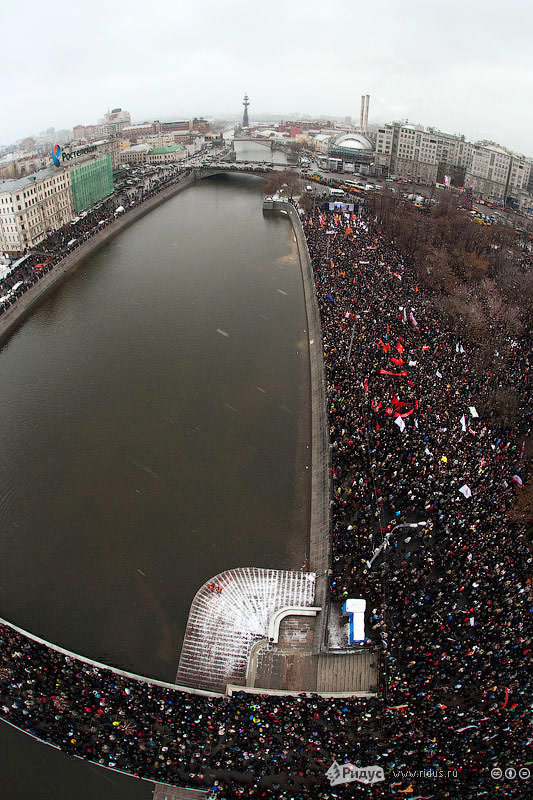
Open source protest, an organizational method that allows many, many small groups to come together to take on larger foes, has been spreading by leaps and bounds. It's now reached Moscow. A picture from today: The crowds on Moscow's Bolotnaya Square (and the spires of the Kremlin beyond). Here are some nice aerial shots.
Capture. Corporate power over government. It may seem like a dour topic (it is) and it may be hard to put it into perspective in our lives. How does it affect you and me? Lobbying, political influence, money in politics all seem very far away from daily life and it’s hard to see just where these issues touch our lives. So, let’s talk about it.
In the past couple of decades our country has been deeply divided on a number of topics but two issues stand out in the arena of corporate power over government: Health Care Legislation & War with Iraq.
. . . . . . . Two Examples Discussed: Health Care and Iraq . . . . . . .
This isn’t government of the people, for the people, by the people. It’s profit maximization for key industries and contractors with interests in military operation and healthcare. This is the essence of capture:corporate power has hijacked the language and purpose of government for their own ends. Democrat or Republican – it no longer matters at the national level because corporate money in politics has bought both parties.
If we put a number on it, people will try to make the number go up.
Now that everyone is a marketer, many people are looking for a louder megaphone, a chance to talk about their work, their career, their product… and social media looks like the ideal soapbox, a free opportunity to shout to the masses.
But first, we're told to make that number go up. Increase the number of fans, friends and followers, so your shouts will be heard. The problem of course is that more noise is not better noise.
In Corey's words, the conventional, broken wisdom is:
Follow a ton of people to get people to follow back
Focus on the # of followers, not the interests of followers or your relationship with them.
Pump links through the social platform (take your pick, or do them all!)
Offer nothing of value, and no context. This is a megaphone, not a telephone.
Think you're winning, because you're playing video games (highest follower count wins!)
This looks like winning (the numbers are going up!), but it's actually a double-edged form of losing. First, you're polluting a powerful space, turning signals into noise and bringing down the level of discourse for everyone. And second, you're wasting your time when you could be building a tribe instead, could be earning permission, could be creating a channel where your voice is actually welcomed.
Leadership (even idea leadership) scares many people, because it requires you to own your words, to do work that matters. The alternative is to be a junk dealer.
The game theory pushes us into one of two directions: either be better at pump and dump than anyone else, get your numbers into the millions, outmass those that choose to use mass and always dance at the edge of spam (in which the number of those you offend or turn off forever keep increasing), or
Relentlessly focus. Prune your message and your list and build a reputation that's worth owning and an audience that cares.
Only one of these strategies builds an asset of value.
Crowdfunding Nation:The Rise and Evolution of Collaborative Funding includes articles on crowdfunding's history, future, and its usefulness for social movements, how-to guides exploring the best practices for launching a campaign, the legal considerations of crowdfunding and, case studies of innovative and inspiring crowdfunding projects, and an interview with Kickstarter's Daniella Jaeger.
$2.99 now available in the Amazon Kindle store or as an ePub direct download, investigates this transformative tool and its many uses.
The failure of the so-called Super-Committee to come up with a plan for reducing the federal deficit has put the automatic sequestration process into play, at least for the time being. If executed, sequestration will impose arbitrary across-the-board spending cuts in the belief that reduced federal spending will reduce the deficit and reverse our economic malaise.
That a brute-force sequester will improve the economy is a contentious proposition, put it charitably. Opponents of the sequester argue that spending cuts by the federal government will depress demand and could even push the economy back into recession. The question of where the deficits are coming from is made doubly important by the threat of a sequester and the fact that we are on the cusp of a presidential election year.
No doubt, anticipating the collapse of the Super Committee, Congressman Chris Van Holland (D-MD), the ranking minority member of the House Budget Committee asked the Director of the Congressional Budget Office on 27 September to provide an estimate of portion of the deficit that is attributable to the economy's underutilization of capital and labour resources.
CBO's responded with a letter report hat estimated the federal deficit for 2012 would be one-third lower, or $630 billion instead of the $973 billion currently projected if the economy was running at full potential — see the attached pdf file.
I asked my friend Marshall Auerback, a financial commentator, for his evaluation of the CBO analysis.
Below, FYI, is Auerback's assessment to the CBO estimate.
——[Auerback Commentary]—–
CBO probably understates the effect of the recession on the deficit.. We do know that tax revenues as a percentage of GDP plunged in 2008.
COL Killebrew is generally a pretty smart guy. Here he makes three points I agree with:
a. The fiscal crisis is largely self-imposed;
b. Ground forces are going to be disproportionately screwed;
c. At least in the near term, “by, with, and through” rather than US unilateral is the option of choice;
and one that I don't:
d. US has the resources, expertise, and will to make the right choices. Don't agree with that, particularly regarding expertise and will.
The following video by Jonah Sachs, creative director at Free Range Studios has prompted me to get back to completing the next installment in this Essential Skills series. He does a beautiful job revealing the secrets of effective and high-impact storytelling.
One of the concepts Jonah presents is that of a “myth gap.” He defines ‘myth’ as the combination of Explanation + Meaning + Story. Historically, myths are the vehicles of culture. They provide a context and framework for the world, hopefully imparting wisdom, insight and guidance as to how we should live our lives. (ie – myth of Genesis). But sometimes, society falls in a myth gap.
Like now.
Another way of saying this is that the cultural narrative is broken.
. . . . . . .
So what are some stories shaping culture today?
Well here’s a few that I’ve been listening to and weaving into the architecture of my own mind:
Makers, hackers, prosumers, and cultural creatives are the driving force of the new economy.
It makes practical sense to support local economies, buy food that’s grown regionally when possible, and build resilience by creating infrastructures designed to weather uncertainty.
The “future of money” is about cooperation over competition. We’re llearning how to intelligently share resources, build value together, and display integrity in thought, word and action – which is then reflected in a boost of social currencies like reputation, influence, trust, authority, and access to opportunities.
Mindless consumption is uninspiring, and ultimately a distraction from engaging in the types of behavior that actually lead to sustained happiness. These include: spending time with people we love, having goals and actively working towards accomplishing them, and cultivating gratitude daily for having the opportunity to experience Life.
These are just a few narratives that keep me inspired and motivated these days.
What stories are guiding you towards a more meaningful future?
In today’s polarized and fractured narrative landscape, the winners are those who can get above the noise and weave new mythologies that act as a beacon of light for the path ahead. As a wise man once said: