Canadian Citizens Keep Lying on the Air Illegal

Advanced Cyber/IO, Civil Society, Cultural Intelligence, Government
0Shares

Robert F. Kennedy Jr.Robert F. Kennedy Jr.

President, Waterkeeper Alliance; Professor, Pace University

Huffington Post, February 28, 2011 09:54 PM

Regulators Reject Proposal That Would Bring Fox-Style News to Canada

As America's middle class battles for its survival on the Wisconsin barricades — against various Koch Oil surrogates and the corporate toadies at Fox News — fans of enlightenment, democracy and justice can take comfort from a significant victory north of Wisconsin border. Fox News will not be moving into Canada after all! The reason: Canadian regulators today announced they would reject efforts by Canada's right-wing Prime Minister, Stephen Harper, to repeal a law that forbids lying on broadcast news.

Canada's Radio Act requires that “a licenser may not broadcast … any false or misleading news.”

Continue reading “Canadian Citizens Keep Lying on the Air Illegal”

SPOT Connect: Any Cell Phone SatComm Capable

Autonomous Internet, Counter-Oppression/Counter-Dictatorship Practices, InfoOps (IO), International Aid, Open Government, Reform, Technologies, Tools
0Shares
Learn More

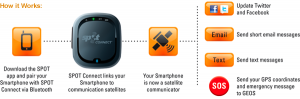
Today’s smartphones provide a level of social connection far beyond what we imagined just a few years ago. But when you go beyond the reach of the grid, your smartphone needs the help of SPOT Connect to keep you in touch with friends, family, and emergency personnel. Simply pair your smartphone with SPOT Connect, and get connected to a global satellite network that lets you send messages and GPS coordinates from virtually anywhere on the planet. Update Twitter and Facebook. Send email and text messages. Request non-emergency help from professional service providers. And in the case of a critical emergency, send an SOS message requesting emergency assistance.

Click to Learn More

WARNING NOTICE: This $169 device does NOT include the subscription fees associated with SATCOM.  There are some “relatively” low cost options, and a small crowd-sourcing effort to buy a satellite that will provide free SATCOM access to Africa, but the pieces are not there yet.  See Autonomous Internet for a larger discussion of the possibilities.

Tip of the Hat to Aaron Huslage for this pointer.

CrisisWatch N°91, 1 March 2011

04 Inter-State Conflict, 05 Civil War, CrisisWatch reports
0Shares

CrisisWatch N°91, 1 March 2011 (pdf)

Anti-government protests also took place in Oman and Djibouti.

In Afghanistan, the standoff continued between President Hamid Karzai and the opposition over the flawed September parliamentary election. A controversial special tribunal set up by Karzai – which the opposition condemns as unconstitutional – has started recounting votes in several provinces. With concerns growing over renewed tension if the tribunal reverses results, CrisisWatch identifies Afghanistan as a conflict risk alert for March. The political crisis came amid an upsurge of insurgent violence across the country.

Continue reading “CrisisWatch N°91, 1 March 2011”

John Seely Brown’s New Culture of Learning and US Unified Community Action Network (US UCAN)

Advanced Cyber/IO, Civil Society, Collective Intelligence, Commerce, Commercial Intelligence, Cultural Intelligence
0Shares
Gordon Cook

in a world of constant flux a person who is not curious is screwed.

John Seeley Brown

In the past eight weeks as I have become more familiar with Internet2’s award to build a backbone to connect upwards of 200,000 unified community anchor institutions into a national network and have put this knowledge alongside that of the peer to peer open knowledge resource Commons represented by Michel Bauwens, I had a gut feeling that somehow someway there is a connection yearning to be made between these two very disparate groups. There is nothing overly obvious in my construct. It is just a tacit feeling that there is a huge potential here.

One thing that I observed from listening to the lecture that I did not get out of the book is that there are ever evolving ways of interpreting one’s surroundings and what is happening. JSB used the same two examples of self-taught surfers in Hawaii and World of Warcraft generation of knowledge that he did in his April 2010 Power of Pull lecture. But by late June 2010 he had evolved these concepts in new interesting and refreshing ways. One point in the lecture that was quite critical indeed was the concept of study groups in the learning 21st-century terms as opposed to education the 19th century term. Success now is found to be dependent to a very large extent on one’s ability to form study groups and that these groups could enable a self-motivated socialized learning experience that a more solitary approach to some rigid curriculum could not. And of course in the world of constant technology change the idea of a rigid curriculum is found wanting.

Read full post….

See Also:

Arno “The Curious” Reuser

CONNECT First, the Collective Intelligence Will Happen Naturally

Review: The World Is Open–How Web Technology Is Revolutionizing Education

Continue reading “John Seely Brown's New Culture of Learning and US Unified Community Action Network (US UCAN)”

MIT on Economic Policy, Ignores Government Corruption

Uncategorized
0Shares

“If you’d asked me five years ago what would happen if the U.S. had unemployment in excess of 9% and every prospect of unemployment at incredibly high levels for some years to come, I’d have said there’d be overwhelming political demand for government to do something. In fact there isn’t. What’s happened is we’ve had a near collapse of the idea that government can do anything about this.”

Paul Krugman

Phi Beta Iota: MIT–as with other “establishment” organizations including the US military–just cannot bring itself to acknowledge that the US Government is corrupt, as articulated so ably by Matt Taibi of Rolling Stone in Griftopia–Bubble Machines, Vampire Squids, and the Long Con That Is Breaking AmericaSee also: (DVD): Inside Job.

Economic Policy Challenges: Macroeconomics and Fiscal Policy

January 27, 2011

These economists, MIT PhDs all, ponder what remains in the macroeconomist’s toolkit to pull the U.S., and much of the developed world, out of recession. They discuss aspects of fiscal and monetary policy that may prove useful in spurring recovery, as well as the complicating matter of politics.

Moderator

Ricardo Caballero PhD '88

Ford International Professor of Economics and Department Head, MIT

Event Host

Bill Gertz: Foreign Terrorists Killed US Economy

Uncategorized
0Shares
Who, Me?

The below article was posted on the Drudge Report tonight … it would be laughable if it wasn't being billed as serious news, in my humble opinion.

Financial terrorism suspected in 2008 economic crash
Pentagon study sees element

By Bill Gertz-

The Washington Times
8:54 p.m., Monday, February 28, 201

Evidence outlined in a Pentagon contractor report suggests that financial subversion carried out by unknown parties, such as terrorists or hostile nations, contributed to the 2008 economic crash by covertly using vulnerabilities in the U.S. financial system.  Read more….