People for a Smarter Planet offers a dynamic and intelligent network of activities, conversations and discussions you can participate in to help build a sustainable and smarter world. Or, if you just want to hang around and listen, that's okay too.
Phi Beta Iota: Now imagine if they had a Strategic Analytic Model and could offer up a zip-code based web platform for enabling transparency and connecting the dots across the ten threats and twelve policies, one dollar at a time. Or a World Brain & Global Game…
1,000 U.S. scientists are involved in exascale development, but China and Europe have stepped up their investment, IBM warns
Full Story Online
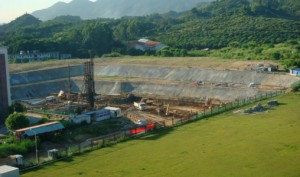
Computerworld – WASHINGTON — To make a point about China's interest in supercomputing, David Turek, IBM's vice president of deep computing, displayed a slide with a picture depicting a large construction site for a building that will house a massive computer.
Speaking at an IEEE-USA forum here on Thursday, Turek pointed to a photo (below) of a supercomputing center being built in Shenzhen, China, and said, “That's a truck — that's a big truck, that's a big hole, and that's going to be a big building. And that's only the first building they are going to build there.”
Phi Beta Iota: Michael O'Hanlon of the Brookings Institute got it right years ago–the ONLY revolutionary technology at the time, and still today, is C4I but better called C2I today because command & control is dead: communication, computing, and intelligence (decision-support, not secrets). Energy revolutions are coming along, including paintable solar energy molecules, but C2I is where it's at for now. CISCO continues to refuse to create cradle to cradle routers that also deliver Application Oriented Network (AON) ownership and rule making to the point of creation, so this is one big need we have; the other is a complete open source software suite of tools that delivers the eighteen functionalities defined by CATALYST et al in 1985-1989. Finally, but actually first, we want free reliable simple cell phones for the five billion poor. THAT is the super-computer of now and ever.
If the construction of settlements in the West Bank is meant to be on hold, why are Israeli buyers being offered new properties on Palestinian land at knock-down prices?
The housing project currently under construction in Almon offers enticingly priced, spacious family homes with a garden and a view. The surrounding neighbourhood, also known as Anatot, sits on a ridge overlooking the Judean hills, near Jerusalem, a blaze of cultivated greenery in the parched landscape. Residents have a relaxed air, and newcomers who have recently relocated from Jerusalem wish they'd made the move years ago. If I were a prospective house-buyer, I'd be charmed. But I would not be looking here – because Almon is in the occupied West Bank.
Phi Beta Iota: Worth a full read. This explains both the economics of the illegal settlements, and the massive financial resources that the Israeli government offers in favor of illegal settlements, at the same time that it lies to a complacent US Government that knows better, but prefers to sacrifice its diplomatic integrity for the pretense of progress.
A sample of a documentary that shows the creative heart that sustains a community regardless of what happens. Grass roots democracy in action. Updated version.
The term “Social Good” has been bandied about, but pinning down exactly what it means in concrete terms can sometimes be tricky. Is social good the same as “the common good”? Is it the same as normal fundraising? Is it just online giving, or is it particular to social networks and web trends?
Social good is equal parts online fundraising and advocacy via social networks. While the Internet has been used before by non-profits and charities to raise money, social good implies more than just money changing hands. Social good campaigns often combine the ability of the Internet to find, introduce and bond communities around a common interest. That interest, in this case, is usually a problem worth fixing.
Where social good starts to get fuzzy is just how that problem gets fixed. Social good campaigns can be about building safe, entirely free, online support communities, spreading awareness through updates, raising cash, or a combination of all three.
Phi Beta Iota: Our colleague Harrison Owen keeps stressing that the Internet has unleashed a new level of self-organization, and we are starting to realize how right he is. What is missing in our view is a service of common concern that provides public intelligence about the true costs of every good and service (while outing corruption through transparency), and at the same time connects the one billion rich to the five billion poor one micro-need at a time BUT visible to those who wish to aggregate needs and solutions. This is illustrated in Graphic: Global Range of Nano-Needs and discussed coherently and in detail in 2010 INTELLIGENCE FOR EARTH: Clarity, Diversity, Integrity, & Sustainability.
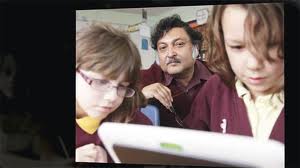
Education scientist Sugata Mitra tackles one of the greatest problems of education — the best teachers and schools don't exist where they're needed most. In a series of real-life experiments from New Delhi to South Africa to Italy, he gave kids self-supervised access to the web and saw results that could revolutionize how we think about teaching.
About Sugata Mitra
Sugata Mitra's “Hole in the Wall” experiments have shown that, in the absence of supervision or formal teaching, children can teach themselves and each other, if they're motivated by curiosity… Full bio and more links
Phi Beta Iota: Harrison Owen recommended this. He has spent his life nurturing self-organizing systems. This is one of the most moving, impactful ideas and presentations we have seen in our lifetime. This is one of the keys.