Search: Integrity

Ethics, Searches
0Shares

We worship at the altar of integrity, for us “God” is integrity manifest in all things at all times. Hence, Hell is what we have now, with corruption rampant, true costs concealed and externalized to the public, and a potential paradise lost to the ten high-level threats to humanity: poverty, infectious disease, environmental degradation, inter-state conflict, civil war, genocide, other atrocities, terrorism, and transnational crime.

FIRST, a definition of INTEGRITY.

1.   The quality or state of being complete; unbroken condition; wholeness; entirety
2.  The quality or state of being unimpaired; perfect condition; soundness
3.  Consistency of actions, values, methods, measures, principles, expectations and outcomes
4.  Moral soundness; honesty; freedom from corrupting influence or motive

SECOND, a short discourse on INTEGRITY IN CONTEXT.

1.  Clarity of spirit, mind, and body is essential to COMMUNICATE with INTEGRITY
2.  Diversity of view, membership, and perspective is essential to THINK with INTEGRITY
3.  INTEGRITY in personal and group ACTION is essential to achieve SUSTAINABILITY.

Hence, the subtitle of our latest book,

INTELLIGENCE FOR EARTH: Clarity, Diversity, Integrity, & Sustainability

Now here are the headlines that bear most on this topic within this Blog.

Journal: Reflections on Integrity & Design

Reference: Integrity–Without it Nothing Works
Reference: Integrity–Without it Nothing Works II
Reference: Integrity–Without It Nothing Works III

See Also:

Continue reading “Search: Integrity”

Event: 1-4 Nov Santa Clara CA CloudExpo

Uncategorized
0Shares
Event Home Page

The Only Enterprise IT Event in 2010 Covering the Entire Scope of the Cloud Computing Spectrum

Cloud computing is steadily becoming an integral part of the enterprise computing environment.

Cloud Expo was announced on February 24, 2007, the day the term “cloud computing” was coined. That same year, the first Cloud Expo took place in New York City with 450 delegates. This coming November 2010, Cloud Expo is returning to Santa Clara with more than 5,000 delegates and over 100 sponsors and exhibitors.

“Cloud” has become synonymous with “computing” and “software” in two short years. Cloud Expo is the new PC Expo, Comdex, and InternetWorld of our decade. By 2012, more than 50,000 delegates per year will participate in Cloud Expo worldwide.

Journal: Solar Panel Molecules

05 Energy
0Shares

Jon Lebkowsky

Self organizing solar panels

by jonl on September 18, 2010“Scientists at MIT have discovered molecules that spontaneously assemble themselves into a pattern that can turn light into electricity — essentially a self-creating solar panel. In a petri dish.” [Link]

I was wondering if this discovery has a practical application. A commenter has the same question, someone else answers:

The implication of the addition of an ‘additive’ to disassemble into a liquid ‘soup’ is that the stuff can be sprayed/painted onto a surface. It also means that it can be mixed with polymers and woven into materials etc.

Paint or spray your house/car/boat/aircraft with it, and decide you want a different colour? No problem, spray the additive/solvent and it comes off.

(Thanks to Audrey Thompson for the pointer.)

Phi Beta Iota: This takes biomimicry to a very high level.  Consider that Nokia now has cell phones that do not need the electrical grid–they repower from ambient energy.  Consider that foot (walking) power can now go easily into a battery on the belt from which various peripherals including a cell phone can be powered.  What is finally happening, in the nick of time, is the discovered of whole systems engineering.  There is no need to hack the planet, the planet was perfect before we got here–we are finally hacking humanity and evolving our consciousness in a better direction.

Journal: Government as Client, Three Levels of Smart

Cultural Intelligence, Government, Methods & Process
0Shares

Steve Denning

Radical management: what to do when your customer is the government

One constraint on implementing radical management is that the customer is on a different path altogether. A frequent example is where your customer is a government bureaucracy. You are aspiring to delight your client, and your client is saying, “Don’t bother with me such questions. Just deliver what the specifications ask for.”

. . . . . .

…realistically, most government organizations are not even trying to practice radical management. One way of understanding how they function is to recognize that organizations operate at three levels, using a schema proposed by Ranjay Gulati in Reorganize For Resilience: Putting Customers At The Center Of Your Business (Boston: Harvard Business Press, 2009)

Level 1: “You take what we make.”

Level 2:  “We believe that our offerings will be useful to you.”

Level 3: “We seek to understand and solve your problems with our offerings”

While radical management is operating at level 3, most government organizations are still stranded at level 1. They are paying scant attention to their stakeholders. Often they have not even taken any decision as to who their primary stakeholders are. As a result, no one really knows what the purpose of the organization is. The managers in such organizations typically follow rules and procedures, rather than systematically consider: how could we deliver more value sooner? These organizations are the quintessential bureaucracy, and the management is quintessentially Dilbertian.

Phi Beta Iota: The government is full of good people trapped in a bad system.  We've decided that in addition to educating the five billion poor one cell call at a time, we have to give government employees an easy to use cell tether to a World Brain that helps them evolve the consciousness of government from the bottom up.

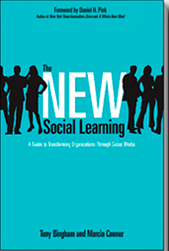
Review (Guest): The New Social Learning–A Guide to Transforming Organizations Through Social Media

5 Star, Best Practices in Management, Communications, Culture, Research, Economics, Education (General), Information Society, Intelligence (Commercial)
0Shares
Amazon Page

Phi Beta Iota: two reviews are provided, one from the blogsphere (Tip of the Hat to Pierre Levy at LinkedIn, and one from Amazon.  If not obvious, this new trend in organizational learning assures that “secret” organizations will get dumber and dumber as time goes by.

Authors:  Tony Bingham and Marcia Connor

I (Bill Ives) was very pleased to receive a review copy of The New Social Learning by Tony Bingham and Marcia Conner. Tony is President and Chief Executive Officer of the American Society for Training & Development (ASTD). Marcia is a Partner at Altimeter Group, founder of the Twitter chat #lrnchat, and writes the Fast Company column “Learn at All Levels.”

Getting a chance to read this timely work excited me for several reasons. First, I began my consulting career in the learning space in the 80s and have remained convinced of its importance for accelerating business performance. I presented at several ASTD session during this period. Second, Marcia was also a colleague of mine at Pistachio Consulting where we did some projects together. I had a chance to review an earlier version of one of the chapters of this book. But most importantly, it is the first book I have seen to help organizations understand and harness the huge workplace learning potential of social media and enterprise 2.0.

Continue reading “Review (Guest): The New Social Learning–A Guide to Transforming Organizations Through Social Media”

Reference: One Group’s View of Nokia’s Future

Blog Wisdom
0Shares
LinkedIn Telecom Group's View on Future of Nokia

NOTE: The document is not active–the links for the author's carried over but are not active. To see individual author's contributions grouped together just sort the table by column two, no header row, ascending, or search by name.

Journal: 20th Century Clunkers vs 21st Century Slims

ICT-IT, IO Sense-Making
0Shares
Steve Denning

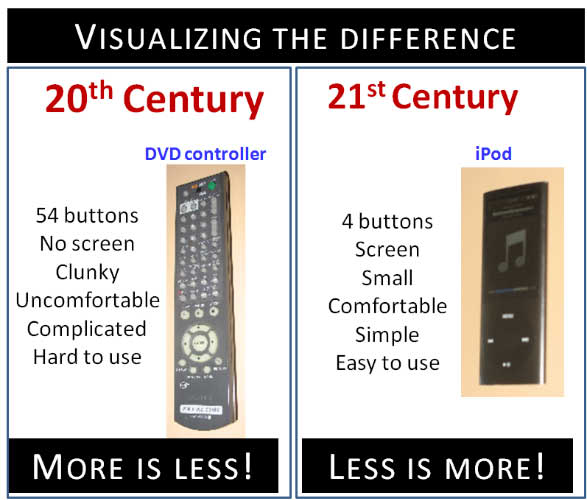
Visualizing the difference between 20th and 21st Century management

I wrote last month about the biggest difference between 20th and 21st Century management. I said there that management in the 20th Century was about achieving a finite goal: delivering goods and services, to make money. Management in the 21st Century by contrast is about the infinite goal of delighting customers; the firm makes money, yes, but as a consequence of the delight that it creates for customers, not as the goal.

That’s a fairly abstract account of the difference.  What does it mean in practice?  Let’s bring that down to earth with a visual embodiment of it.

Network On Call Not In Hand

Read the entire Blog Post

Phi Beta Iota: It's not just about functionality and ease of use–it is about what the handheld allows you to access, leverage, exploit, share, and made sense of.  The handheld is a key, nothing more.  That is why smart phones are history.  It is the collective intelligence of all humans that is smart, first one with a dumb device and a full range of M4IS2 services in the cloud wins.  Google is math hashing digital garbage–we are not betting on them.

See Also:

Graphic: Epoch B Multinational Network Rising
2008 COLLECTIVE INTELLIGENCE: Creating a Prosperous World at Peace
Complexity & Catastrophe (91)
Complexity & Resilience (99)