One percent see it as the top problem today, down from 46% in 2001
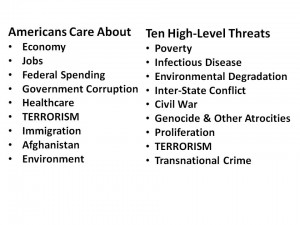
PRINCETON, NJ — Nine years after the terrorist attacks of Sept. 11, 2001, 1% of Americans mention terrorism as the most important problem facing the country, down from 46% just after the attacks.
. . . . . . .
Still, Americans rated economic issues such as the economy, jobs, and federal spending, as well as corruption in government and healthcare, even higher. They rated terrorism as more important than immigration, Afghanistan, and the environment.
EXTRACT 1: According to Manpower Inc., the global job-placement company, the nation has a gaping disconnect between openings and qualified candidates – a gap contributing to around 3 million unfilled U.S. jobs – which in turn hampers growth.
EXTRACT 2: Talent shortages span a broad scale, from engineers who can contribute to global development teams to electricians, mechanics and other specialized machine-shop skills that have seen waves of retirees exit the workforce in recent years without a commensurate wave of apprenticeships to replace them.
EXTRACT 3: “Notwithstanding all our best efforts in attempting to fix the system with recent improvements in workforce development, the pipeline is broken,” Sullivan said. “The fact that virtually all (kindergarten through 12th grade) education in southeastern Wisconsin is based solely on a college prep curriculum, with no exposure to industrial arts, means we are not feeding the market with the right skill sets.”
EXTRACT 4: Resigned they might not find the exact candidates they need, even from abroad, employers will begin to abandon the notion of the ideal candidate. Instead, they will seek the most “teachable fit.” This is a new breed of job candidate – folks who lack some qualifications “but whose capability gaps can be filled in a timely and cost-effective way.” Employers who are willing to set up in-house training academies increasingly will look outside their traditional industries.
by: Melvin A. Goodman, t r u t h o u t | News Analysis
EXTRACT 1: The defense budget is, in fact, out of control, increasing funding for both near-term and long-term programs and activities.
EXTRACT 2: In addition to unprecedented military spending, the Pentagon has gained increased leverage over the $75 billion intelligence community as well as increased influence over the national security and foreign policies of the United States.
EXTRACT 3: Spending on intelligence has tripled since 9/11, marking the rise of a national security state that finds all branches of government, even the judiciary, bowing to the demands of the military and intelligence communities. Like the Bush administration, the Obama administration used the state secrets privilege to block a lawsuit by former CIA prisoners who were tortured in overseas prisons. We have had four directors of national intelligence in the past five years, and they have failed to correct the decline in strategic intelligence or strengthen the overall intelligence apparatus.
Melvin A. Goodman
EXTRACT 4: Since 9/11, the national security process has been in a state of decline with a dearth of statesmen and an abundance of shadows on issues dealing with Iraq, Afghanistan, terrorism, insurgency and, now, cyber-war that are swaying the actions of American policymakers.
I've fallen in love with EmpowerMind and what they are doing for our country
and the world to assist young people, and folks of all ages, to become
exceptional learners and therefore exceptional contributors to society.
WordPress works best with the shortest possible searches, plus patience. Using the middle column to get to Graphics/Africa also works. Here is what you were looking for.
I am in this book, but that is not saying a great deal since I came out from under cover with permission after Alvin Toffler built the chapter on “The Future of the Spy” around me, in War and Anti-War: Making Sense of Today's Global Chaos.
Based on the lack of authorship, details, and the kludge of names, I was tempted to give this a three but went to a four solely because it is probably a good illustration of the range of information about CIA officers that is online today AND the price is sensational. This is a very fairly priced book, and for that alone I do recommend its purchase.
I suggest to you that this article is a keeper, that David Woods gets it. While it focuses on the Army, I think it's applicable in significant part to the other
David Wood Biography
DoD military Services, particularly to the Marine Corps, and to one or two non-DoD Federal agencies have been close partners in the national security effort.
V/R,
REDACTED
In the 10th Year of War, a Harder Army, a More Distant America
The U.S. Army now begins its 10th continuous year in combat, the first time in its history the United States has excused the vast majority of its citizens from service and engaged in a major, decade-long conflict instead with an Army manned entirely by professional warriors.
This is an Army that, under the pressure of combat, has turned inward, leaving civilian America behind, reduced to the role of a well-wishing but impatient spectator. A decade of fighting has hardened soldiers in ways that civilians can't share. America respects its warriors, but from a distance.
“A lot of us are here because society has no further use for us,” he said. “The Army has become home for a lot of restless souls who can never really go back.





 Online Distillation?