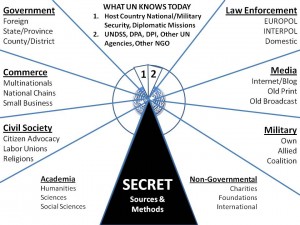
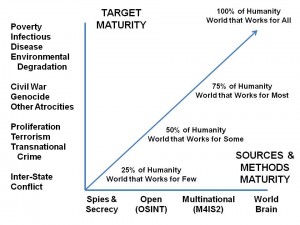
Phi Beta Iota: We are detecting a fascinating evolutionary process within the United Nations “system” which is not a system at all, more like an archipelago with a different cat in charge of each island. Information-sharing is coming into vogue, but more importantly, the United Nations, perhaps stimulated by the report of the United Nations High-Level Panel on Threats, Challenges, and Change, A more secure world: our shared responsibility, appears to finally be realizing that all threats are connected and that poverty is the foundation for all of the other threats thriving–one cannot defeat transnational crime (threat #10) without first addressing poverty (threat #1).
With the top United Nations anti-drug official urging concerted global action to “break the vicious circle between insecurity and underdevelopment” being increasingly fuelled by criminal networks, drug smugglers and human traffickers, the Security Council today called on the world body’s Member States to increase international and regional cooperation to tackle transnational organized crime.
The Council invited Secretary-General Ban Ki-moon, who opened today’s meeting, to consider transnational threats as a factor in conflict prevention strategies, conflict analysis, integrated missions’ assessment and planning and to consider including in his reports, as appropriate, analysis on the role played by those threats in situations on the Council’s agenda. [Phi Beta Iota: Emphasis Added.]
UNITED NATIONS (Reuters) – International criminal gangs and traffickers are exploiting large geographic blind spots where radar, satellite or other surveillance is minimal or nonexistent, the U.N. crime and drugs czar said on Wednesday.
Antonio Maria Costa, head of the Vienna-based U.N. Office on Drugs and Crime (UNODC), told members of the 15-nation U.N. Security Council that countries must improve their systems of sharing intelligence to reduce these surveillance gaps.
“We need a change in attitude,” Costa told the council. “It is time to regard information sharing as a way of strengthening sovereignty, not surrendering it.”
Yet another contemptuous snub to US “peace” efforts. Biden ought to tell them to go to hell and turn around and fly home … but he won't, thus confirming again the our pusilanimous acquiescence to Israeli policies that hurt and humiliate the United States
Chuck
Israel OKs new settlement work despite slowdown
By AMY TEIBEL, Associated Press Writer, 8 March 2010
JERUSALEM – Israel authorized the construction of 112 new apartments in the West Bank despite a pledge to slow down settlement building, the government disclosed Monday — enraging the Palestinians just a day after they reluctantly agreed to resume peace talks.
Full Story Online
Phi Beta Iota: The time has come to crush Israeli genocide against the Palestinians and Israeli theft and waste of water from Arab aquifers. We protest the continued use of taxpayer funds to arm and supply dictators in the Middle East and the Israeli genocide machine. A regional water authority and a two-state solution that leaves Jerusalem as an international neutral zone wouild appear to be called for, and easily affordable if we divert the money we now waste on war to waging peace in the Middle East. Gandhi said it best: “Palestine is to the Palestinians as France is to the French.”
I was forced to buy this book as part of a twelve book review for an international organization, and even though it was a business expense, this kind of greed pricing makes me urge all authors to use Print on Demand services and bypass the publishers entirely. Having read the book now, I can assure the reader that this is worthwhile ONLY as a library book on loan. As an independent publisher myself, I could publish this book for $39.95, give Amazon its 55%, and still cover my costs and then some (sell one third of the print run, the rest is profit).
The book is very well put together, with 24 authors that together cover history, Islamic and Jewish water law, eight countries, and five regions, finishing up with the most valuable portion of the book, a discourse on trends with some excellent tables, but no visualization of note. “New Media” is going to bury publishers like this, they are ten years behind the meaningful presentation curve.
Two key points to place this book in context:
1) The law is chaotic, driven by corporate interests, and generally out of touch with reality and with science.
2) The law is unenforceable at the local level and I believe international law will soon be unenforceable at the national level.
The editorial intent is to focus on “issues of architecture, agency, adaptiveness, accountabily, access, and allocation.”
Despite the excellence of the individual contributions, I give this book a three for two reasons: the greed pricing that makes the book unaffordable to the Amazon reader; and the larger lack of context–this is a book about law for lawyers, not a book about where the law is right and wrong and where it should go. Useful as a starting point, this does not help as much as the first book I recommend above, which is also reasonably priced.
The editors have done an excellent job of summarization. In discussing the changing characteristics of governance (by many) as opposed to government (by one), they draw on the collection as a whole to list seven fragmentations:
01 Geographical fragmentation (goverance must be multi-level and multi-national)
02 Functional fragmentation (“world bodies” versus public interest bodies)
03 Resource fragmentation (dispersed actors that I note need harmonization through shared information)
04 Interest fragmentation (harder to reconcile)
05 Norm fragmentation (national, corporate, and social all in conflict)
06 Policy fragmentation (still struggling to find ways to share information and reach consensus)
07 Decision-making and implementation fragmentation (Epoch A going down, Epoch B rising)
The book tends to gloss over the reality that corporate interests are funding and driving the UN and other international water bodies, but I do find their short summary of the Dublin Conference useful and list the four principles here:
01 Notion of finite and necessary nature of water
02 Need for participatory approach at all levels of management
03 Central role of women in water management [rather strangely presented by authors as also tied to the need to recognize water as an economic good–vice a human right]
04 Establishment of multi-stakeholder forums
The authors discuss a theory of change and are very weak on this point. Ted Gurr and others do it better. Revolutionary change occurs across the political-legal, socio-economic, ideo-cultural, techno-demographic, and natural-geographic domains, and these are all deeply inter-connected with one another and with the psycho-social nature of the individuals, most of whom are being radicalized and will no longer tolerate colonial-era practices maintained by corrupt elites.
The conclusion is most helpful and tables are used to good effect.
Differential factors leading to difference water laws including water geography, economic dependence, history and hydro-politics, and importance to ecosystems.
Forces leading to converging [or not] domestic water law and policy include civilization, religion, conquests, communism, international codification, environmentalism, epistemic communities, and globalization.
Colonial influences interacting with tribal and religious derivations in the Middle East and Africa are dissected by this book but I cannot help feeling that this kind of effort deals with the elephant's shadow rather than the elephant itself. Never-the-less, a superb effort.
The table on page 399 on key water principles is very helpful and worthy of retension.
+ Water law principles include sovereignty, equity, and avoidance of harm.
+ Human rights principles include participation, conflict resolution, prior informed consent, and human rights generally.
+ Environmental law principles include environmental impact assessments, sustainable development, precautionary approach, polluter pays principle, decentralization, open international economic system, and notification (of accidents).
The table on page 400 addresses water principles from other sources of governance.
+ Water rights based on ownership, appropriation, and licensing
+ Sectoral approach to water; different laws relevant to water in different fields
+ Gender bias concerns: ownership and appropriation often only possible by males
+ Contextual governance
+ State regulation of contracts
The book concludes that the law needs to open up to other disciplines (see the Graphic on Web of Fragmented Knowledge); that institutions must change [or be replaced]; and that fairness must be a primordal attribute of water law.
Amazon limits me to ten links. ALL links are active at Phi Beta Iota the Public Intelligence Blog.
Phi Beta Iota: We strongly recommend McGovern's article be read in its entirety. Key points:
1. US has no mutual defense treaty with Israel and no order to the US military to support Israel is Constitutionally valid without a Senate validation.
2. Israel will not get away with a USS Liberty atrocity on Admiral Mike Mullen's watch.
3. Washington is remains a moral and intellectual cesspool with the White House lacking a strategic analytic model, intelligence (decision-support) or any clue as to how to restore democracy and prosperity in America and peace in the rest of the world. Partisanship–uninformed partisanship–is what runs the White House today and it is NOT WORKING.
4. C/JCS has the right idea but the wrong company–no one now working in the US national security “establishment” has the combination of brains and integrity to actually propose a strategic analytic model; a reconstruction of secret intelligence so it provides non-secret decision-support to everybody now flying deaf, dumb, and blind in the NCA; and a redirection of the Pentagon so its budget funds the four forces after next–reform can be revenue and jobs neutral!
President Obama is at a fork in the road. He can stick with business as usual–partisanship, polling, and proxies that pay lip service to concepts like “national security,” or he can commit to creating a national strategy that gets a grip on reality and then connects means, ways, and ends to achieve a prosperous world at peace. From where we sit, C/CJS is the only person with both the right idea and the courage to speak the truth in public. Three immediately useful references:
A massive cultural tsunami is sweeping round the world as the five billion poor acquire Information and Communication Technologies (ICT), and the one billion rich realize that the era of Empire Rule Of, By, and For the Few is over. Happily, this is a revolution in human affairs that will be non-violent for the simple reason that no redistribution of existing wealth can match the infinite new wealth that the entrepreneurial poor can create for themselves when empowered with ICT.
Great search–no such thing. Obama received a concept for inter-agency governance placed under the door of his hotel room in Des Moines, Iowa (shown to the Secret Service detail first), but he and Plouffe and Axelrod blew off all attempts to prepare the Obama team to actually govern. Obama has Emanuel and Axelrod, nothing more, and they are destroying his Presidency. Pelosi, Reid, Panetta, and the rest of them are no help at all—there is not a strategic thought to be had among the whole bunch.
We've done what we could to put ideas on the table for the past 21 years, and it's like throwing pearls before swine–they eat the pearls and the public gets goose-shit.
Just over 100 years ago, as the nineteenth century drew to a close, big business in America was synonymous with productivity, quality, and success. “Economies of scale” meant that big railroads and big oil companies could move cargo and supply energy cheaper than their smaller competitors and, consequently, became even larger.
But there also proved to be a dark side to size and in the first decade of the 20th century mainstream opinion turned sharply against big business for three reasons. [Click on headline for complete original post.]
Phi Beta Iota: The earlier literature represented by Small is Beautiful and Human Scale has now been dramatically reinforced by literatures on civilization building, collective intelligence, common wealth, and so on (other lists). They all boil down to keeping power at the lowest level possible. Aggregated power is bad for democracy–this applies to big government just as it does to big banks, and it applies especially to the ludicrous notions of world government (as opposed to a world brain, where every node is unique and independent).




 Greed Pricing, Useful Content,