
Review: China Safari–On the Trail of Beijing’s Expansion in Africa

5 Star, Country/Regional, Culture, Research, Economics, Information Operations, Water, Energy, Oil, Scarcity
0Shares
Amazon Page

5.0 out of 5 stars Engaging, Earnest, New Insights, a Great Contribution

February 22, 2010

Serge Michel, Michel Beuret, Paolo Woods (Photos)

Of the modest number of books focused on China in Africa, this is one of the two best, and both are unique–if you buy only one, at least read my summary of the other, China into Africa: Trade, Aid, and Influence Whereas this book is direct journalism with wonderful color photos and direct ground-truth stories, China Into Africa is a best in class collection of academic essays.

Sixteen full pages of color photos in the middle of the book were unexpected and a complete delight.

On balance between the two books, this one taught me more and provided insights I could not get elsewhere to include the clear understanding, documented across multiple encounters by the authors, that the Chinese consider any Chinese business area or housing area of, by, and for their Chinese workers, to be sovereign territory of China immune to indigenous inspection or intervention.

Highpoints for me:

+ Africa is undergoing a huge transformation, and in combination, the infusion of Chinese infrastructure with the discovery of new energy fields and the growing need of all for what Africa has, is creating a perfect environment for a wealth explosion, and the US is missing it.

+ US has given up in Africa, in large part because the US Government other than the military does not have the resources, the human capital, the area knowledge, or the innate interest to actually do something strategic. The Chinese, in contrast, are unifying and pacifying Africa with infrastructure and commerce, while gaining direct access to natural resources that they can take possession of at half the market value by controlling the supply chain and no doubt lying about how much they are extracting.

+ Chinese presence in Africa is vertically and horizontally integrated, to include relatively thorough exploitation of what I have named the eight tribes of intelligence (academic, citizen-civil sector, commercial, government, law enforcement, media, military, and non-governmental), the Chinese appear to be way ahead of the US and all others in the Information Operations (IO) domain.

Continue reading “Review: China Safari–On the Trail of Beijing's Expansion in Africa”
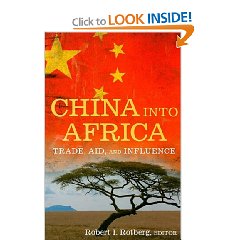
Review: China into Africa–Trade, Aid, and Influence

4 Star, Country/Regional, Diplomacy, Economics, Water, Energy, Oil, Scarcity
0Shares
Amazon Page

4.0 out of 5 stars One of Two “Best” on China in Africa

February 22, 2010

Robert I. Rotberg, contributing editor

Of the modest number of books focused on China in Africa, this is one of the two best, and both are unique–if you buy only one, at least read my summary of the other, China Safari: On the Trail of Beijing's Expansion in Africa. Whereas t his book is a best in class collection of academic essays, China Safari is direct journalism with wonderful color photos and direct ground-truth stories.

While this book good easily be five stars in terms of staid academic documentation and reasonable insights, is just does not give me–nor does the other book–a 360 degree view aided by a few maps and charts. This is all print, and while there is a great deal of detail, the over-all synthesis and analysis is not there–each piece stands on its own. Here are my distilled notes.

01 Rotberg China's Quest for Resources, Opportunities, and Influence in Africa
+ Third era in Chinese-African relations, first was in the 600-700 AD period
+ Since 2006 China has displaced Europe and is set to displace the USA within the decade
+ India and Japan are pushing back in Africa, but weakly
+ China is building infrastructure as a means of capturing below-market price direct access to natural resources
+ China's neutral non-interventionist policies have opened doors closed by Western human rights badgering
– Downside is the substandard goods that China is dumping, and sub-price, displacing local economy suppliers
– Downside is Chinese labor brought in, thousands as a time, not hiring or training local labor
– US Government generally “ill-prepared” to monitor or understand China's broad presence in Africa
– Neither the African Union nor any of its regional economic commissions have a China strategy or policy
Continue reading “Review: China into Africa–Trade, Aid, and Influence”

Journal: Commentary on Moonlighting at the CIA

Government, Intelligence (Government/Secret), Leadership-Integrity
0Shares
Thomas Leo Briggs

In a 1 February 2010 article adapted from the his forthcoming book, ‘Broker, Trader, Lawyer, Spy: The Secret World of Corporate Espionage,' Eamon Javers wrote:

Full Story Online

“In the midst of two wars and the fight against Al Qaeda, the CIA is offering operatives a chance to peddle their expertise to private companies on the side — a policy that gives financial firms and hedge funds access to the nation’s top-level intelligence talent, POLITICO has learned.”

“The never-before-revealed policy comes to light as the CIA and other intelligence agencies are once again under fire for failing to ā€œconnect the dots,ā€ this time in the Christmas Day bombing plot on Northwest Flight 253.”

“But sources familiar with the CIA’s moonlighting policy defend it as a vital tool to prevent brain-drain at Langley, which has seen an exodus of highly trained, badly needed intelligence officers to the private sector, where they can easily double or even triple their government salaries. The policy gives agents a chance to earn more while still staying on the government payroll.”

Commentary Below the Fold

Continue reading “Journal: Commentary on Moonlighting at the CIA”

Contributing Editor: Marcelo Henrique de Ɓvila (Brazil)

01 Brazil, Authors & Editors
0Shares
Marcelo Henrique de Ɓvila

“I believe Logics, Linguistics, Semiotics, Philosophy and Information Science are disciplines that play key roles in Intelligence. As an Intelligence student and researcher, I am interested in investigating the foundations of Intelligence, focused on Intelligence Analysis, according to an inter and transdisciplinary approach, inspired by Biology and guided by Critical Thinking”.

Brazilian ISR Auditor with interdisciplinary background. Former Chancellery Officer at Brazilian Ministry of External Relations. Bachelor Degree in Agronomist Engineering at the Federal University of Uberlândia, Estate of Minas Gerais. Master Degree in Molecular Biology at the University of Brasilia. Diploma in Strategic Intelligence (CSIE 2009), and in Defence Resources Management (CGERD 2008), both at the Brazilian National War College (Escola Superior de Guerra/Ministry of Defense). Diploma in Intelligence Analysis at the Brazilian Intelligence Agency School. Associate student of the Centre for Research on Architecture of Information at the University of Brasília.

Chief Editor of the Blog InteligĆŖncia Brasil and Coordinator of InteLingua Project, a not-for-profit international mass collaboration initiative aimed to translate open source Intelligence literature. Ā  Curriculum Lattes Online

Journal: 21 Years Late, An Inkling of Discovery

08 Wild Cards, Methods & Process, Military
0Shares

Marcus Aurelius

Military Launches Afghanistan Intelligence-Gathering Mission

Full Story Online

By Joshua Partlow

KABUL — On their first day of class in Afghanistan, the new U.S. intelligence analysts were given a homework assignment.

First read a six-page classified military intelligence report about the situation in Spin Boldak, a key border town and smuggling route in southern Afghanistan. Then read a 7,500-word article in Harper's magazine, also about Spin Boldak and the exploits of its powerful Afghan border police commander.

The conclusion they were expected to draw: The important information would be found in the magazine story. The scores of spies and analysts producing reams of secret documents were not cutting it.

“They need help,” Capt. Matt Pottinger, a military intelligence officer, told the class. “And that's what you're going to be doing.”

The class that began Friday in plywood hut B-8 on a military base in Kabul marked a first step in what U.S. commanders envision as a major transformation in how intelligence is gathered and used in the war against the Taliban.

Last month, Maj. Gen. Michael T. Flynn, the top U.S. military intelligence officer in Afghanistan, published a scathing critique of the quality of information at his disposal. Instead of understanding the nuances of local politics, economics, religion and culture that drive the insurgency, he said, the multibillion-dollar industry devoted nearly all its effort to digging up dirt on insurgent groups.

“Eight years into the war in Afghanistan, the U.S. intelligence community is only marginally relevant to the overall strategy,” he wrote in a paper co-authored by Pottinger and another official and published by the Center for a New American Security.

Phi Beta Iota: DoD mind-set time lags are quite consistent with those of other bureaucracies.Ā  They are just 21 years late.Ā  See the two original publications below:

1988Ā  Commandant of the Marine Corps “Global Intelligence Challenges of the 1990's

1992Ā  USMC GM-14 “E3i: Ethics, Ecology, Evolution, and Intelligence–An Alternative Paradigm

and so on…..sadly, DoD is still in lip service mode and is about to implode DIOSPO.Ā  In Ripley's “Believe It Or Not” column, the joint briefing created by Joe Markowitz and Robert Steele, with help from loyal frustrated DoD personnel who do want to get it right, has not been read and is not being acted on.Ā  If anyone is interested, see both briefings here:

2009 DoD OSINT Leadership and Staff Briefings

See also:

Search: The Future of OSINT [is M4IS2-Multinational]

Search: jack davis analytical support for peace

Analysis, Searches
0Shares

This really should be two searches.

Seaching for Jack Davis yields:

Who’s Who in Public Intelligence: Jack Davis

Search: jack davis and his collected memoranda o

Search: The Future of OSINT [is M4IS2-Multinational]

Graphic: The UN and the Eight Tribes of Intelligence

Searching for analytic support for peace yields:

Journal: Haiti–Ready for a Rapid-Response Open-Source-Intelligence-Driven Inter-Agency Multinational Multifunctional Stabilization & Reconstruction Mission…

Search: United Nations Intelligence Training

Search: Multinational Engagement (Intelligence)

Search: Strategic Analytic Model

Journal: Strategy versus Secrecy

1998 Open Source Intelligence: Private Sector Capabiltiies to Support DoD Policy, Acquisition, and Operations

1997 Creating a ā€œBare Bonesā€ Capability for Open Source Support to Defense Intelligence Analysis

1990 Expeditionary Environment Analytic Model

Search: four levels intelligence analysis

Journal: Intelligence & Innovation Support to Strategy, Planning, Programming, Budgeting, & Acquisition

Reference: Earth Intelligence Network Concept for Execution

Book: INTELLIGENCE FOR EARTH–Finished Less Fwd/Afwd

Journal: DoD Mind-Set Time Lags Most Fascinating

Looking for Anomalies in All the Wrong Places

Continue reading “Search: jack davis analytical support for peace”

Journal: Haiti Update 21 February 2010

03 Environmental Degradation, 07 Other Atrocities, 08 Wild Cards
0Shares

U.N. aid chief ‘disappointed' with Haiti earthquake relief efforts

UNITED NATIONS — The United Nations' top humanitarian relief coordinator has scolded his lieutenants for failing to adequately manage the relief effort in Haiti, saying that an uneven response in the month after the devastating Jan. 12 earthquake has undercut confidence in the world body's ability to deliver vital assistance, according to a confidential e-mail.

The criticism from John Holmes, the head of the U.N. Office for the Coordination of Humanitarian Affairs, focuses on the United Nations' sluggish implementation of its humanitarian “cluster strategy,” which assigns key U.N. relief agencies responsibility for coordinating the delivery of basic needs in 12 sectors, including water and shelter.

Haiti: Earthquake Situation Report #22

WASH partners are currently reaching 850,000 people with 5 litres of water a day, covering 83 per cent of the target population. A 75 per cent gap remains, however, in the provision of latrines.

The Health cluster warns that there is a risk of a large-scale outbreak of diarrhea, given the present overcrowding, poor sanitation and lack of effective waste disposal systems in spontaneous settlement sites.

Rain brings more misery to Haiti earthquake survivors

Aid agencies warn of new humanitarian disaster if shelter and sanitation not improved quickly

Study: Quake damage twice value of Haiti economy

A report by three Inter-American Development Bank economists found last month's earthquake to be more devastating than the 2004 Indian Ocean tsunami was for Indonesia, and five times deadlier than the 1972 earthquake that leveled Nicaragua's capital.

Reference: Haiti Rolling Directory from 12 January 2010