Army Lt. Col. Paul Yingling, one of the best officers I've encountered in Iraq, recently gave a talk at the Marine base at Quantico, Va., about military leadership and adaptation.
Nine key factors are examined by BGen McMaster in his talk to the Office of the Director of National Intelligence (ODNI). Answers question on why we were so unprepared. Final paragraph of trip report:
Can’t get much from a database and IT networks, but contractors keep pushing and we keep buying. But what really need is experts from anywhere, context, and also need to ask the soldiers! Make Phebe Marr a general! Also pay attention to: Charles Tripp, R. Kadeiri, Sarah Chayes, Barnett R. Rubin and Ahmed Rashid, Michael Howard, Frontline piece on Children of the Taliban, Fariad Ali Han on borders. Educate analysts (and self-educate) on the place, don’t waste time training them on the process.
Strongly Recommended by BGen McMaster in Talk at ODNI
January 20, 2010
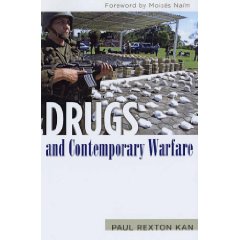
Paul Rexton Kan
This is one of two books strongly recommended, with deep admiration, by BGen McMaster, USA (Ret) speaking to the Office of the Director of National Intelligence (ODNI) on 19 January. The four page trip report on his remarks about improving intelligence in support of the multinational mission in Afghanistan has been posted to Phi Beta Iota the Public Intelligence Blog.
I have bought this book and will review it within two weeks. CIA got its start in drug running and money laundering in Viet-Nam, and has at best facilitated the expansion of the drug zone and at worst financed it–at least half of the billion dollars a year that were channeled into Afghanistan by CIA via the Pakistani Intelligence Service are assumed (by me) to have been stolen, and today Pakistan is the primary site for the processing of Afghan opium into #4 heroin for onward shipment to Europe and elsewhere.
General McMaster also recommended Organizations at War in Afghanistan and Beyond. In my own review of Ghost Wars: The Secret History of the CIA, Afghanistan, and Bin Laden, from the Soviet Invasion to September 10, 2001 From that review pending my doing a complete proper review of this book:
The most important point in the book is not one the author intended to make. He inadvertently but most helpfully points to the fact that at no time did the U.S. government, in lacking a policy on Afghanistan across several Administrations, think about the strategic implications of “big money movements.” I refer to Saudi Oil, Afghan Drugs, and CIA Cash.
The greatest failure of the CIA comes across throughout early in the book: the CIA missed the radicalization of Islam and its implications for global destabilization. It did so for three reasons: 1) CIA obsession with hard targets to the detriment of global coverage; 2) CIA obsession with technical secrets rather than human overt and covert information; and 3) CIA laziness and political naiveté in relying on foreign liaison, and especially on Saudi Arabia and Pakistan.
My bottom line: the $75 billion a year for secret intelligence is not producing intelligence, only waste and profit. We are killing our troops in the field by being incompetent at intelligence. That breaks my heart.
Strongly Recommended by BGen McMaster in Talk at ODNI
January 20, 2010
Abdulkader H. Sinno
This is one of two books strongly recommended, with deep admiration, by BGen McMaster, USA (Ret) speaking to the Office of the Director of National Intelligence (ODNI) on 19 January. The four page trip report on his remarks about improving intelligence in support of the multinational mission in Afghanistan has been posted to Phi Beta Iota the Public Intelligence Blog.
I have bought this book and will review it within two weeks. The key point that General McMaster made in referencing the book is that the author of this book has it right, there is no such thing as a leaderless jihad, and it is vital to be able to identify, understand, and interdict the often obscure means by which a jihad “organization” is formed and operated.
The most important point in the book is not one the author intended to make. He inadvertently but most helpfully points to the fact that at no time did the U.S. government, in lacking a policy on Afghanistan across several Administrations, think about the strategic implications of “big money movements.” I refer to Saudi Oil, Afghan Drugs, and CIA Cash.
The greatest failure of the CIA comes across throughout early in the book: the CIA missed the radicalization of Islam and its implications for global destabilization. It did so for three reasons: 1) CIA obsession with hard targets to the detriment of global coverage; 2) CIA obsession with technical secrets rather than human overt and covert information; and 3) CIA laziness and political naiveté in relying on foreign liaison, and especially on Saudi Arabia and Pakistan.
Provided for information as representative of the increased consciousness across America of the inconsistency between a two-party tyranny and the democratic values inherent in the Constitution and the Republic.
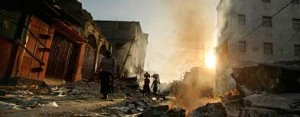
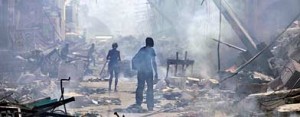
PORT-AU-PRINCE, Haiti – The most powerful aftershock yet struck Haiti on Wednesday, shaking more rubble from damaged buildings and sending screaming people running into the streets eight days after the country's capital was devastated by an apocalyptic quake.
The extent of additional damage or injuries caused by the magnitude-6.1 temblor was not immediately clear, AND Prime Minister Jean-Max said the government was sending a plane and an overland team to check on the situation in Petit-Goave, the center of this morning's aftershock.
The U.S. Geological Survey said Wednesday's quake was centered about 35 miles (60 kilometers) west-southwest of Port-au-Prince and 6.2 miles (9.9 kilometers) below the surface — a little further from the capital than last week's epicenter was.
“It kind of felt like standing on a board on top of a ball,” said U.S. Army Staff Sgt. Steven Payne. The 27-year-old from Jolo, West Virginia was preparing to hand out food to refugees in a tent camp of 25,000 quake victims when the aftershock hit.
The world still cannot get enough food and water to the hungry and thirsty, one week after an earthquake shattered Haiti's capital.
The airport remains a bottleneck and the port is a shambles. The Haitian government is invisible, nobody has taken firm charge, and the police have largely given up.
The Doctors Without Borders cargo plane carrying 12 tons of medical equipment, including drugs, surgical supplies and two dialysis machines, was turned away three times from Port-au-Prince airport since Sunday night despite repeated assurances of its ability to land there, the group said.
The 12-ton cargo was part of the contents of an earlier plane carrying a total of 40 tons of supplies that was blocked from landing on Sunday morning. Since January 14, Doctors Without Borders has had five planes diverted from the original destination of Port-au-Prince to the Dominican Republic. These planes carried a total of 85 tons of medical and relief supplies.
Full Story Online
U.S. Diverts Spy Drone from Afghanistan to Haiti.
As part of the Haiti relief effort, the U.S. military is sharing imagery from one of its high-end, high-flying spy drones, the RQ-4 Global Hawk.
Sharing imagery from a spy drone may sound like an unusual move, but it's part of a larger push within the Pentagon to declassify and share imagery in stability operations and disaster relief.
SOUTHCOM, in fact, seems to be taking a page from STAR-TIDES. The command has set up two collaborative portals: One that is accessible to partner nations, international organizations, NGOs and academia; a second, designated “for official use only” (i.e., unclassified, but restricted) that is open to users across the Department of Defense.
The game hit the Internet on July 25, 2007. With a title reminiscent of a Bruce Lee epic or — a much more dangerous allusion for Beijing bureaucrats schooled in tumultuous history — an echo of “Outlaws of the Marsh” (tales of 12th century Chinese Robin Hoods), “Incorruptible Fighter” riveted Chinese cyber-audiences who had an angry yen (or a yuan) for tarring, feathering and then executing corrupt government officials.
Yes, winning the game entailed eliminating government crooks. China Daily described the game as “the story of a man who fights corrupt officials and purifies himself by improving morality and ethics. After weathering various hardships and weeding out the bad guys, he finally gets to embrace a corruption-free world in which people live peacefully.”
China Daily credited government workers in the city of Ningbo (Zhejiang Province, eastern China) with creating the game. A commenter at StrategyPage.com (writing on Aug. 20, 2007) said this was true and provided additional details: Besides nailing crooked leaders, players could get even with the leaders' kids “and their bikini-clad mistresses.”
Recipe for a blockbuster. The game had sex, mayhem and graphic revenge extracted from arrogant, thieving officials protected by a Kafka-esque system they controlled.
Alas, the game itself had no happily ever after. “Incorruptible Fighter” disappeared from the Internet on Aug. 5, 2007. Who shut it down? That was never quite clear, but Internet commenters argued it scorched “exposed nerves.”
Indeed it did. Real world corruption threatens China's government and economy, and its stability. Chinese President Hu Jintao said in October 2007, “Resolutely punishing and effectively preventing corruption bears on the popular support for the party and on its very survival.” While the demise of the Communist Party (which has corrupt and reformist factions) would ultimately benefit China, a Chinese civil war featuring nuclear-armed regional warlords is a geo-strategic nightmare.
Corruption — from petty graft by the county commissioner to the mega-theft of billions by tyrants — is a global affliction. Corruption coupled with systemic lack of accountability produces more than cynicism and anger. In the developing world, it steals the future, condemning millions to poverty.
Phi Beta Iota: Global crime takes in $2 trillion a year. HALF of that goes to pay off corrupt govvernment officials. Lawrence Lessig has stated his intent to focus on outing and reducing corruption, and we join him–corruption is not just about money, but about Deep Secrecy, Sweet-Heart Deals, Informal Privileges, etcetera. We need to either clean up our government at every level, or systematically replace every person who refuses to be transparent with one who embraces transparency in the public interest. That is the heart of Public Intelligence.

 Thursday, January 22, 2009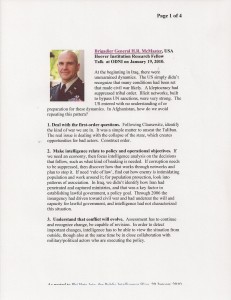
 Strongly Recommended by BGen McMaster in Talk at ODNI


 The extent of additional damage or injuries caused by the magnitude-6.1 temblor was not immediately clear, AND Prime Minister Jean-Max said the government was sending a plane and an overland team to check on the situation in Petit-Goave, the center of this morning's aftershock.