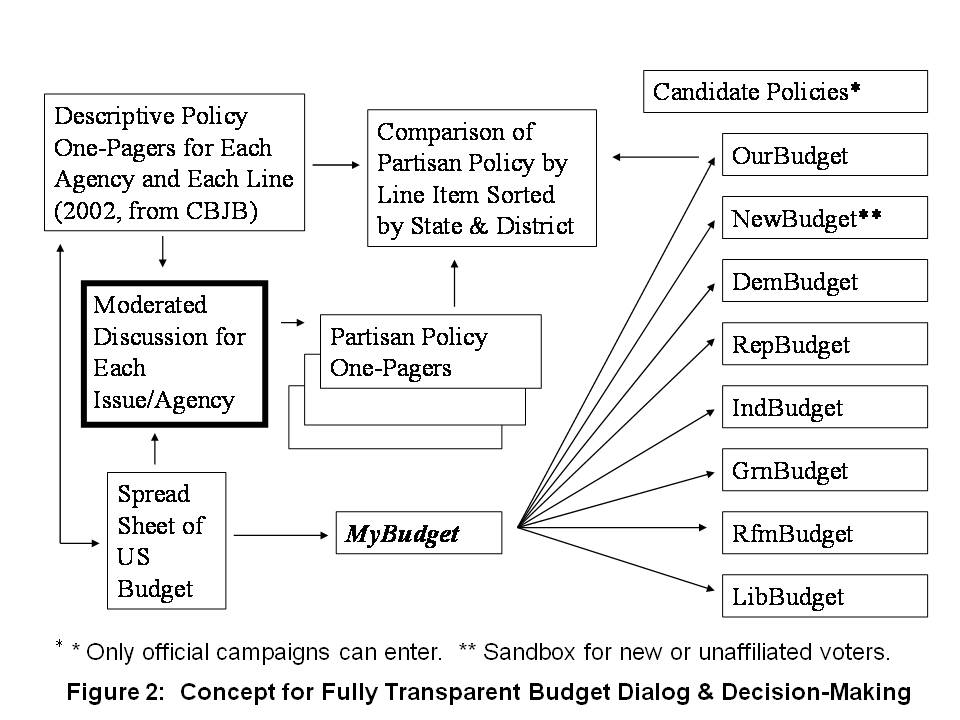
Created by and the exclusive intellectual property of Robert Steele, shared under Creative Commons commrcial exploitation forbidden.

The truth at any cost lowers all other costs — curated by former US spy Robert David Steele.
Created by and the exclusive intellectual property of Robert Steele, shared under Creative Commons commrcial exploitation forbidden.
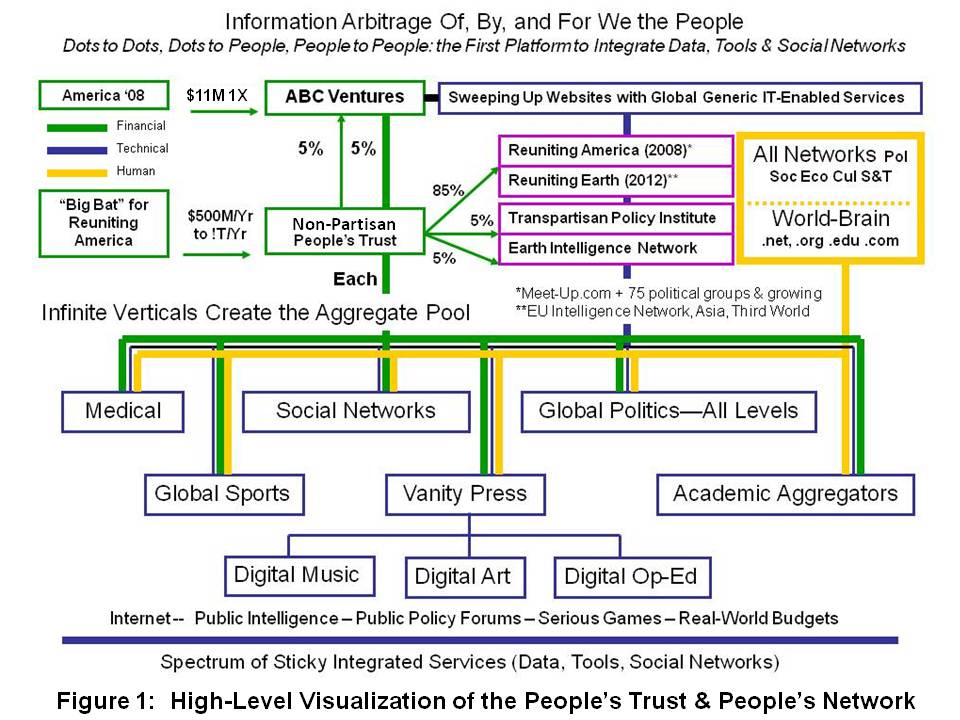
Original to and the exclusive intellectual property of Robert Steele, shared under Creative Commons no commercial exploitation, with credit to Joe Trippi, Joe Costello, and Zephy Teach-Out, the true originals who changed democracy forever.
 Polemical, Provocative, Frightening, & Credible, April 15, 2008
Webster Griffin Tarpley
Edit of 18 Oct 2008: New book by this same author with much more detail including extensive notes, Barack H. Obama: The Unauthorized Biography. Tell others. We have a problem and it is not Obama, it's the people around and behind him.
Edit of 9 May 2008: “House Negro.” That's what a Reverend of color called Senator Obama, and I agree. The Democratic “system” is trying desperately to field a “front” that can win, and Obama has rolled over for them. Just as Colin Powell betrayed all moderate Republicans by confusing loyalty with integrity (instead of quitting and calling for Dick Cheney's impeachment and then running for President in 2008), Obama is, as this book suggests, a Manchurian candidate–a House Negro.
Edit of 7 May 2008: I lost all respect for Obama when he finally disowned Reverend Wright. His original instincts were correct, his late renunciation is further proof that he is bought and paid for by the system. Reverend Wright, despite his inflamatory language, was right on target in seeking to arouse passion about misdeeds done in our name. This can still be a great Republic, but it needs integrity, transparency, and dignity for all. I respect Reverent Wright more than I respect Senator Obama at this point.
Edit of 5 May 2008: Please ignore the individuals whose hysterical reviews demonstrate they are reacting to mine, they have not actually bought nor read the book. I deal with reality, nothing else. This book is a wake-up call, just as the 935 lies and the 25 impeachable offenses of Dick Cheney are a wake-up call. I have confidence in our Collective Intelligence. I have no confidence in the think tanks, the candidates, or the political system of a two party organized crime spoils system.
Edit of 1 May 2008: In the author's own words:
This is not an academic study. It is a vigorous political polemic. It is meant to sound an alarm against a looming catastrophe. All of that is sincere, and none of it is hidden. Now that the phase of adulation and cultism is dissipating, I urge you to take a fresh look.
In the context of all that I know and have read, this book shocked me into realizing that the author may well be correct, and that Senator Obama and his wife, as intelligent and well-intentioned as they may be, are nothing more than puppets to a Trilateral Commission/Federal Reserve mafia.
I say this as someone who believed in the potential of this candidate, but who subsequently found that his campaign staff, his senior political advisor, and even Oprah Winfrey, are so enthralled with the prospects of an easy engineered win (money talks), that they are refusing to engage with or listen to Libertarians, Greens, Reforms, Naderites, or Independents. They refuse to mention the word “transpartisan” that outs the lie of bipartisanship (“keep the two-party spoils system alive, continue to exclude Independents and others from all debates”), they refuse to address the need for Electoral Reform and the naming of a transpartisan cabinet in advance of the election, and they refuse to create much less publish any semblance of a balanced budget, without which all of their promises are empty (as well as often mis-guided). So for all of these reasons, as polemical as the author's book it, I find it credible and compelling. This book also explains why Mike Bloomberg has gone silent–others with more money than he appear to have persuaded him he could, like Bear Sterns, be punished by being bankrupted.
MOST INTRIGUING is the manner in which the author dissects and evaluates Senator Obama in the context of who his advisors are.
I now realize that the refusal of all three candidates to outline any kind of strategy for eradicating the ten high-level threats to mankind by harmonizing the twelve policies is deliberate–they don't HAVE a strategy, they have an agenda, and it does not include our well-being.
Let me set the stage with two quotes from pages 178 and 179:
“Obama is best understood as a multi-contractor puppet with hardware from the Ford Foundation and software from the Rockefeller-Trilateral-Brzezinski circles.”
“The Obama campaign has thus far been shown to represent: the Ford Foundation, the Trilateral Commission, the New York Council on Foreign Relations, the Chicago Council on Foreign Relations, the Bilderberger Group, Skull and Bones, the RAND Corporation, the Soros Foundation, the Rockefeller family, and the Friedmanite Chicago School of economic genocide. Obama is the Manchurian candidate groomed and indoctrinated by those financier-controlled groups. As president, Obama would impose a regime of crushing economic austerity and a new set of foreign wars far worse than what has been seen under Bush.”
I am going to highlight a few points here, and reserve the option of modifying this review after I talk to the author tonight. I want to get this down while it is fresh in my mind.
The real kicker, the “truth-teller” that persuades me this author is on to a very important potential nightmare scenario for the USA, is the role of Zbigniew Brzezinski as the top foreign policy advisor and indeed the “maker” of both Jimmy Carter and Barack Obama.
I have always respected Brzezinski's talents, but as I have grown older and wiser I have come to see him as nothing more than a war criminal, no better or worse than Henry Kissinger, both of them convinced that a) they know better, b) their grand strategic design demands the subversion of all who stand in their way, and c) never mind a little genocide here and there (and especially in Africa), eugenics is code for depopulating the areas we have not finished looting.
What I see in the two political parties, both Running On Empty, is a propensity to promote sycophants and then let them do great evil “in our name” and without retribution.
The book on Kissinger has been written: The Trial of Henry Kissinger. The book on Brzezinski remains to be written. For a taste, see Breaking the Real Axis of Evil: How to Oust the World's Last Dictators by 2025.
I share the author's view of Brzezinski as a loose cannon with a rabid anti-Russian sentiment, and I for one will not vote for any candidate that allows Brzezinski to play with our loose nukes, or to antagonize Russia with missile defense in Poland.
The author is quite persuasive when he discusses the manner in which Brzezinski obtained both political asylum and a lucrative complete funding package for the Chechnyan terrorist leader now granted asylum and living in splendor here in the DC area (at taxpayer expense).
He makes it a point to observe that Brzezinski is an opponent of Third World development, wanting no more miracles such as have been achieved in Asia.
I believe the author when he describes Senator Obama as Brzezinski's last chance, at 80, to create destabilization along the Russian western border, and to goad China into invading Siberia to the point there is a Russian-Chinese war. Thus does Brzezinski go up in flames, taking the rest of us with him.
Other Obama advisors (less Joe Nye, who can be reasonable) are also frightening, buy and read the book for details.
The author has several major pet rocks that get tossed around, and I summarize them here:
1) The Clintons are the lesser evil because they have no single owner and Senator Clinton, for all her flaws and tribulations, appears to be genuinely in favor of New Deal arrangements for the working class and the vanishing middle class..
2) The young trouble this author. He considers them ignorant, gullible, and too subject to manipulation,
3) Fascism lurks, and one price Senator Obama may have to pay is that of his life–being assassinated early on (shortly after inauguration ostensibly by a foreign agent)so the Vice President can take over and fulfill the fascist/corporate control dream. I shake my head as I write this–if I had not lived the life I have, been part of the CIA, read all the books I have, all of this would be disreputable ranting. The book is an indictment, not a conviction, and merits attention.
In other provocative notes the author considers Mark Penn to have been a mole into the Clinton campaign all along, and to have provided a strategy intended to fail, bolstered by fake polling that misled Senator Clinton.
The author laments the splintering of the 9/11 Truth Movement between Kucinich and Ron Paul, and suggests that Kucinich was in grave error when he threw his delegates to Senator Obama.
The author explores how John Edwards dominates the two major issues of the day, poverty and labor rights, and these were essentially stolen from him with “big money” we do not see behind the “little money.”
The author draws to a close warning the reader that like Jimmy Carter, Barack Obama was selected and promoted by the Trilateral Commission, and that like Jimmy Carter, he will preside over a melt-down of the US. Indeed, he draws a line from “malaise” to Mrs. Obama's discussion of “broken souls.”
The author believes that Senator Obama is being set up for a fall with the national infrastructure fund, which will be speculative and lead to a major economic setback (for the little people, the funds will do fine).
The author believes that the mental health of the candidates for President is something that must be examined in public very carefully. He has grave doubts about both Senator Obama and Senator McCain, and while I have grave doubts about Senator Clinton's ability to listen to anyone other than her cronies, I do NOT have a single doubt at all about her sanity and seriousness of purpose.
His draft emergency economic recovery plan covers a stop of foreclosures, raising minimum wage, Tobin Tax implementation, single-payer health care, tax relief for families, nationalization of the Federal reserve and re-regulation of banking and finance, funding infrastructure to eliminate daily auto commutes, protection of the family farm, attention to global depression, and restoration of FDR's “freedom from want.”
So there you have it. I am impressed.
See also Someone Would Have Talked: The Assassination of President John F. Kennedy and the Conspiracy to Mislead History and also An Act of State: The Execution of Martin Luther King, New and Updated Edition and of course all the books on the lies told to We the People regarding Viet-Nam and more recently, 9-11, Katrina, and Iraq.
There are others. Bottom line: Government lies (both left and right) and We the People need to flush all these knaves down the toilet and start over.
For competing visions that do not tolerate Manchurian machinations, see, among many others:
The Tao of Democracy: Using Co-Intelligence to Create a World That Works for All
The World Cafe: Shaping Our Futures Through Conversations That Matter
Society's Breakthrough!: Releasing Essential Wisdom and Virtue in All the People
How to Change the World: Social Entrepreneurs and the Power of New Ideas, Updated Edition
Collective Intelligence: Creating a Prosperous World at Peace
The Best Book on the Topic, with a CD-ROM, Totally Rich,April 15, 2008
Anwar Shah
This is the very best book on Participatory Budgeting I could find (other than those on Puerto Alegre specifically, I will review one of those later) and once in hand, it has fully satisfied. The higher than normal cost for a book of this type is fully justified by the CD ROM.
Use the Search Inside This Book line under the book cover to see the Table of Contents and other elements of the book. I did not do that but if you have any doubts at all, reading the Table of Contents should be more than enough to overcome them.
For my purposes the two most important parts of the book were overview by the editor Anwar Shah (top expert with the World Bank); the guide to participatory budgeting by Brian Wampler; and the concluding appendix by Alan Folscher, on Citizen Participation and State Effectiveness, and also–very important–Preconditions and Enabling Factors for Citizen Engagement with Public Decisions. The rest of the book is regional case studies, and the CD ROM is country case studies.
From the Overview
+ Participatory Budgeting is direct democracy
+ It empowers citizens to deliberate, debate, and influence
+ It is a tool for educating, engaging, and empowering citizens
+ Transparency can reduce inefficiency as well as corruption
+ It strengthens governance by including the marginalized
+ It comes with significant risks (this was the new stuff for me)
– Process can be captured by interest groups
– Can cover up existing injustices
– Tyranny of group dynamics can overpower good intentions
– Tyranny of method can exclude other democratic means (much as the fine print in many legal agreements excludes access to courts and juries by including a concealed agreement to abide by arbitration)
Introduction to Participatory Budgetng
+ Four factors for success
– Strong mayoral support
– Civil society willing and able to engage in the debate (harder to find that I realized)
– Supportive policy environment that can withstand legislative pressure\
– Financial resources to actually fund programs sponsored by citizens
Guiding Tenets Include:
+ Division of municipality into regions for easier discussion and implementation
+ Government-sponsored meetings throughout the year
+ Quality of Life Index is created to weight program toward less well off
+ Deliberation and negotiatiion is public
+ Bus caravan visits all the proposed projects before voting on them
+ Elected representatives vote on all the projects (open or secret)
+ Municipal councel is elected with two representatives from each region
+ Year end report is published
+ Everything in monitored publicly year round
The above cannot possibly capture the nuances and complexities of each individual case study, so that is where ethnographic specificity must be applied.
Appendix on Citizen Participation
+ Types of participation
– Information sharing
– Consultation
– Joint decision making
– Initiation and control by citizen stakeholders
+ Preconditions and Enabling Factors
– Openness and democratic depth of the political and governance systems
– Existence of enabling legal frameworks
– Capacity for participation inside and outside government
– Existence of functional and free media institutions
– Willingness and capacity of government to make budget information open
What most surprise me as a lay reader (i.e. I claim no expertise at all, I simply believe to direct democracy) was the MANY OBSTACLES to participatory budgeting. I have heard that WikiCalc is coming along, which would along for budget information to be commented on and then different perspectives aggregated from the individual to the neighborhood or political preference level; and I hope that EarthGame will become a reality in which each person plays themselves and has access to full information, but in the context of populations that struggle day to day, it is going to take much more than an “invitation” to achieve participatory budgeting. In a nutshell, we know now that it can work, but getting it to work anywhere is going to be a real challenge.
Great book. A solid academic endeavor that if I were repeating my MPA this year, should certainly be in the Budgeting Course.
See also:
The Tao of Democracy: Using Co-Intelligence to Create a World That Works for All
The World Cafe: Shaping Our Futures Through Conversations That Matter
Society's Breakthrough!: Releasing Essential Wisdom and Virtue in All the People
How to Change the World: Social Entrepreneurs and the Power of New Ideas, Updated Edition
The leadership of civilization building: Administrative and civilization theory, symbolic dialogue, and citizen skills for the 21st century
Smart Mobs: The Next Social Revolution
The Wealth of Networks: How Social Production Transforms Markets and Freedom
Collective Intelligence: Mankind's Emerging World in Cyberspace
Group Genius: The Creative Power of Collaboration
Collective Intelligence: Creating a Prosperous World at Peace
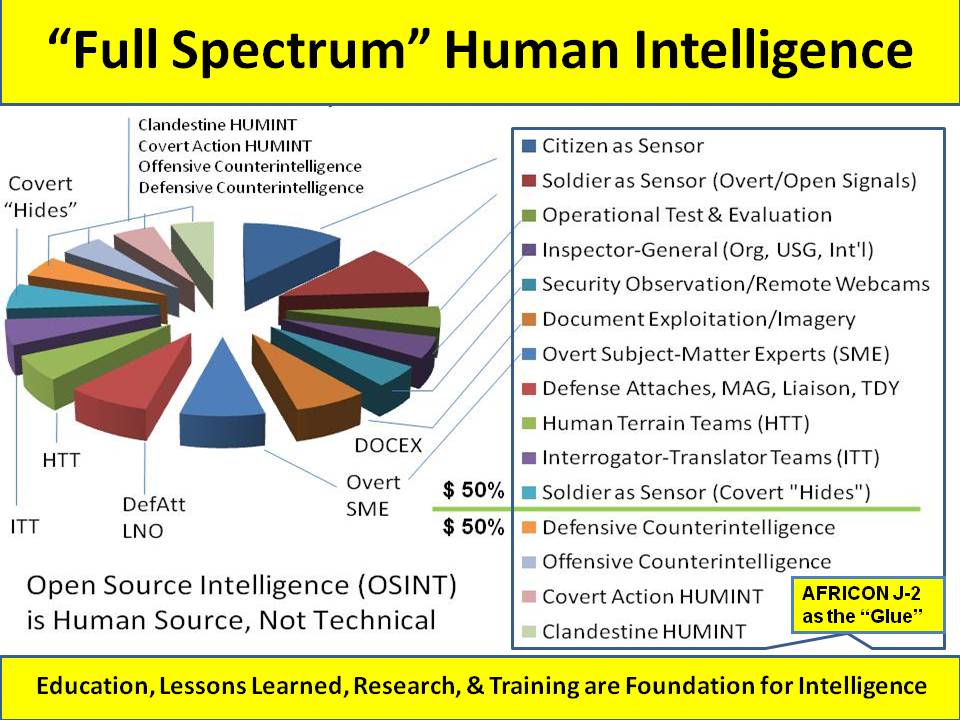
This is a variation of the Human Intelligence (HUMINT) graphic greated in Sweden, one that shows the J-2 for a region, in this case AFRICOM, being central to the provision of leadership across all of the aspects of HUMINT represented within DoD and the rest of government, all of them largely “out of control” right now.

The bulk of this slide was created by Stephen E. Arnold and included in his chapter on search engines (over 75 of them). Robert Steele added the Google manipulation of what you see based on the published analytic studies by Arnold with respect to Google.
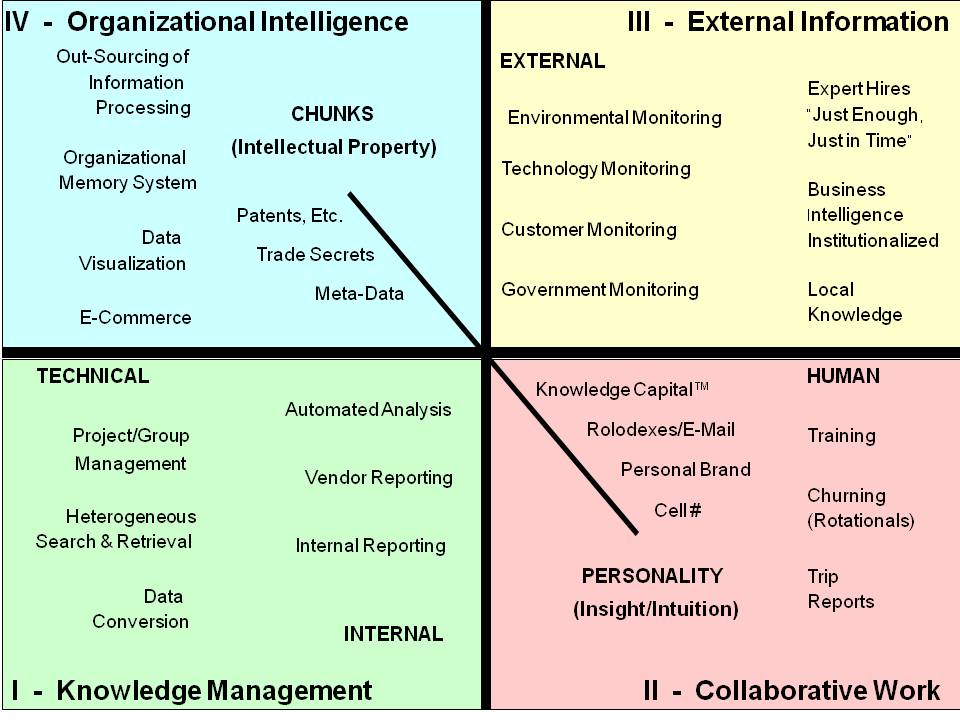
This was inspired by Harold Wilenski's book, Organizational Intelligence (Knowledge and Policy in Government and Industry), and Robert Steele's growing awareness that what passes for “Knowledge Management” is nothing more than internal data mining. Augmented by an understanding of collaboration networks and by the growing but still immature field of commercial intelligence, the chart took shape rather quickly.
Not anticipated, but now consistent with both the strategic direction of the Earth Intelligence Network, and the reality of how cell phones rather than laptops are the device of choice for the poor, was the seminal role of the cell phone as the device of choice for achieving organizational intelligence.
It can be useful placed side by side with Nova Spivak's Meta-Web illustration to see a convergence of the technical-centered (Spivak) and the human-centered (Steele).
