I took my 16 year old on a swing of some these schools, and I have a simple bottom line: the author established an interesting formula and title years ago, and over time, half his recommendations do not live up to the billing. Some of his recommended schools are in the middle of no where, with very poor maintenance, sloppy students and inattentive staff, and not at all as advertised. Others, like Evergreen in Washington State, are clearly top of the line.
I have also realized that with the thousands of colleges and universities across America, including community colleges that are now going “upscale” and expanding their computer and laboratory facilties, that this book is like a placebo–it pupports to offer a life-changing experience with a very narrow selection of schools, when in fact there are plenty of life-changing schools right before our eyes, in every state of the Union.
It merits comment that this past week none of the schools in this book that we visited caught my son's attention (he is one of those who thought, until this trip, that he never wanted to go to college), but when we visited Muhlenberg College, my alma mater, not only did he perk up, but the hand of God was visible–a college educated custodian opened the locked rooms in the Arts Center, showing him the music and digital video programming rooms, and that sealed the deal.
Read this book for ideas, discard the “list” as flawed and misrepresentative and open your eyes to all the options.
6 Star Holy Cow! “Insider” Speaks Truth, Tars Both Parties,
July 25, 2005
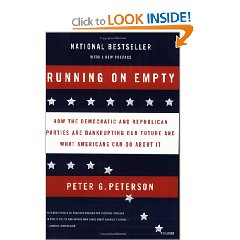
Peter G. Peterson
Edit of 9 Jan 15 to elevate to 6 stars. In the context of the hundreds of books I have reviewed (see my master list easily found, Worth a Look: Democracy Lost & Found Essay, Book Review Blurbs and Links, this book stands out as one of the earliest and most thoughtful — still a classic, still relevant. SIX STARS.
Edit of 16 Apr 08 to add more links on the bad and the good.
I find it extraordinary to have the Chairman of the Council on Foreign Relations, which I have always considered to be an old man's club of established elites, largely out of touch with 80% of the real world (that is to say, the 80% that has almost nothing in the way of wealth, health, or rights), step up to the plate and speak truth.This book addresses the second core issue in America's future, i.e. the twin deficits that are not only going to kill the business of America, but also deprive the children of America of their future. (Lapham addresses the first: restoration of honest democracy). In combination, the $7 trillion deficit in federal spending, and the $500 billion a year trade deficit, with roughly $2 billion in foreign loans being required every single day to keep America afloat, both suggest that we are snorting political cocaine and every one of us is a damn fool for allowing two political parties to get away with selling us down the river.As the author points out in the Preface, when the International Monetary Fund (IMF) cautions its own master, the USA, that it is in danger of becoming an insolvent Third World country, running up bills that “would require an immediate and permanent 60 percent hike in the federal income tax, or a 50 percent cut in Social Security and Medicare benefits,” we cannot say we have not been warned.The author is balanced, focused, deliberative, and earnest. He carefully explains how both the “mainstream” political parties have completely abdicated all responsibility, and completely betrayed the public interest in their eagerness to sell legislation to the highest corporate bidders.
There is one grievous flaw in the book. In concluding that we can only survive by educating ourselves and then finding our voice, the author neglects to address the fast means of achieving short-term fiscal recovery in tandem with campaign finance and electoral reform: the elimination of subsidies, tax fraud, and tax relief for corporations. We have close to a trillion in unwarranted and unsound subsidies to poor agricultural, fisheries, forestry, and minerals programs where every dollar in subsidy is yielding high long-term costs to the taxpayer citizen; we have over $50 billion a year in documented import-export tax fraud ($25 rocket engines going out, $3000 toothbrushes coming in–advanced money laundering and tax avoidance); finally, the corporate share of federal tax revenue has dropped from 32% to 6% in the past twenty years, with corporations like Halliburton paying $15M in taxes on billions in profit–easy to fix: pay taxes on the profit declared to the stockholders.
See also the more recently published book by John Bogle, Wall Street mutual funds giant, The Battle for the Soul of Capitalism, in which he singled the author of this book out for special praise. What this means is that Wall Street and the “elite” now realize, as Dean Garten from Yale tried to tell them in The Politics of Fortune: A New Agenda For Business Leaders, we are all in this together, government is hosed, labor is vital, morality and integrity are non-negotiable foundations for mutual prosperity. 2008 could be the foundation year of the 2nd American Republic.
This is not your run of the mill boy meets girl from other side of the tracks, they live happily ever after (or not). This is an extraordinarily deep and pleasing look at what happens when technology fails, and man's only salvation is another person who is still in touch with nature.
I was moved by this movie, and found it to be nuanced and elegant. Not only does the pilot survive, but in doing so, he returns to the land, he returns to “the people of the land” (the Eskimos), and he overcomes the falsely-rooted prejudices of those who fall prey to the fools' gold that is found in technology, and scorn those who remain close to the land.
At all levels, this is an extraordinary movie.
Books that support this theme include Lionel Tiger's “The Manufacture of Evil,” Jean Ralston Saul, “The Dictatorship of Reason in the West,” Clifford Stoll, “Silocon Valley Snake Oil,” and Norman Cousins, “The Pathology of Power.”
Brilliantly Clever at All Levels–Remakes US View of India,
July 19, 2005
Naveen Andrews
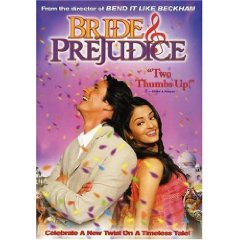
This movie is so extraordinarily clever, at all levels, that I have watched it twice with undivided attention, and have it playing on background now. It does nothing less than remake US views of India. As I read the full page advertisements in the Washington Post saluting the visit of the Indian Prime Minister, and reading about the White House agreeing to sponsor nuclear information exchanges while India sponsors a second green revolution, I cannot help but think that this movie, in a unique way, captures both the beauty of India, and its arrival as a world power equal to the US.
I spend a lot of time thinking about both reality and perception. The US has blown it when it comes to the billions of poor–not just the Arab fundamentalists, but the non-violent individuals who see us occupying their countries and looting their natural resources. If America could produce a movie like this, one that reflected the best of America, the ideals of the original Republic, it would have more of an impact than the billions of dollars we are spending on a heavy-metal military.
This movie is extraordinary. It is brilliant. It is worth buying, viewing multiple times, and as a gift idea.
1. What private industries or fields do you feel would most benefit from your experience and training within Intelligence?
Intelligence is not about secrets. It is about advanced decision-making that makes the most of all available sources, in all languages, in near-real time but also including a complete grasp of history going back 200 years (e.g. all Chinese statements on the Spratley Islands, or energy), and down to the neighborhood level where the real action is. Consequently, understanding the process of intelligence, and how to blend sources, softwares, and services to reach the most informed decision possible, is relevant to every industry and field. With the exception of oil companies and pharmaceutical companies, both of which practice intelligence at an advanced level but with a complete lack of ethics, most industries, and most governments, are stupid. The U.S. Intelligence Community, to take one prominent example, is costing us roughly ten times what it should, and has access to less than 10% of the relevant information needed for national security and national competitiveness—not because that information is not accessible, but because the community is led by people who are intellectually and culturally handicapped.
2. What are the career prospects for an analyst working outside an intelligence agency?
The last place an intelligent intelligence analyst should want to work is within an intelligence agency. By definition, such agencies are catastrophically and pathologically unfit places of employment. Think of throw-away cameras as an example. Instead of trying to sell your brains to an agency that thinks it knows it all (a high end photography shop), make a real difference in the private sector by bringing your intelligence cycle skills to a normal business (the grocery store that does not put on airs, just wants an inexpensive camera for normal people). Your influence as a thinker will be inversely proportional the budget and secrecy of your employer. Higher budget, more secrets, less influence.
3. How mobile do you feel you were in the region you specialized in? For example, if your duties required you to primarily focus on issues and topics within the Middle East, do you feel you could later transfer to another region such as Central Asia or Europe? Would such a transfer require extensive re-training?
It is not about knowing specifics anymore. It is about “knowing who knows,” as Stefan Dedijer, the Swedish-Croatian father of business intelligence said at my conference in 1992. I continue to be amazed by the intellectual decrepitude of National Intelligence Council officers who do not know how to use citation analysis to identify the top 100 published people in the world on any topic, and then through them the top 100 unpublished people on the same topic. I also marvel at the moronic logic of CIA security officers that choose to investigate CIA analysts—including NIOs—that try to talk to real experts who are not US citizens, most of whom do not have a clearance and do not want a clearance, because a clearance is like drugs—it disconnects you from reality.
4. How much does intuition, or gut feeling, become involved when deciding to trust or ignore information obtained through various collection methods?
This is your best question. Intuition is extremely important, but only if you are well-versed and have full access to all sources in all languages. You need to speak at least one foreign language, you need to be able to interact with individuals who are fluent and read-in at a native level, and you need to have an open mind. Under those conditions, intuition is vital and can fill the 5% “gap” in what can be known by normal methods. It is not possible to do good intelligence from archives or written sources. Only by talking to as many people as possible, can you “intuit” the truth. When you are at the top of your game—something that will take 20-30 years to develop—you can “know without knowing.”
5. How do you feel computer technology is changing the Intelligence field in regards to information collection and analysis?
The current IC investments are a waste. Google, Amazon, IBM (DB2 with OmniFind, and Radio Frequency Identification or RFID, not Web Fountain) will, when combined with CISCO AONS (Application Oriented Networking System), change the face of the planet. We are creating an alternative commercial global multinational multiagency multidisciplinary multidomain Open Source Information System – External (OSIS-X) in the private sector, and the US IC has no clue what is about to hit it. $30 Motorola cell phones with cameras in the hand of billions of new capitalists in China and India and elsewhere, are changing the intelligence paradigm (see my Op-Ed).
6. Do you feel that the rapid spread and easy accessibility of Information Technology makes Intelligence/Counterintelligence easier or more difficult to perform?
As Peter Drucker said in Forbes ASAP on 28 August 1998, we have spent the last fifty years on the T in IT, we now need to spend the next fifty years on the I in IT. Morality matters more than technology. We are beyond connecting the dots (which US IC stinks at). This is about connecting dots to people and people to people. This is about collective intelligence, wisdom of the crowds, common sense, bottom up multi-cultural consensus with long-term shared values.
7. How do you typically deal with the stress of the type of work you perform?
CIA has the highest suicide, divorce, alcoholism, and adultery rates on the planet. My personal list of suicides now numbers 17. I keep myself strong with sushi, sailing, and reading. I am blessed with three children, and every day I try to live my life with two thoughts in mind: what will help these three children, and what can I do to earn the Nobel Peace Prize. The really important part of dealing with stress is to not buy in to the bullshit, not let morons with authority screw up your world view, and understand that simply by being alive, being able to think, and being able to adhere to a personal moral code, you are a man with God-like capabilities. What you think, how you behave, can change the world for the better. We all have our demons and burdens to bear, but man is the only beast with both a historical memory and the ability to envision alternative futures. Do not obsess on getting a job with clearances—focus instead on being the most open-minded and most ethical person you know. Brains are over-rated. Ethical constancy is more valuable. If I have one regret, it is that I was not as tolerant in my lifetime as I should have been. I allowed stress to lead to shouting, and shouting disconnected me from important alternative viewpoints. Be tolerant. The Golden Rule (“do unto others as you would have them do unto you”) is still the single best precept for living your life. When you do have authority, and power over people, try to be humble and not abuse your authority. My single greatest crime against humanity as an ass-chewing I gave to professional who I later realized did not have my knowledge level and also had no money, and no authority—he was blameless. I am ashamed to this day for my mis-treatment of that person (I subsequently apologized three different times, but the it does not eradicate the stain on him or on me).
8. How do you handle friends and family who ask about your work at the Central Intelligence Agency during and after your tenure?
In the old days, we were not allowed to tell our wives what we did, and this destroyed marriages when late night operations were confused with infidelity. CIA today is largely a joke. Clandestine case officers are largely messenger boys to local liaison, and “non-official cover officers” are widely derided for their stupid cover (with a few glorious exceptions). I am out from under cover, with permission, and here I want to give CIA high marks: their personnel system and their Publications Review Board are among the sanest and most gifted elements of that organization. Analysts are not under cover. The morons that prevent them from having business cards and reaching out to society should be fired. Case officers, who are under cover, should live that cover, with one exception: their spouse. If you cannot trust your spouse, find a new spouse. I do want to emphasize that being a case officer, or a special operations officer, is the highest calling in life. As screwed up as CIA is, there is no greater life-affirming means of serving your country than being a case officer or a special operations officer, followed by being an all-source analyst or intelligence science & technology officer.
9. How did you discuss your day at work with family who may have known you worked in the Intelligence field?
Boring is always good. “Paperwork.”
10. How does your work affect conversations you may have about politics or current events with friends and family? Does the secret nature of your work cause you to avoid conversations regarding politics or current events?
Get this through your head: secrets are generally stupid. If you get caught up in the secrets, you are disconnecting from reality. I learn vastly more from books and conversations than I ever learned form any codeword document. Indeed, as a young lieutenant honored very early in my career to be the S-1/Adjutant for a 1,500 man Battalion Landing Team the first thing I did every morning was shred the SI/TK. The dirty little secret in Washington DC is that most SI/TK is not worth the paper it is printed on. Listening to the street, and having an open mind, are vastly more important than access to secrets. If you read my 550 plus reviews at the below URL, you will be vastly better-educated than most CIA or DIA or NSA analysts. You do not have to agree with my views—think for yourself—but read widely. There is no substitute for reading widely in the open literature.