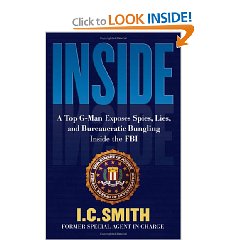
Review: Inside–A Top G-Man Exposes Spies, Lies, and Bureaucratic Bungling in the FBI

5 Star, Intelligence (Government/Secret), Justice (Failure, Reform)
0Shares

Amazon Page
Amazon Page

5.0 out of 5 stars

Not Enough on Spies, Plenty on State-Level Corruption and FBI Idiocy,

January 27, 2005
I. C. Smith
I bought this book in an airport for two reasons: because I knew the man, and because the FBI does not produce enough good authors. Although I was disappointed by finding that only 20% of the book covers spies and lies, while 80% covers bureaucratic bungling and leadership failures with in the FBI, overall I put it down fully satisfied.

We all know now that Al Qaeda was never operating in secret, and even today, is not operating in secret. We are simply incompetent at looking at open sources in foreign languages. IC Smith conveys this perfectly early on in his book, on page 7, when he repeats something he said that was published in the media, to wit “These guys were not superhuman, but they were playing in a system that was more inept than they were.” I share IC's anger over the FBI's failure to translate and exploit the many boxes of documents in Arabic that were captured in the Philippines and after the first World Trade Center attack, the botched car bombing.

If there is one word that summarizes this book's message, beyond incompetency, it is “corruption.” IC Smith tells it like it is when he discusses Congressional corruption, refusing to fix known problems in the Intelligence Community; Presidential corruption in abusing power and covering up those abuses; state-level corruption across Arkansas; intelligence community management corruption and malfeasance–some would even say treason, although IC avoids this word.

On a very practical level, IC Smith is probably the foremost authority to come forward and denounce the practice of having prosecuting attorneys manage investigations. The book has many examples of where trained investigators were not allowed to do their job, and prosecutors botched or blocked investigations that would have otherwise been timely and successful.

In passing, he skewers the staff at the FBI Academy, almost none of whom have actual street experience (nor do most FBI managers at the wood-paneled office level), and it is clear that while America has many dedicated Americans serving within the FBI, they are badly trained and badly led.

In addition to this book I recommend Michael Levine's Deep Cover: The Inside Story of How DEA Infighting, Incompetence and Subterfuge Lost Us the Biggest Battle of the Drug War (on the Drug Enforcement Agency), and Mark Riebling's Wedge: From Pearl Harbor to 9/11–How the Secret War between the FBI and CIA Has Endangered National Security (on the FBI-CIA wars that continue to this day), as well as George Allen's book None So Blind: A Personal Account of the Intelligence Failure in Vietnam (on the continuing ability of the White House–regardless of occupation–and the Intelligence Community–to lie to themselves, to Congress, and to the American people).

IC is a straight shooter. I'm glad he made it to retirement without being shot by a crook or stabbed in the back (fatally) by one of the suits in Washington that pretend to serve the people while serving only themselves.

Links added 20 Dec 07:
Legacy of Ashes: The History of the CIA
Web of Deceit: The History of Western Complicity in Iraq, from Churchill to Kennedy to George W. Bush
Dark Alliance: The CIA, the Contras, and the Crack Cocaine Explosion
Lost History: Contras, Cocaine, the Press & ‘Project Truth'
See No Evil: The True Story of a Ground Soldier in the CIA's War on Terrorism
On Intelligence: Spies and Secrecy in an Open World

Vote on Review
Vote on Review

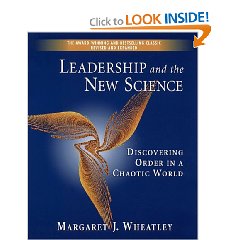
Review: Leadership and the New Science–Discovering Order in a Chaotic World Revised

5 Star, Complexity & Resilience, Leadership
6Shares

Amazon Page
Amazon Page

5.0 out of 5 stars “Tipping Point” Book Vital to Government, Not Just Business,

January 22, 2005
Margaret J. Wheatley
Edit of 20 Dec 07 to add links.

This book is beyond five stars, and not just for business, where it is receiving all the praise it is due, but within government, where it has not yet been noticed. It was recommended to me by the author of Building a Knowledge-Driven Organization and I now recommend it to everyone I know. If there are two books that can “change the world,” these are the ones.

Although the Chinese understood all this stuff centuries ago (Yin/Yang, space between the dots, the human web), the author is correct when she notes late in the book that the commoditization of the human worker (Cf. Lionel Tiger, Manufacture of Evil: Ethics, Evolution, and the Industrial System) and the emphasis on scientific objectivity and scientific manager (Cf. Jean Ralston Saul, Voltaire's Bastards: The Dictatorship of Reason in the West) were perhaps the greatest error we might have made in terms of long-run progress. Coincidentally, as I finished the book, on the Discovery channel in the background they were discussing how the leveeing of the Mississippi blocked the Louisiana watershed from cleansing the Mississippi naturally, as it once used to.

It's all about systems–the author does cite Donella Meadows' 1982 article in Stewart Brand's Co-Evolution Quarterly, but does not pay much heed to the large body of literature that thrived in the 1970's around the Club of Rome.

There are perhaps three bottom lines in this book that I would recommend to any government leader who hopes to stabilize and reconstruct our world:

1) Information is what defines who we are, what we can become, what we can perceive, what we are capable of achieving. Blocking or controlling information flows stunts our growth and virtually assures defeat if not death. It is the optimization of listening–being open to *all* information (and especially all the information the secret world now ignores)–that optimizes our ability to adjust, evolve, and grow.

2) Command & control is history, block and wire diagrams are history. General Al Gray had it right in the 1990's when he talked about “commander's intent” as the baseline. Leaders today need to be disruptive, to look for dissonant views and news, and to empower all individuals at all levels with both information, and the authority to act on that information.

3) Disorder is an *opportunity*. We have the power to define ourselves, our “opponents,” and our circumstances in ways that can either inspire protective, constricted, secretive, “armed” responses, or inclusive, open, sharing “pro-active” peaceful responses.

The author is to be praised for noting early on in the book that “Ethical and moral questions are no longer fuzzy religious concepts but key elements in the relationship any organization has with colleagues, stakeholders, and communities.” I would extend that to note that social ethics and foreign policy ethics are the foundation for sustainable life on the planet, and we appear to be a long way from understanding that it is ethics, not guns, that will stabilize and fertilize…Cf Jonathan Schell, The Unconquerable World: Power, Nonviolence, and the Will of the People.

It also merits comment that the author essentially kills the industry of forecasting, scenarios, modeling, and futures simulations. I agree with her view (and that of others) that early warning is achieved, not through the theft of secret plans and intentions or the forecasting of behavior, but rather by casting a very wide net, listening carefully to all that is openly available, sharing it very widely (as the LINUX guys say, put enough eyeballs on it, and no bug will be invisible), and then being open to changed relationships. Trying to maintain the status quo will simply not do.

I give the author credit for carrying out an extraordinary survey of the literature on quantum mechanics, and for developing a PhD-level explanation of why old organization theory, based on the linear concepts of Newtonian physics, is bad for us, and how the new emergent organization theory, understood by too few, is let about the things and more about the relationships between and among the things.

This is an elegant essay and a heroic personal work of discovery, interpretation, and integration. While I would have liked to see more credit given to Kuhn, Drucker, Garfield, Brand, Rheingold, and numerous others that I have reviewed here for Amazon, on balance, given the academic narrowness of her Harvard PhD, I think the author has performed at the Olympic level. This is a radical book, somewhat reminiscent of Charles Hampden-Turner's book, Radical Man: The Process of Psycho-Social Development. which as I recall was not accepted by Harvard as a thesis at the time. Perhaps Harvard is evolving (smile).

For other key books that complement and precede this book, see my lists on information society, collective intelligence, business intelligence, and intelligence qua spies and secrecy in an open world.

A handful of other amazing books (am limited to ten total):
The Tao of Democracy: Using Co-Intelligence to Create a World That Works for All
Society's Breakthrough!: Releasing Essential Wisdom and Virtue in All the People
One from Many: VISA and the Rise of Chaordic Organization
The Cultural Creatives: How 50 Million People Are Changing the World
Group Genius: The Creative Power of Collaboration

Vote on Review
Vote on Review

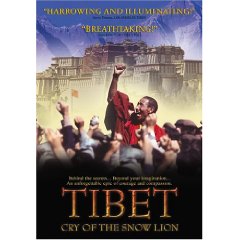
Review DVD: Tibet – Cry of the Snow Lion (2003)

6 Star Top 10%, Atrocities & Genocide, Consciousness & Social IQ, Crime (Government), Culture, Research, Empire, Sorrows, Hubris, Blowback, Philosophy, Religion & Politics of Religion, Reviews (DVD Only), Truth & Reconciliation, Values, Ethics, Sustainable Evolution
0Shares

Amazon Page
Amazon Page

5.0 out of 5 stars Liberation through Knowledge: Absorbing,

January 15, 2005
Shirley Knight
Edit of 20 Dec 07 to add other significant DVDs.

Halfway through this probing, sensitive, sharp, spiritual documentary film I thought to myself, “wow, this is what CIA covert propaganda *should* be able to produce” and then instantly corrected myself: David Ignatius of the Washington Post has it right: overt action is vastly superior to covert action, and in this instance, a loose coalition of kindred spirits have come together in time and focus to produce something remarkable, something much more threatening to Chinese behavior in Tibet than any military armada: a collage of truth-telling.

This is a world-class documentary, full of vivid images, well-blended historical and modern footage, and extremely good production planning and voice over editing. Early on I was struck by the similarity between the Tibetans, the Native Americans, and the Guatemalan Indians, all of whom share some basic moral precepts.

The portrait painted of Tibet as a nation committed to the concept of spiritual education, is a compelling one. One analogy offered up by one of those interviewed I found especially compelling: Tibet was spending 85% of its budget on spiritual development, with 10% of its population in monasteries–this being the equivalent of America redirecting its entire defense budget toward education.

The documentary will clearly infuriate the Chinese, for it carefully itemizes the many ways in which Tibet is uniquely Tibetan, including in its language, greatly distant from Chinese. Shown are Chinese torture instruments, including electrical cattle prods used in the vaginas of nuns and the mouths and throats of monks. The photographs are graphic.

Also covered are the genocide, the torture, imposed by the Chinese, as well as the loss of morality–625 brothels to serve the Chinese garrison.

The documentary carefully covered the death of 30 million Chinese and half the Tibetan population that resulted from Mao Tse Tung's order that Tibet grow wheat instead of barley–shades of the Soviet Union and its failed socialist agriculture.

6,200 monasteries destroyed–as one Tibetan government official in exile notes, this is not just places of worship, but places of scholarship and cradles of a specific civilization.

A section of the documentary focuses on CIA training of the Tibetan resistance, the conclusion of the Tibetans themselves that CIA was not serious, only providing enough support to enable harassment but not victory, and then the coup de grace–Henry Kissinger selling Tibet out for the sake of engagement.

A very powerful section points out that the US, with its 89 billion dollar a year trade imbalance with China, is in fact subsidizing Chinese repression and genocide, not only against Tibet, but against Muslims in China and other separatists elements. US business, according to this documentary, has sold democracy out in favor of profit.

As the documentary drew to an end, I found myself asking again: is this CIA propaganda, as the Chinese would have us believe? Or is the Dalai Lama is fact the representative of a group that may well be the soul of the world, a kernel of hope for non-violent resolution to all that ails us? I found myself wishing that we did indeed have a more effective People's Intelligence Agency (PIA), one that I could trust, one that we could all trust, to actually get the facts right, without political, economic, or cultural manipulation and distortion.

I was educated by this documentary. I had never really thought about Tibet as other than a spiritual oddity. This documentary very effectively points out that it can and should be a zone of peace, not least because it is situated between China and India, two of the most populous nations on earth, between them holding one half of the earth's population, and both of them nuclear *and* poor.

The documentary ends on a high note. It explicitly calls for liberation through knowledge and compassion, and one educator is very effective in pointing out that no one expected apartheid to end in South Africa, or the Berlin Wall to fall, yet both came to pass. Tibet, by this telling, is next.

This is an eye-opening, intelligent, visually-stimulating, and spiritually unnerving documentary. These people–both the observers and the observed–have served us all well.

See also, with reviews:
Peace One Day
The Snow Walker
Lord of War (2-Disc Special Edition)
Syriana (Full Screen Edition)

Vote on Review
Vote on Review

Review: Enforcing the Peace–Learning from the Imperial Past

4 Star, Empire, Sorrows, Hubris, Blowback, History, Peace, Poverty, & Middle Class, Voices Lost (Indigenous, Gender, Poor, Marginalized)
0Shares

Amazon Page
Amazon Page

4.0 out of 5 stars Worthwhile but Stops Short,

January 6, 2005
Kimberly Zisk Marten
This book came highly recommended to me, but I now believe, after reading it, that is was recommended because it contributes to the tarring of America for being an imperial power in the present, while also documenting the almost certain failure of any imperial power in the present that chooses to a) act unilaterally and b) impose its values and form of governance on an uncooperative indigenous population.

On balance, I find the book worthy in so far as it draws parallels between the imperial occupations of the past and those of the present that focus on winning the war but pay no attention to winning the peace. Unfortunately, the book stops precisely where I was hoping it would start: it fails to address the two biggest aspects of winning the peace: a) inter-agency operations that mobilize *all* sources of national power and b) a deliberate concept, doctrine, manning, funding, and capabilities for stabilization and reconstruction, such as the Defense Science Board has recommended and the US Department of Defense is now implementing.

A few notes:

1) The author coins the term “complex peace operations” where the term is not needed–the author means to discuss peace enforcement missions;

2) The author is completely correct and helpful in pointing out that multilateral operations inspire legitimacy, while unilateral operations inspire counterinsurgency;

3) The author focuses on political will with respect to sustained occupation by military forces (we do not have it), but does not engage in what I regard as the more important discussion, which is the need for political will and wit to understand, as General Tony Zinni understands, that the fastest way to reduce violence and restore legitimacy is to introduce water, food, and medicine to the area;

4) The author very helpfully spends time discussing why the German and Japanese reconstruction models are irrelevant to today's failed states;

5) The author praises the military for being able to do humanitarian and other “operations other than war” when the military is well-led and carefully monitored, but misses the larger point that most military professionals and historians will gladly point out: one needs both forces–a big war force put into OOTW operations will lose its skill at big war within two years, while also being incompetent at small war/OOTW for the first two years it is thus engaged;

6) The author suggests, and I believe with good reason based on solid research, that the West is over-reaching when it seeks to impose Western values, Western forms of governance, and even singular governments on ethnic divisions that have stood the test of time–flexibility in accepting multiple forms of self-governance is essential;

7) Finally, and I have seen this myself in Viet-Nam and in El Salvador, and read of it in many other places, the author points out that any time the West intervenes and seeks to select leaders on the basis of its own criteria, it inevitably disregards local realities and ends up creating more friction than it resolves.

The author ends with the suggestion that we focus less on instilling liberal democracies, and more in simply assuring sufficient security such that commerce can be practiced and the arts can flourish.

This is an ably crafted and documented book, but it stops short. It urgently needs a companion volume that collects and integrates lessons from successful interventions. As the book went to press, Haiti was breaking apart for the second time, and I note with interest that the one force that might actually be effective there–the French-speaking French gendarme, is nowhere to be found.

Ten other books as good or better:
The Fifty-Year Wound: How America's Cold War Victory Has Shaped Our World
The Unconquerable World: Power, Nonviolence, and the Will of the People
The Paradox of American Power: Why the World's Only Superpower Can't Go It Alone
Imperial Hubris: Why the West Is Losing the War on Terror
Security Studies for the 21st Century
The Search for Security: A U.S. Grand Strategy for the Twenty-First Century
Modern Strategy
Blessed Unrest: How the Largest Movement in the World Came into Being and Why No One Saw It Coming
The Battle for the Soul of Capitalism: How the Financial System Underminded Social Ideals, Damaged Trust in the Markets, Robbed Investors of Trillions – and What to Do About It
Running on Empty: How the Democratic and Republican Parties Are Bankrupting Our Future and What Americans Can Do About It

Vote on Review
Vote on Review

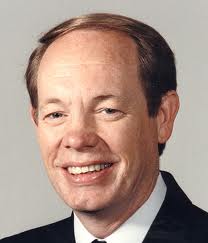
Who’s Who in Peace Intelligence: Douglas Johnston

Alpha I-L, Peace Intelligence
0Shares
Doug Johnston
ICRD Home Page

Dr. Douglas Johnston is the President and founder of the International center for Religion and Diplomacy (ICRD).Ā  The Center's mission is to address identity-based conflicts that exceed the reach of traditional diplomacy by incorporating religion as part of the solution.

In 2004 he was recognized with the Golden Candle Award of the Open Source Solutions Society:

OSS '04: To Dr. Douglas M. Johnston,Ā president and founder of the International Center for Religion and Diplomacy,Ā for his path-finding efforts with regard toĀ Ā Preventive Diplomacy as well as Religion and Conflict Resolution.Ā  Among his many works, two stand out for defining a critical missing element in modern diplomacy:Ā Religion, the Missing Dimension of Statecraft (Oxford University Press, 1994), and Faith-based Diplomacy:Ā  Trumping Realpolitik (Oxford University Press, 2003).Ā  He has restored the proper meaning of faith qua earnestness instead of faith qua zealotry, and this is a contribution of great importance.

Dr. Johnston is a distinguished graduate of the US Naval Academy and holds a Masters degree in Public Administration and a Ph.D. in Political Science from Harvard University. He has a broad range of executive experience, including assignments in government as Director of Policy Planning and Management in the Office of the Secretary of Defense, and later as Deputy Assistant Secretary of the Navy. In academia, he taught international affairs and security at Harvard University and was the founder and first director of the Kennedy School's Executive Program in National and International Security. In the military, he served in the U.S. nuclear submarine service and retired as a Captain in the Naval Reserve.

Dr. Johnston has edited and authored several books, including Religion, the Missing Dimension of Statecraft (Oxford University Press, 1994); Foreign Policy into the 21st Century: The U.S. Leadership Challenge (CSIS, 1996); and Faith-based Diplomacy: Trumping Realpolitik (Oxford University Press, 2003).

http://duckduckgo.com/?q=Douglas+Johnson+faith+religion
Web Update

Dr. Johnston's hands-on experience in the political/military arena coupled with his work in preventive diplomacy, has guided the work of ICRD since its inception. In 2007, he received The Founding Spirit Award for Faith by The Washington Times at its 25th anniversary celebration and in 2008 was identified in a leading Christian journal as ā€œThe Father of Faith-based Diplomacy.ā€

“Life is a miracle and should be treated as such.”
Douglas Johnston