2004 Briefings in Italy on The New Craft of Intelligence

Briefings & Lectures
0Shares

2002 FAILURE of 20th Century Intelligence

2004 COLLECTION: Know Who Knows

2004 PROCESSING: Make the Most of What You Know

2004 ANALYSIS: All-Source Analysis, Making Magic

2004 NEW RULES for the New Craft of Intelligence

Note: Ms. Carol Dumaine of CIA's Global Futures Partnership was also invited and authorized by CIA to present at the same two-day session.

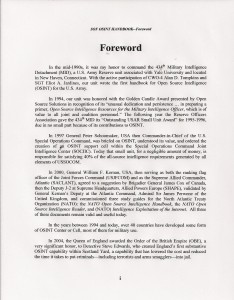
2004 Simmons (US) Foreword to the Special Operations Forces (SOF) Open Source Intelligence (OSINT) Handbook

Hill Letters & Testimony, Historic Contributions, Military
0Shares

This Foreword, the first one done by Congressman Rob Simmons of Connecticutt for any handbook or book in the larger Open Source Intelligence (OSINT) arena, would be revised and used for others publications, but in its time, in 2004, this was the first-ever deep high-level statement of both need and opportunity with respect to OSINT as a separate discipline.

SOF OSINT HANDBOOK
SOF OSINT HANDBOOK

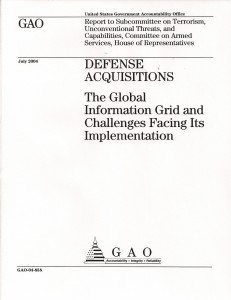
2004 General Accountability Office (GAO) Report: Defense Acquisitiions: The Global Information Grid and Challenges Facing Its Implementation

General Accountability Office
0Shares
Full Report Online
Full Report Online
Summary Only
Summary Only

Oops 2004: The most critical challenge ahead for DOD is making the GIG a reality. While DOD has taken steps to define its vision and objectives for the GIG on paper and in policy and is beginning to make a heavy investment in the GIG as well as systems that will be heavily dependent on the GIG, it is not fully known how DOD will meet these objectives. For example, it is not known which investments should take priority over others and how these decisions will be enforced. Moreover, it is not known how DOD will assess the overall progress of the GIG and determine whether the network as a whole is providing a worthwhile return on investment, particularly in terms of enhancing and even transforming military operations. According to DOD officials, the enhancements DOD is making to its planning and budgeting processes are meant to begin addressing these questions. Until DOD implements an investment and oversight strategy for the GIG as a whole, it is at risk of making investments that do not fit DOD’s vision for the future.

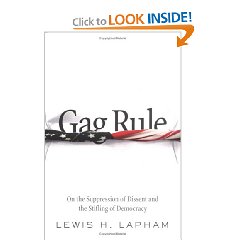
Review: Gag Rule–On the Suppression of Dissent and Stifling of Democracy

5 Star, Censorship & Denial of Access, Democracy
0Shares

Amazon Page
Amazon Page

5.0 out of 5 stars Elegant Essay, Among Best of 475+ Books on Future of America,

July 14, 2004
Lewis Lapham
This is an elegant essay, possibly the best single individual work I have read within the 475+ non-fiction books on national security and global issues including the future of America. It absolutely must be read in conjunction with Peter G. Peterson's “Running on Empty: How the Democratic and Republican Parties are Bankrupting Our Future and What Americans Can do About It” as well as Tom Atlee's “The Tao of Democracy” and Bill Moyers' “Doing Democracy.”Steeped in history and the relationship of dissent to democracy, the author provides a down-to-earth yet erudite condemnation of the ease with which America was led to war on Iraq by a small group of individual who were able to silence Congress, the media, and all other public interest organizations. From the first chapter to the last, the author follows the Will and Ariel Durant method of balancing easy to read general comments with equally easy to read detailed footnotes. Early on he singles out Nancy Pelosi and Robert Byrd as being among the few that stood up to the falsehoods and were grounded in reality, speaking out with integrity and courage.

Two comparisons are drawn by the author between the Bush Administration's abuse of the law and their control, and the past: the American past, when the Sedition Act was used to jail dissenters and subvert new immigrant voters; and the German past, when Hitler and Goering pulled off a gradual castration of free voice and vote with incremental steps, all done gradually, incrementally, inconspicuously, until suddenly a state of totalitarian rule existed. As the White House officially considered postponing the Presidential election of 2004, perhaps canceling it all together, one's bones can only feel the chill of these two examples, both discussed calmly and carefully by the author.

There is a solid strain of economic thinking woven throughout the book, and one can only conclude that the concentration of wealth and the crimes against the working poor now being perpetuated, can only lead to a Great Depression as the labor economy collapses and the technology economy is attacked by the combined ills of overdue break-down, deliberate sabotage, and a withdrawal of foreign credit. The author makes the point on page 85 that America has elevated capital above humans–capital votes in America, humans do not, in the one place where it really matters: the crafting of legislation that transfers wealth from the individual working poor to the privilege elite that own the military-industrial-prison complex.

Gifted ideas and turns of phrase abound. The author is consistent with others I have read in lamenting the continuing decline of our educational system, designed to create conformist factory workers, and goes beyond the norm in suggesting that perhaps 70% of our national potential intellectual capacity is being “killed” by the mediocrity of our existing educational institutions. I agree with that. Our children survive school, much as we survive hospitals and corporations–our institutions are no longer about humanity and emergence, but rather about docility and conformity.

The author is eloquent on the rise of politics as ignorance aggravated by a sublime arrogance that confuses a commitment to a narrow elite with “God's will,” and regards laws as means of “crowd control.”

Sadly, the majority of America does not read books. If they did, this book would be motivating people to take to the streets and demand that the core issue in the election of 2004 be that of restoring the integrity of politics, from counting every vote to refusing every bribe. Absent an awakening of the upper middle class that does read and think for itself, the author has written the epitaph of democracy in America.

Vote on Review
Vote on Review

Review: The Lessons of Terror–A History of Warfare Against Civilians

3 Star, Terrorism & Jihad
0Shares

Amazon Page
Amazon Page

3.0 out of 5 stars One Core Idea: Don't Kill Civilians, End Collateral Damage,

July 14, 2004
Caleb Carr
I would not normally have bought this book, which started out as an article and should have stayed there. However, it is being touted in Special Operations circles, and in the interest of ensuring that I respect and understand what my uniformed colleagues are reading, I made the effort.First off, the book is *mostly* about how terrorism or scorched earth tactics are not a good idea for states. I agree. However, the book completely misses the point on how effective terrorist attacks are as a means of causing great economic and social pain to industrial era states that persist in pursuing unilateralist Christian crusades as well as immoral capitalism that enriches micro-elites while disenfranchising the bulk of foreign populations. Do the math: for $500 *thousand*, Bin Laden got roughly $500 *billion* in costs to the U.S. taxpayer. He (and his thousands of successors) can keep this up forever, we cannot.

There is major aspect of this book that I applaud, and it takes it from 3 to 4 stars: it is the single most effective statement I have seen that denounces U.S. “precision” warfare as not so precision afterall, because of the pre-planned (i.e. pre-meditated and culpable) deaths of tens of thousands of civilians as acceptable “collateral damage.” Although “total war” certainly applies to state on state warfare, the author correctly notes that killing civilians is neither beneficial nor acceptable when making war on dictators or terrorists. That has to be “man on man” and America is simply not capable of doing that–the military-industrial complex would cease to exist as we know it if we actually focused on funding ground truth intelligence at the neighborhood level, and the ability to send invisible snake-eater in and out to do justice on the basis of “one man, one bullet,” something I have long advocated.

The author is conventionally leftist and in harmony with Chalmer Johnson's and other critiques of the misadventures of the Central Intelligence Agency, but I find his critiques uninformed and sophomoric. Although I certainly agree with the author's short listing of CIA's analytical and operational failures over time, as someone who actually understands CIA and the US military better than the author, I have to wave the “CRAP” flag on several of this author's pages as they pertain to intelligence, pages 204 and 260 in particular.

The book ends with the observation that terrorism is like slavery, piracy, and genocide in that sufficient action must be taken to stop individual behavior along those lines, and the sensible suggestion that “evangelical Western capitalism must learn greater restraint and respect for other cultures” and that Western governments must eschew “gunboat diplomacy as self-defeating. Golly. The author may understand but does not demonstrate substantive understanding of the degree to which slavery, piracy, and genocide (18 active campaigns right now, a great deal more than the author's “still attempted in some corners of the world”) continue to be tolerated by Western governments.

There is nothing in this book helpful to crafting a new grand strategy balancing military, diplomatic, intelligence, cultural, and economic initiatives to “close the gap” (see my review of Thomas Barnett on “The Pentagon's New Map.”

Overall this double-spaced essay with no footnotes strikes me as gross misrepresentation. The bibliography is marginal, especially with respect to both modern terrorism and U.S. intelligence. The author took something he knows about–the history of conventional state military warfare–and dressed it up as being relevant to the Global War on Terror. Yes, but it could have been done in one page. This is a very labor intensive way to get to the obvious point, made much more intelligently by Jonathan Schell in “Unconquerable World”: there are not enough guns in the world to quell instability stemming from abusive government rule and immoral capitalism. Tony Zinni sums it up in one line: the faster you introduce food into an area, the more quickly the violence ends.

Vote on Review
Vote on Review

Review: The Pentagon’s New Map–War and Peace in the Twenty-First Century

4 Star, Insurgency & Revolution, Military & Pentagon Power, Priorities, Security (Including Immigration)
0Shares

Amazon Page
Amazon Page

4.0 out of 5 stars Young Man, Big Ideas Finally Refined in 2007,

July 14, 2004
Thomas P.M. Barnett
EDITED 8 July 2007 to add rave review of the author's newest incarnation, his presentation given to TED (URL in the comment). He has finally distilled and refined his ideas into a world-class presentation that is a fantastic stage-setter for more substantive and detailed presenations (see second URL in comment). His current (2007) brain is beyond five stars. I am so very pleased to see this brilliant development.

Old Review (Still Valid on the Book Itself)

This is another of those books that started as an article and should have stayed there. The author, who appears to be either unfamiliar with or unwilling to credit works from earlier decades as well as more recently that present ideas similar to and often superior to his, has essentially three good ideas that can be summed up as follows:

Idea #1: World can be divided into a Functioning Core and a Non-Integrating Gap. The disconnected gap is bad for business (risky) and the US military can protect its budget by getting into the business of exporting security so that Wall Street can do more business safely.

Idea #2: Connectivity or disconnectedness are the essential means of defining and influencing which countries are able to move into the Functioning Core and which remain in the Non-Integrating Gap [too state-centric for my taste, but a good point–my 1990's call for Digital Marshal Plan remains valid.]

Idea #3: Economic relationships have replaced military power as the essential attribute of relations among nations–for example, we cannot deal with China as a military power without first having a comprehensive economic strategy and economic tools with which to influence them.

There are many points where I agree with the author, and I give him credit for thinking of all of this on his own, without much attention to decade's worth of scholarship and informed professional opinion in the military journals. He is absolutely correct to note that we cannot fence the Gap, we must stabilize it. Of course, Joe Nye and Max Manwaring and Mark Palmer and Bob Oakley and Jonathan Schell, to name just 5 of the 470+ national security authors have made important points along these lines, but their work is not integrated here. This is one massive Op-Ed that should have remained an article.

The author has irritated me with his low-key but obvious assumption that he is the first to break out of the box and “get it.” On page 63 he goes on at length with the view that America has lacked visionaries, and the implication that he is the first to come forward. Not true. From John Boyd to Chuck Spinney to Bill Lind to GI Wilson to Mike Wylie we have had many visionaries, but the military-industrial complex has always seen them as threats. We tend to dismiss and shoot our visionaries, and I am truly glad that the author's personal relations with Cebrowski and a few others–as well as his fortunate association with a couple of naval think-forward endeavors–has given him some running room.

There is actually little of substance in this book. The article has been expanded, not with substance, but rather with very long descriptions of this young man's engagement in the process of the Pentagon and the process of strategic reflection. His discussions of the many forums that he found boring if not hostile to free thinking are excellent, and that aspect of the book takes it to four stars where it might normally have only received three.

Two weaknesses of the book, perhaps associated with the author's urgent need to “stay inside the wire” in order to keep his job:

1) All his brilliance leads to just two forces being recommended: the “big stick” force and the “baton-stick” (constabulary) force. In fact, were he more familiar with the literature, he would have understood that from diverse points we are all converging on four forces after next: Big War, Small War including White Hat/Police Ops, Peace War, and Cyber-Economic War. Inter-agency strategy, inter-agency budgeting, and inter-agency operations, with a joint inter-agency C4I corps under military direction, are the urgently needed next step.

2) The author is delusional when describing and praising our operational excellence in defeating well-armed enemies. Were he more familiar with the after action reports from Iraq, particularly those done by the Army War College (clearly on a different planet from the Navel War College), he would understand that Iraqi incompetence was the foremost factor in our success, especially when Rumsfeld insisted on throwing out the sequence of force plans and sending us in light and out of balance. He also ignores the vulnerability of complex systems and relies much too heavily on University of Maryland and CIA unclassified publications that are completely out of step with European conflict studies and other arduously collected ground truths about the extent of state and sub-state war and violence.

I disagree with his concluding recommendations that place Africa last on the list of those areas to be saved. His overall recommendations are simplistic, focusing on the standard litany for Pentagon go-alongs: Iraq, Korea, Iran, Colombia, Middle East, China, Asian NATO, Latin American NATO, Africa.

I note with interest his use of the term, “the military-market link.” I believe this refers to an assumption, matured by the author in the course of his Wall Street wargames, and certainly acceptable to the neo-conservatives, to wit, that the U.S. military exists to export security so America can do business. I would draw the reader's attention to Marine Corps General Butler's book, “War as a Racket”, and his strong objection to having spent his career as an “enforcer” for US corporations.

I do want to end with a note of deep sympathy for the author. On the one hand, he overcame a period of time when his sanity was questioned by ignorant Admirals and other “lesser included” Captains of limited intellect. On other he is trapped in a system that does not like iconoclasts but rewards those who innovate on the margins. His book is most useful in describing this environment, where people who rely on secrets are completely out of touch with reality, and service chiefs focus on protecting their budgets rather than accomplishing (or even defining) their mission. He appears to have discovered the Catholic mafia within the naval services, and his several references throughout the book lend weight to my belief that we need to do religious counter-intelligence within the government.

Vote on Review
Vote on Review