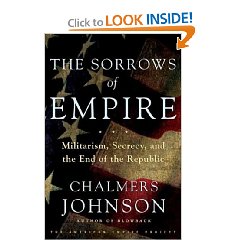
This is tough reading, in part because the publisher's choice of paper and font are not the best. As one who has previously recommended such books as Lionel Tiger's “The Manufacture of Evil: Ethics, Evolution, and the Industrial System”, Norman Cousins “The Pathology of Power”, and many other books on the pathologies of treating man as a “good”, of scientific objectivity as “value neutral” and therefore bad, of secrecy as counter-productive to “precautionary principle” decision-making, I immediately recognized this book as an integrative work, possibly supplanting all those other books by bringing the various arguments together in one place.This is indeed a brilliant product by a towering intellect, and it has the bibliography and index that one would expect from a world-class endeavor. I recommend it together with Philip Alott's “The Health of Nations: Society and Law beyond the State”, Stewart Brand's “Clock of the Long Now”, and John Lewis Gaddis “The Landscape of History”.
The author's bottom line: not only must we come to grips with how power is managed in every nation and organization, but also we must manage at the *global* level if we are to succeed in optimizing fulfillment at the *individual* level.
Sobering, Makes an Important Case, Rough Around the Edges,
January 24, 2004
Chalmers Johnson
This double-spaced book is an indictment of American militarism and unilateralism, and it merits reading by every citizen. It loses one star to a lack of structure and sufficient references to a broader range of supporting literature, and to the author's tendency to go “a bridge too far” in blaming the CIA for everything and in assuming that our troops and their families are somehow enjoying their “luxurious” overseas deployments.It may be best to begin the review where the author ends, by agreeing with the case he makes for the potential collapse of America if the people fail to take back the power and restore integrity and participatory democracy to the Congress. Absent a radical reverse, four really bad things will happen to America: 1) it will be in a state of perpetual war, inspiring more terrorism than it can defeat in passing; 2) there will be a loss of democracy and constitutional rights; 3) truthfulness in public discourse will be replaced by propaganda and disinformation; and 4) we will be bankrupt.
It merits comment that today, as I read and reviewed the book, which documents over 725 US bases around the world, many of them secret, there is a public discussion in which the Pentagon is acknowledging only 400 or so bases to exist.
There is a considerable amount of short-hand history in the book that can be skimmed rapidly–from the roots of American militarism in the Spanish-American war, to the non-partisan efforts of both Clinton and Bush fils to establish a military base structure in Arabia and in Central Asia.
The author provides a number of worth-while commentaries on war crimes and associations with genocidal acts and repressive dictators on the part of Henry Kissinger, Wes Clark, James Baker, Dick Cheney, and other mostly Republican “wise men” associated with the oil companies of America.
On pages 100-101 he draws on a number of authoritative sources to note that the casualty rate for the first Gulf War was close to 31% (THIRTY-ONE PERCENT) due to the exposure of the 696,778 veterans serving there being exposed to depleted uranium rounds and other toxic conditions *of our own making*, with 262,586 of these consequently falling ill and being *officially* declared to be disabled by the Veteran's Administration. I have no doubt that there will be an additional 100,000 or more disabled veteran's coming out of Gulf War II. These disabilities are multi-generational. Veterans disabled in the Gulf have higher possibilities of spawning children with deformities “including missing eyes, blood infections, respiratory problems, and fused fingers.”
The author excels, I believe, in bringing together in one book the combined costs and threats to the American Republic of a military that on the one hand is creating a global empire that is very costly to the US taxpayer and very threatening to everyone else; and on the other hand, is creating anti-democratic conditions within the United States, to include frequent and expensive preparations for dealing with “civilian disorder conditions” here at home.
The author also excels in discussing both the collapse of US diplomacy (today the Pentagon manages 93% of the international relations budget, the Department of State just 7%), and the rise of private military companies that he carefully lists on page 140–Halliburton, Kellogg Brown and Root, Vinnell, Military Professional Resources, DynCorp, Science Applications Corporation, BDM (now TRW), Armor Holdings, Cubic, DFI, International Charter. There are more–they are all “out of control” in terms of not being subject to Congressional oversight, military justice and discipline, or taxpayer loyalty.
In the middle of the book the author examines the change in the roles of the military from its World War II and post-Cold War missions to five new missions that have not been cleared with the American people: 1) imperial policing; 2) global eavesdropping; 3) control of petroleum fields and channels; 4) enrichment of the military-industrial complex; and 5) comfortable maintenance of the legionnaires in subsidized compounds around the world, such that numbers could be justified that could never be maintained in garrison within the USA.
On page 164 the author notes most interestingly that China is among the greatest purchasers of fiber-optic cable in the world (thus negating much of NSA's 1970's capabilities), and on page 165 he discusses, with appropriate footnotes, how the US, UK, Canada, and Australia are circumventing the prohibitions against monitoring their own people by trading off–the Canadians monitoring British politicians for the British, the British monitoring US politicians, etcetera.
Among the strongest sections of the book is the detailed discussion of America's love affair with ruthless dictators (and Muslim dictators at that) in Central Asia, all in pursuit of cheap oil our privilege elite think they can control. Of special interest to me is the author's delicate dissection of the vulnerability of any Central Asian energy strategy, and his enumeration of all the vulnerabilities that our elite are glossing over or ignoring.
Summing it all up, the author attributes US militarism and the Bush fils “doctrine” to “oil, Israel, and domestic politics”, and he bluntly condemns it all as “irrational in terms of any cost-benefit analysis.” Quoting Stanley Hoffmann, an acclaimed international relations theorist, he condemns Bush's “strategy” (as do I) as “breathtakingly unrealistic”, as “morally reckless”, and as “eerily reminiscent of the disastrously wishful thinking of the Vietnam War.”
This is a fine book. Read widely enough, it has the potential for constructively informing the popular debate that is emerging despite all efforts by the Administration and its corporate cronies to suppress discussion [e.g. MoveOn.org's $2M in cash for a Superbowl ad has been rejected by CBS on the grounds of being too controversial]. Despite a few rough edges, I believe the author represents a body of informed scholarly and practical opinion such as I have tried to honor with my many non-fiction reviews, and I hope that everyone who reads this review decides to buy the book.
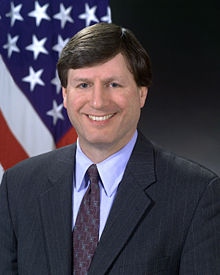
Dr. Stephen Cambone was a fine Undersecetary of Defense for Intelligence (USD(I)) given the context he was in and the policy personalities he was dealing with. His most brilliant moment, for the public interest, came on 22 January 2004 when he spoke to the Security Affairs Support Association (SASA) about the need for universal coverage at the neighborhood level of granularity. When combined with Boyd Sutton's findings on the Challenge of Global Coverage (Frog Left), and the 9-11 Commission depiction of an independent Open Source Agency (OSA) on page 413 of its report (Frog Right), the stage is now set for the present USD(I) to finally get moving on this program with an Initial Operating Capability (IOC) of no less than $125 million a year, as has been agreed to by OMB principals and key staff on successive occasions.
Stephen Cambone
The other two legs of the DoD OSINT stoolare below. Note that the 9-11 Commission did not have time to fully understand the OSA it was recommending; all serious practitioners have agreed that it cannot be within the secret intelligence world, but rather outside the wire, perhaps under joint Defense Intelligence (DIA) and Civil Affairs (CA) proponency, the first responsible for firehosing all OSINT to the high-side, building the bridge from Intelink-U to the SIPR Net; the second responsible for both ingesting all open source information from multinational partners including Non-Governmental Organizations (NGO), and for multi-national information-sharing and sense-making at the unclassified level, all of which is both shared liberally without secret world constraints, and also feed immediately to the high-side for further explotation by all-source analysts with access to all available classified information.
ABSTRACT: The primary hyposthesis that I will endeavor to support is that leveraging the benefits of network organization constitutes a new source of power and a new way of accomplishing global governance.
Complexity + Networks + Connectivity = Panarchy
CONCLUSION: In this paper I have shown that the convergence of processes crosses a critical threshhold to create new possibilities for governance. The result is a new system. The key distinction between the old system and the new lies in the fact that governance in the old system was achieved through states, whereas in the new system it is not only achieved outside of hierarchies through horizontal networks, but is in fact often achieved in spite of hierarchies.
Phi Beta Iota: The author is meticulous in crediting James N. Rosenau, Turbulence in World Politics: A Theory of Change and Continuity (Princeton, NJ: Princeton University Press, 1990) for originating many of the concepts that underlay the emergent scholarship on panarchy.
A Former Spy Myself, I Found This Book Generally Lacking,
January 20, 2004
John le Carre
John Le Carre writes two kinds of books: truly riveting and gloriously accurate depictions of the spy world, and more labored pseudo-literature that over-reaches and disappoints. This book falls into the latter category.As one who has both read much of what Le Carre has written, and also had the privilege of being a clandestine case officer (spy under official cover), I was initially taken with the concept of the book, despite its obvious intent to resurrect the genre in the aftermath of 9-11, but soon found myself bored beyond belief. It is closer to “The Naive and Sentimental Lover” side of Le Carre, than to the more deservedly riveting Tinker, Tailor, Drummer Girl, or Smiley's People, Looking Glass War side of Le Carre.
There was a time, absent good non-fiction on the spy world, when Le Carre's work, his George Smiley work especially, not only delighted but informed. Now, with so many truly top-notch non-fiction books about intelligence (for instance, those by Milt Bearden, Robert Baer) one is really much better off reading non-fiction for fun. See my short and long lists of intelligence books (as well as emerging threats and blowback/dissent in foroeign affairs) for a sense of what non-fiction can deliver these days in the way of compelling and disturbing real-world spy reading.
Extraordinary Strategic/Tactical Guide for People Power,
January 20, 2004
Bill Moyer
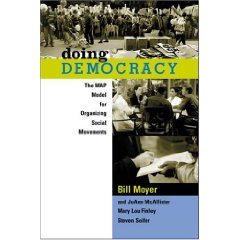
This book is both a strategic orientation to, and a tactical primer on, how to develop and manage non-violent social movements at the grassroots or “people power” level.The reason this book is important is because it solves the most important problem or gap facing all social movements: the lack of strategic models and methods that help activists understand, plan, conduct, and evaluate their social movements. I have read this book from cover to cover and it fulfills the objective. Had Howard Dean and Joe Trippi read this book six months ago, they would not have blown the lead and come in a sorry fourth (less than half of what Kerry had, less than a quarter Kerry and Edwards combined), to guys that did *not* figure out MoveOn.org and the Internet as a collective consciousness tool.
This is among the most heavily marked up books I have read in the past four years, and instead of summarizing it in detail, which may cause some of you to avoid buying it, I will simply endorse the primary author's view that social movements are needed now more than ever, for the simple reason that the powerholders are making life on the planet unsustainable–everything they do (think Dick Cheney here) to increase profits, control, and power, is also “increasing unemployment, the gap between rich and poor, violence, ecological collapse, and unsustainability”.
There are four aspects of the book that are especially valuable as we all find ourselves in a “world war” between fundamentalist groups (both Islamic and extremist Americans of the religious right falling prey to neo-conservative doctrine) and progressive individuals seeking the common good:
1) the author's focus on sub-movements, on creating a strategic campaign that specifically embraces each sub-movement as a distinct but coordinated element, is the “aha” factor in leaping forward.
2) the author's specific discussion of negative rebels and how much harm they can do to the larger movement is compelling, to the point of actually suggesting that we need to create a counterintelligence service within social movements to address this. The few violent protesters in Seattle got all the media coverage, and the non-violent mass lost a great deal of credit.
3) the eight-stages of social movements are extremely detailed and the case studies help to explain why the “slump” must be overcome in the fifth stage, when success has been achieved but there is a perception of failure.
4) the importance of having an economic strategy for where the social movement's vision needs to go, is not understood by most presidential candidates. This book is valuable to anyone who would be president, or senator, for it explains not only how to organize and lead a social movement, but how to govern resources to its desired ends after the fact of victory. Real world budgeting is a neglected aspect of leadership during the electoral process.
I would say that this book (together with Tom Atlee's “The Tao of Democracy: Using CO-INTELLIGENCE to create a world that works for all”), is core reading for anyone interested in saving his or her neighborhood, his or her country, or the world at large. The primary and secondary authors are also to be commended for making the point that it is possible to be effective *regardless of who is President or what party is in charge in the capitol*–they emphasize local grass-roots effectiveness that is non-partisan.
Juliette Beck and Nancy Gregory make contributions that should have been acknowledged on the cover. Juliette Beck especially, with her focus on globalization and the sub-movements and stages of the aggregate movement, provides a most satisfactory case study that concludes the book.
President, OPEN SOURCE SOLUTIONS, Inc. Editor's Note: [Mr. Steele is a veteran of the clandestine service with three back-to-back tours in Latin America]. He received two awards while an operations officer. He has also served in offices responsible for programming satellite systems and advanced information technology applications, and concluded his government career as the senior civilian responsible for standing up the $20 million Marine Corps Intelligence Center, and subsequently as a senior civilian in the C4I Department at HQMC responsible for National Foreign Intelligence Program and General Defense Intelligence Program resources under Marine Corps cognizance. Sometimes controversial, always visionary, he is one of those influencing the future of our intelligence community.
The time has come to outline a vision of the future of American intelligence. It was distressing to me, in reading Alvin and Heidi Toffler's latest book, War and Anti-War: Survival at the Dawn of the 21st Century, to discover in their chapter on “The Future of the Spy” that I am not only considered the “rival store” because of my emphasis on the importance of open sources of intelligence, but that I am considered (by the Tofflers, who have become good friends) to be “the single most forceful enemy of secrecy in Washington”. The Tofflers are brilliant, and I am indebted to them for focusing attention on these issues, but I would like to tell my peers and colleagues in AFIO where I really stand, and in this way solicit comment. All of us, retired or serving, must come together to reinvent ourselves.
I'll sum up my vision in a nutshell: let's get back to basics by doubling the clandestine service, refocusing our technical investments, dramatically increasing our consumer base and the voice of our consumers in validating collection and production, and by leveraging–for the first time–the vast “virtual” intelligence community that exists outside the beltway. At the same time, we can significantly improve the totality of our government's ability to capture unclassified information critical to national competitiveness [by realigning positions within our Embassies to increase the effectiveness of State and Commerce as collectors of unclassified information.] If the intelligence community is to remain a significant element of our national power, then it must recognize that its present form is destructive and counterproductive. The intelligence community cannot and will not survive at its present funding levels unless radical changes are instituted immediately.
Let's begin with open source intelligence (OSCINT), since that it the arena where I first confronted our inadequacies. When Colonel Walter Breede and I first stood up the Marine Corps Intelligence Center in 1988, with $20 million in funding, courtesy of the General Defense Intelligence Program, it never occurred to us to question the value of the existing Top Secret/Codeword architecture and databases, and so we set in motion a spending plan that ultimately led to $10 million being obligated for a classified communications and computing system with direct access to CIA, NSA, and DIA data. Since Walt and I had always been collectors, it just blew us away when we went to produce intelligence and our analysts discovered that the Third World “data fill” has simply not been accomplished over the years. We are paying the price today for our obsession with the Soviet Union.
The good news is, as I discovered when the shock wore off, that there is an enormous “virtual” intelligence community out there, outside our vaults, which has much of the encyclopedic information that we require to satisfy the needs of our traditional consumers, as well as the needs of new consumers such as the Environmental Protection Agency. It came as a surprise to me, when I devised the first open source exploitation strategy for the Marine Corps, to discover that I could meet most of our needs by spending $20,000 a year on commercial online services such as LEXIS/NEXIS (Mead Data Central), DIALOG, BRS, and the U.S. Naval Institute's PERISCOPE, plus a few CD-ROMS such as those available from Jane's Information Group. The first strategic intelligence product of the Marine Corps Intelligence Center, a study of 69 geographic entities, was completely unclassified and based solely on unclassified sources.
The bad news is that neither our architectures nor our procurement practices lend themselves to exploiting open sources. Our architectures, which meet security standards for Top Secret/Codeword, essentially comprise a cement bunker without windows, a bunker into which the fresh air of open sources does not readily enter. Our procurement practices are overwhelmingly skewed toward the funding of hardware acquisition and in-house analysts, rather that toward the leveraging of external centers of excellence who bear their own overhead costs. Worse, I do not see any positive steps to correct these deficiencies. Although the military intelligence community, and the scientific & technical intelligence analysts in particular, do well in exploiting open sources, the general approach of the intelligence community in recent years has been to create a duplicate architecture, to require analysts to go to separate workstations to use open sources, or to “bundle” detailed analysts queries into large “blobs” which force the private sector respondent to vomit back into the classified computers a mirror image of their entire holdings simply because they are not designed to “unbundle” the queries.
Developing OSCINT concepts and doctrine is critical to our future as an intelligence community. The National Foreign Intelligence Board (NFIB) was recently advised that 40% of the all-source product comes from OSCINT, at a cost of 1% of the National Foreign Intelligence Program (NFIP). While I personally feel that they underestimated the cost and that it is closer to $2 billion a year, 7% of the NFIP, this is never-the-less a shocking and instructive insight into the role that OSCINT plays in our profession.
Following are my policy recommendations on OSCINT:
a) Trying to get analysts to move to a different workstation, and bundling analysts' queries, is dumb, expensive, and counterproductive. We must use our industrial partners, our traditional external research partners each of whom has a Sensitive Compartmented Intelligence Facility (SCIF), to provide both the security air gap, and the “laundering” of our specific queries, so that individual analysts working from their classified workstations can send out a specific query and receive a specific response at their classified workstation. We cannot afford to recapitalize the existing architecture, nor can we count on analysts to tolerate a diversity of workstations and the security requirements inherent in transferring OSCINT data from one system to another. Our industrial partners can be relied upon to provide the virus checking and other security measures associated with introducing external OSCINT into the Top Secret/Codeword domain.
b) Reliance on industrial partner outreach efforts is not enough. A national program is required which nurtures distributed centers of excellence in various subject matter areas. One of our most important deficiencies as a community is the inexperience of our analysts. The Director of Intelligence for CIA recently commented on his dismay, in assuming his position, at discovering that he had a bunch of “19 year olds” doing analysis. Obviously they are a few years older than that, but his point is well-taken–I can testify, as a result of my brief experience as an observer of the DCI's Management Advisory Group, that the CIA strategy for keeping personnel costs down relies heavily on a constant cycling in and out of those under the five year mark. The result of this is a gap in the middle. In the military we match this lack of continuity and expertise by assigning people to different tasks every two years, never allowing anyone to master a language or a topic. There are two solutions: on the one hand, we need to develop a cadre of experts (and a related career progression path) in the many areas of interest; and on the other hand, we need to use our experts to oversee and take advantage of a much broader circle of distributed experts–experts whose overhead we need not finance. It is my opinion, expressed in draft legislation now in staffing, that the best way to nurture distributed centers of excellence is through a Vice Presidential initiative, a National Information Foundation, which provides grants to specific business, media, and academic institutions, and which is independent of, but responsive to, the intelligence community.
c) Finally, we need to extend our methods to the rest of government. It was instructive to me, during one Open Source Lunch Club (second Tuesday of every month at the Tivoli in Rosslyn) to hear a Special Assistant to the President comment that the intelligence community was fairly useless in strategic economic decision-making because it did not report on domestic economic matters, and that the rest of government, for instance the Federal Reserve, was fairly useless because it was lousy at the business of intelligence–of collection management and distilled analysis. We must overcome the existing separation between our intelligence community analysts with clearances, and the many expert analysts in different elements of government without clearances. One way to do this is to adopt Andrew Shepard's recommendations, in his “Intelligence Analysis in the Year 2002: A Concept of Operations”, and put intelligence community analysts alongside the consumers. There are two reasons for doing this: the first is that our consumers need real-time decision-support, and not the flood of “classified information” that they now receive and ignore; and the second is that 90% of what a policy-maker reads and listens to today is both unclassified and unanalyzed. We have abdicated our role of informing policy, and by focusing on secrets, failed to exercise our critical capability to validate and place in context non-secrets.
Now let me turn to imagery and signals intelligence, before concluding with observations on the discipline nearest my heart, clandestine human intelligence.
Imagery intelligence, in its time, was the “oasis” in the desert. However, over the years, someone has come along and watered the desert. It was no surprise to me to see the President of the United States overrule the DCI and direct that one meter resolution synoptic imagery be pushed into the private sector. There are three good reasons why this was necessary: the first is that our restrictions to date have amounted to nothing more than a U.S. taxpayer subsidy of Russian and French imagery sales. The second, more important, is that our existing classified imagery systems and their related priority management process have proven unable to satisfy urgent contingency mapping, charting, and geodesy (MC&G) needs. It is my estimate that we are 75 satellite years behind in fulfilling basic MC&G requirements. In the case of the Marine Corps, of 69 countries of interest, there are zero 1:50,000 maps for 22 of our most likely contingencies, and dated (10-15 year old) maps for ports and capital cities only (not maneuver areas) for an additional 37 countries. Commercial synoptic (i.e. we can do contour lines) one meter resolution imagery is more likely to satisfy Marine Corps needs than the present government-owned constellation with its related priority system. Lastly, and also important, the reality is that we cannot maintain our technological leadership, our ability to produce satellites, under the reduced ordering rate now funded by the U.S. government–unless we are allowed to sell this technology overseas, we simply will not be able to keep the assembly lines open, nor continue to support leading edge research.
We still have not solved the wide-area imagery problem, although progress has been made. We need to be aware that Ted Turner, of CNN fame, is hell-bent of having his own imagery system and never again being censored by the U.S. government. It is inevitably that there will ultimately be a global constellation of commercial satellites with images for sale to anyone. This would be a good time to shift our emphasis from collection to processing, from stove-pipe analysis to integrated analysis and inter-disciplinary tipoff, and near-real-time tactical dissemination. That will provide our competitive advantage.
Signals intelligence (SIGINT) has always been a mystery to me. It was absolutely useless to me [as a case officer], and this was especially galling when a test run in Panama, done as a personal favor when I was chasing terrorists, demonstrated that SIGINT could make a dramatic contribution to my local operations. I simply was not important enough in the over-all scheme of things. We have a long way to go before SIGINT is a major contributor to local human intelligence (HUMINT) operations.
On a broader scale, the Clipper Chip initiative must be mentioned. There is no question in my mind but that NSA authorities–smart people with super computers–believe this to be essential to our future. However, and I say this as a direct result of my international notoriety and expanded circle of contacts, they are out of touch with the American people and with reality. The Clipper Chip is dead. NSA needs to focus on being able to do its mission secretly, without recourse to public admissions of incapacity–it also needs to consider how its smart, computer-friendly analysts with language skills, can make a difference in monitoring the unclassified traffic that is so prevalent on the Internet and other elements of “cyberspace”. NSA has a very important and expanded role to play in collecting and processing intelligence from cyberspace, provided we can all agree that much of the intelligence to be gained from cyberspace is not necessarily encrypted, but simply lost in the confusion and noise that characterizes that environment.
[And now to HUMINT, I will be blunt, for I care deeply about this discipline. When I was at The Farm they emphasized security and counter-surveillance. Then I got overseas and discovered that a) I was working from an official installation easily covered by host country surveillance; b) I was expected to work after hours and on week-ends, making it very easy for the host-country to identify me; and c) I was expected to meet every one of my 20 agents and every one of my fifteen developmental every week. There is no discipline more important to national security decision-making than HUMINT, for it is only “in your face HUMINT” from deep and proven penetrations which can persuade policy-makers to use force and take other measures which might be politically troublesome at home.
It is impossible to maintain a clandestine service worthy of the same from within official installations and using youngsters whose idea of cover is impossible to sustain because they have never really held a job in the private sector. Unfortunately, the existing funding profile for clandestine operations relies on official cover and a very young and inexperienced–and therefore low-cost–population. Going deep and long will cost money. It is my view that the funding profile for the clandestine service must double over time, with a majority of that doubling going toward increased non-official capabilities, increased support to pre-emptive military operations, and increased penetrations of “rogue-government” and international criminal gang leadership circles. This is the greatest challenge facing the U.S. intelligence community, and the one most likely to be ignored and under-funded.]
We have got to get out of the Embassies, and we have got to get away from the idea that only yuppies who can pass security hurdles should be allowed to be [case officers]. There is absolutely no justification for imposing the same security standards on collectors as are applies to all-source analysts. In my view, we need many more Third World ethnic career agents, many more [non-official cover officers], and much more in the way of contingency coverage. In brief, we need to go deep and go long. If I were DCI, I would spin off the Directorate of Operations (of which one third would be devoted to military support) as a separate agency, and I would give them the funding necessary to support mid-career hires–let someone learn their cover at the expense of others, and then turn them into spies. I would also ensure that we shifted to multiple networks of non-official covers with at least a bare bones overlapping coverage of every country and every global criminal organization and tribe in the world.
There is no question in my mind, but that in an age of technical sophistication, and national-cultural fragmentation, that HUMINT is move vital that ever. I have not touched on counterintelligence and the Bob Ames case. Nor do I need to. We fell in love with the polygraph, even though we knew in the mid-l980's that it was a marginal vehicle. Two of my classmates got wrapped up in Cuba (and appeared on international television) because the Cuban double-agents all managed to pass the polygraph. There is a discernible tendency in the USA to rely too much on technical panaceas, and to eschew labor-intensive or “complicated” approaches. I am here to say: open sources are an important and fundamental part of the solution. Do NOT send as spy where a schoolboy can go. HOWEVER, if you do NOT have a diverse collection of spies out there, penetrating the wide variety of communal (non-national and often tribal or religious) groups that are hostile to your interests, then plan for major damage to national security and national competitiveness, for you have abdicated your right to survive and betrayed the most fundamental interests of the American people today and of the generations to follow.
NOTE: For detailed critiques of current U.S intelligence capabilities, and related recommendations for improvement, see among other publications the following:
“Intelligence in the 1990's: Recasting National Security in A Changing World”, American Intelligence Journal (Summer/Fall 1990)
“Applying the ‘New Paradigm': How to Avoid Strategic Intelligence Failures in the Future”, AIJ (Autumn 1991)
“The National Security Act of 1992”, AIJ (Winter/Spring 1992)
“A Critical Evaluation of U.S. National Intelligence Capabilities”, International Journal of Intelligence and Counterintelligence (Summer 1993)
“Talking Points for the Director of Central Intelligence” dated 20 July 1993, subsequently published in Proceedings of the Second International Symposium on “National Security & National Competitiveness: Open Source Solutions” (Washington, D.C. 2-4 November 1993)
“Reinventing Intelligence: Holy Grail or Mission Impossible”, Periscope (Journal of the Association of Former Intelligence Officers), June 1994