Review: For the Common Good–Redirecting the Economy toward Community, the Environment, and a Sustainable Future

5 Star, Best Practices in Management, Economics, Environment (Solutions)
0Shares

Amazon Page
Amazon Page

5.0 out of 5 stars Ethical, Humanitarian, Communitarian, Sustainable,

January 1, 2004
Herman E. Daly
Edit of 21 Dec 07 to add links

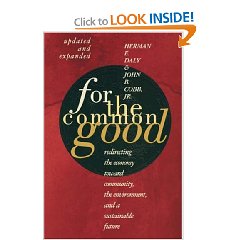
Dr. Herman E. Daly may well be a future Nobel Prize winner …he is especially well-regarded in Norway and Sweden, where he has received prizes one step short of the Nobel. He is the author, co-author, or primary contributing editor of many books that fully integrate the disciplines of economics and ecology. I bought the three most recent for the purpose of selecting one to give out at my annual Global Information Forum. I ended up choosing this book to give away to hundreds, in part because it is available in paperback and is not a more expensive “trade” publication; and in part because it is strong in laying out specific ecological policy areas in the context of a strong theological or ethical perspective.

Of the three books I reviewed, (the newest Ecological Economics: Principles And Applications, the oldest, updated, Valuing the Earth: Economics, Ecology, Ethics) the first, the text-book, is assuredly the most up-to-date and the most detailed. If you are buying only one book for yourself, that is the one that I recommend, because these are important issues and a detailed understanding is required with the level of detail that this book provided. It should, ideally, be read with “Valuing the Earth” first (see my separate review of that book, from the 1970's updated with 1990's material and new contributions), then this book (“For the Common Good”), and finally the text book as a capstone. But if you buy only one, buy the text book.

This is a second-edition work, updated from the 1984 first edition. I like it very much in part because it comes across as less academic and more common-sense in nature. Part One does a lovely job of tearing apart the fallacy of misplaced concreteness with respect to economics, the market, measuring economic success, the reduction of the human to a “good” that can be traded without regard to humanity and ethics and community, and land. Part Two gently introduces the reader to the many distinguished thought-leaders and practitioners who have gradually matured the discipline of economics to embrace humanity, community, and sustainability as non-negotiable realities that cannot be ignored.

Part Three, a major factor in my choosing this book over the others for broad pro-bono distribution, addresses the specifics of policies one element at a time: free trade versus community; population; land use; agriculture; industry; labor; income policies and taxes; from world domination to national security as an objective. Finally, Part Four, without being corny or preachy, describes the religious or ethical vision (I still think the Golden Rule works as a one-sentence definition of common interest).

An afterword on debt in relation to money and wealth is particularly timely as the American public foolishly allows the White House carpetbaggers to run up a $7 trillion deficit that our great-grandchilden will never be able to pay off if we continue is these evil and irresponsible directions, all in sharp opposition to the sensible and ethical constructs in this book.

Of the three books, none of which really duplicate one another in any negative way, albeit with overlaps, this is the second that I recommend for purchase, after the textbook.

See also, with reviews, published since then:
The Battle for the Soul of Capitalism: How the Financial System Underminded Social Ideals, Damaged Trust in the Markets, Robbed Investors of Trillions – and What to Do About It
Natural Capitalism: Creating the Next Industrial Revolution
Green to Gold: How Smart Companies Use Environmental Strategy to Innovate, Create Value, and Build Competitive Advantage
Cradle to Cradle: Remaking the Way We Make Things

Vote on Review
Vote on Review

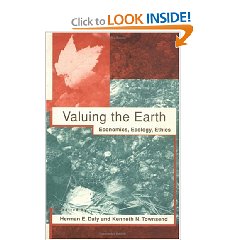
Review: Valuing the Earth–Economics, Ecology, Ethics

5 Star, Best Practices in Management, Economics, Environment (Solutions)
0Shares

Amazon Page
Amazon Page

5.0 out of 5 stars A Treasure Chest–The Originals Plus the Current Masters,

January 1, 2004
Herman E. Daly
Edit of 21 Dec 07 to add links to more recent books that build on this.

This is one of three books that I bought for review with the intent of selecting one for broad pro-bono distribution. Although I chose “For the Common Good” and I recommend “Ecological Economics” as the one book to buy if you buy only one (see my reviews of those books at their own pages), this book is a treasure chest of original and current thinking that should certainly be in your hands if you can afford all three books. As another reviewer has noted, it finally re-publishes some of the hard to get original thinkers from the steady-state economics era of the 1970's. However, it does so with an ample leavening of 1990's authorship, and hence could reasonably be regarded as a first-class “readings” complement to the text book (“Ecological Economics”).

There is a chart on page 20 of this book that is quite extraordinary. Titled “The ends-means spectrum”, it brilliantly runs down from the top: Religion and Ethics as guidelines to ultimate and intermediate ends of humanity; to the middle Political Economy as a means of managing the factors of production to specific political ends; to the bottom: Technics and Physics as the “ultimate” foundation or “ground truth” of flow-entropy-matter-energy that must constrain political and religious ends.

This book, in which Kenneth N. Townsend is the second contributing editor-author, blends practical, political, economic, and theological writings, over several decades, in a most pleasing manner. E. F. Schumacher's “Buddhist Economics” jumped out at me, reminding me that our predominantly Protestant corporate capitalist ethos is very far removed from the realities that guide and repress billions around the Earth, all of whom have fewer options than we do. With that thought in mind, I strongly recommend William Greider's “The Soul of Capitalism: Opening Paths to a Moral Economy” as a very current complement to any of the books that Dr. Daly has helped bring into the marketplace of ideas.

See also, with reviews:
The Battle for the Soul of Capitalism: How the Financial System Underminded Social Ideals, Damaged Trust in the Markets, Robbed Investors of Trillions – and What to Do About It
Natural Capitalism: Creating the Next Industrial Revolution
Green to Gold: How Smart Companies Use Environmental Strategy to Innovate, Create Value, and Build Competitive Advantage

Vote on Review
Vote on Review

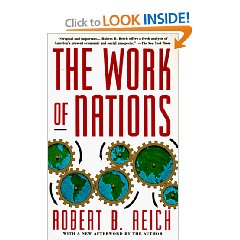
Review: The Work of Nations–Preparing Ourselves for 21st Century Capitalism

4 Star, Capitalism (Good & Bad), Strategy
0Shares

Amazon Page
Amazon Page

4.0 out of 5 stars Incomplete but Original and Worthy of a Second Look,

January 1, 2004
Robert B. Reich
Edit of 21 Dec 07 to add links.

One reason I read only books I have bought (so that I may liberally mark them up) and tend to never discard a book, which is becoming a real problem in my basement, is because current reading will often lead one back to some gems and to a reestimation of earlier readings. Robert B. Reich's “The Work of Nations: Preparing Ourselves for 21st Century Capitalism” can be read with renewed appreciation and respect if one if also now reading William Greider's The Soul of Capitalism: Opening Paths to a Moral Economy or any of the books by Herman E. Daly (e.g. Ecological Economics: Principles And Applications).

I read Reich's Locked in the Cabinet, but this book remains a better gauge of his value to America, and I do hope we get a chance to hear from him again. If you have not read this book, it is a real bargain as a used book and you should buy it–Reich will remain relevant for decades to come.

Relevant books published since then:
The Battle for the Soul of Capitalism: How the Financial System Underminded Social Ideals, Damaged Trust in the Markets, Robbed Investors of Trillions – and What to Do About It
Blessed Unrest: How the Largest Movement in the World Came into Being and Why No One Saw It Coming
Natural Capitalism: Creating the Next Industrial Revolution
The Wealth of Networks: How Social Production Transforms Markets and Freedom
The Fortune at the Bottom of the Pyramid: Eradicating Poverty Through Profits (Wharton School Publishing Paperbacks)
Revolutionary Wealth: How it will be created and how it will change our lives

Vote on Review
Vote on Review

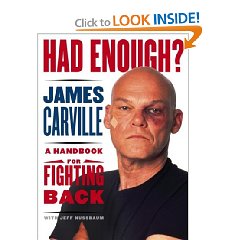
Review: Had Enough? A Handbook for Fighting Back

4 Star, Politics
0Shares

Amazon Page
Amazon Page

4.0 out of 5 stars Elegant, Missing Some Pieces, Great Bridge to the Future,

January 1, 2004
James Carville
Edit of 21 Dec 07 to add links.

Having reviewed, with appreciation, a number of the books that lambaste the extremist Republican carpetbaggers now in the White House (I am myself a moderate Republican who feels betrayed), I can say here that James Carville has done very, very well. He is vastly more elegant and politically focused than Al Franken, Jim Hightower, or Michael Moore, and dramatically easier to read than Paul Krugman, Matthew Crenson & Benjamin Ginsberg, or the cultural creative/new progressive/radical center readings (see Steele's List on Democracy & the Republic).

Lies and the Lying Liars Who Tell Them: A Fair and Balanced Look at the Right
Thieves in High Places: They've Stolen Our Country and It's Time to Take It Back
Dude, Where's My Country?
Peddling Prosperity: Economic Sense and Nonsense in an Age of Diminished Expectations
Downsizing Democracy: How America Sidelined Its Citizens and Privatized Its Public
We the People: An Introduction to American Politics, Sixth Shorter Edition

This is a double-spaced book with big print and small pages, but it does the job. James Carville may be a ragin' Cajun with a smart mouth and a weak bladder (read the book) but he clearly has three things going for him: a brain that is in gear before he talks or writes; good friends strong on both policy and research; and a gift for cutting to the chase. Where I would want to have five of my author-advisors putting together a 1 page summary and 5 page detailed review for each of the key policy areas, Carville manages to do in one book what none of the Democratic candidates–not Dean, not Gephardt–have done: he breaks George W. Bush's back with six strokes of the rod: 1) provide for the common defense (homeland insecurity, screwed up military and foreign policy); 2) provide for the general welfare (deficits and debts matter a lot, tax cuts are a huge lie); 3) secure the blessings of liberty to ourselves and posterity (education, environment and energy, health care–and notice the emphasis in the Constitution on *posterity*, which is the opposite of carpet-bagging); 4) Establish justice (campaign finance reform, corporate governance, myth of tort reform); 5) insure domestic tranquility (why entitlements matter, notes on lying, the religious right, and friends); and finally, 6) form a more perfect union.

This is a quickie book, clearly tapping a multi-million person market for books that contain truth and oppose the impeachable activities of the extremists now looting America through their control of US government policy. It is a simplistic and imperfect book, but sufficient to persuade me that anyone who can muster 1000 brilliant experts covering the 250 critical policy and budget topics that must be mastered to win the general election, must, of necessity, have James Carville as the moderator and facilitator.

The book has several useful graphics, and among them two stand out: one on the changes in the opinion of billions of people around the world from before 9-11 to after three years of Bush in power; the other on the $980 billion–almost one trillion–in uncollected annual tax revenue from corporations that tell their stockholders one thing and the IRS another. I absolutely agree with this author that among our highest priorities must be our restoration of America as good neighbor and global friend to legitimate governments (that cuts out the 44 dictators still operating as looting pals of the Cheney-Bush-Perle regime); and the capture of the lost corporate revenue that could, with other savings, fully fund the most important national security investments: in our people, their health and education, and the restoration of legitimate democracy in America.

Perhaps most interestingly, Carville has avoided the rush to Dean that characterized myself and others who thought Dean would mature quickly and move from Amway parties to structured policy and outreach to all parties including moderate Republicans like myself. Carville cites George McGovern and Nancy Pelosi as special people, and I agree with the first. Pelosi has had her moments, but she has been a doormat in the anchor leg and I will never forgive her for taking impeachment off the table). He also highlights the Center on Budget and Policy Priorities and the Citizens for Tax Justice as meriting special attention, and I only wish that George Soros has earmarked funds for these rather than for organizations that have been too quick to support Howard Dean and abandon a centrist non-partisan policy development position.

Buy this book. Read my other 435 or so reviews. And then, as Carville suggests, stop writing to your Senators and Representatives. Write instead to the editors of your local newspaper and start putting these people (Senators and Representatives) on the spot for betraying the public trust. Download the free NATO Open Source Intelligence Handbook (at oss.net or Google for it) and begin following Tom Atlee's concept for citizen wisdom councils. Take back the power, and don't wait for the Democrats to get their act together, it may be years.

See also:
Vice: Dick Cheney and the Hijacking of the American Presidency
Running on Empty: How the Democratic and Republican Parties Are Bankrupting Our Future and What Americans Can Do About It
Weapons of Mass Deception: The Uses of Propaganda in Bush's War on Iraq
Blood Money: Wasted Billions, Lost Lives, and Corporate Greed in Iraq

Vote on Review
Vote on Review

2003 Andregg (US) State of the Academic Tribe in 2003

Academia, Historic Contributions
0Shares

Michael Andregg
Michael Andregg

Prof. Michael Andregg, Chief OSINT Shrink (USA)

IOP '06.Ā  For academic excellence and support to the dual concepts of Open Source Intelligence (OSINT) across all seven tribes of intelligence, and the urgent need for intelligence reform, inclusive of a psychological re-orientation away from compartmented lunacy and toward inclusive openness.Ā  Professor Andregg embodies the concept of Information Peacekeeping–conflict deterrence and stabilizing wealth creation through the sharing of open information in all languages.

In 2003 Pofessor Andregg, one of the few who really understood both the distinctions among the eight tribes of intelligence, and the urgency of cross-fertilizing among them, provided the below overview.

Michael Andregg
Michael Andregg
Michael Andregg
Michael Andregg

2003 Stephen E. Arnold (US) One Machine…One View

Historic Contributions, Technologies, Tools
0Shares
Stephen E. Arnold
Stephen E. Arnold

PLATINUM Arnold, Mr. Stephen E. Arnold

For his constant demonstration of the utility of Open Source Intelligence (OSINT) in the understanding of social networks, emerging technologies, and cultural realities.Ā  As a world-renowned authority on information and communications, with a deep understanding of the public policy value of open source information, he has made himself available around the world, and had much more influence than most realize.Ā  His publication of the book, “The Google Legacy,” is a mere milestone in one of the most distinguished information careers in the world.

Stephen E. Arnold
Stephen E. Arnold

2003 Cammaert (NL) Reflections on Peace Intelligence with the Military Advisor to the Secretary General of the United Nations

Historic Contributions, Military, Non-Governmental, Peace Intelligence
0Shares

Patrick Cammaert
Patrick Cammaert

The Netherlands, MajGen Patrick Cammaert, Royal Marines

IOP '06.Ā Ā MajGen Cammaert is recognized for his extraordinarily diplomatic and diligent furtherance of common sense and understanding at the highest levels of United Nations leadership, with respect to both the generic value of the process of intelligence to peacekeeping and conflict avoidance, and the specific value of open sources of information, including geospatial information, useful to the strategic mandate, the operational force composition, and the tactical campaign.Ā  As Military Advisor to the Secretary General from 2003-2005, and then as Force Commander of UN Forces in the Congo, he devised and began implementation of the regional United Nations Joint Military Analysis Centre (UN JMAC) program.Ā  His leadership with respect to a common standard of intelligence training for all UN civilian and uniformed personnel are likely to have a considerable impact on the future effectiveness of peacekeeping operations

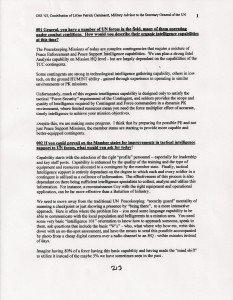
Although the Brahimi Report (AF) and the efforts of Louise Frechette (CA) as Deputy Secretary General to achieve strategic decision-support coherence were both important, no single person has done more to help the United Nations understand that intelligence is not a “dirty word” but rather an essential tool relevant to the strategic level (getting the mandate right), the operational level (getting the force structure right), and the tactical level (being effective in multicultural environments). Below are his responses to questions, as presented on a video interview done in New York.

Patrick Cammaert
Patrick Cammaert