This SIPRI map presents a snapshot of multilateral peace operation deployments worldwide in September 2009. Using data drawn from the SIPRI Multilateral Peace Operations Database, it shows where missions are taking place, how large they are and which organizations and coalitions are conducting them.
Download this SIPRI Map.
Publisher: SIPRI
1 page (A3)
November 2009
Phi Beta Iota: Berto Jongman recommends this. All of these operations are what we envisioned being supported with M4IS2 out of the embedded Multinational Decision Support Center within the Defense Open Source Center as described in 2009 DoD OSINT Leadership and Staff Briefings.
If the United Nations cannot run a conference in Copenhagen without riots in the streets, why would anyone want to turn over the governance of the world to these people?
For old “skeptics” like myself, watching the chaos in Copenhagen was sheer joy. It’s always a mistake for liars to gather in one place to trumpet their lies because it always attracts people who believe that the truth is the best antidote.
The UN climate summit reached a weak outline of a global agreement last night in Copenhagen, falling far short of what Britain and many poor countries were seeking and leaving months of tough negotiations to come.
Questions Abound
Scientists Attach Hope to Wrong Rising Star – Blow Credibility & Get Gored
As polls show credibility for scientists falling off the same cliff as Obama, Wall Street, politicians and the media, perhaps there is a reason. Perhaps there is a link between them.
As Ronald Reagan used to say, facts are stubborn things. The fact is that imminent man-made climate disaster has been shown to be a massive fraud driven by manipulated data and deliberate suppression of facts to the contrary.
The latest Climate-gate shoe to drop is the Moscow-based Institute of Economic Analysis (IEA) accusation that the Hadley Center of Britain's Meteorological Office deliberately relied on a carefully selected 25% of Russia's weather stations that fit its theory of global warming.
Chávez said that “the Kyoto Protocol cannot be declared dead or extinguished, which is what the US pretends to do. Which is why (President) Evo (Morales of Bolivia) tells a great truth: If Obama, Nobel War Prize, said here, by the way, it smells of sulfur here. It smells of sulfur. It keeps smelling of sulfur in this world.
Trick No. 1: You Destroy Conflicting Data:
Trick No. 2: You Cherry Pick Your Data to Show a Recent Rise in Temperatures
Trick No. 3: You “Adjust” Away Inconvenient Trends That Threaten to Derail Your Hypothesis:
Trick No. 4: You Cherry Pick the Model to “Prove” Global Warming is Real
Trick No. 5: You Spend a Lot of time Promoting Your Views with the Media–and Publicly Attacking Your Skeptics.
Trick No. 6: “The Science is Settled. The Science is Settled.” The Climategate code
In addition to the more than 1,000 emails and assorted documents that were leaked to the public a month ago, there were several files containing software code, seemingly source code for the calculations the Climate Research Unit of East Anglia used for processing and adjusting temperatures for their calculations of global warming.
Immediately after the leak, attention was drawn to comments in the code's documentation that seemed to indicate that the programmers had difficulty understanding what had been done previously, did not feel capable of righting the programming wrongs, and on occasion invented weather stations to park data or even invented data.
Now, as computer scientists and programmers have had more time to analyse the code as well as the comments, programming errors that would change calculations or even cause the program to skip data are coming to light.
Utterly Brilliant Synthesis, Vital First Step–US Violates Every Single Principle
December 18, 2009
United States Institute of Peace
This book is a six-star special and will be so rated at Phi Beta Iota, the Public Intelligence Blog, where I cluster like non-fictions books in 98 categories, one of which is Stabilization & Reconstruction.
At its most fundamental this is without question the most extraordinary sensible and useful synthesis of all possible documents devoted to the subject, offering up a truly remarkable–just an amazing–framework for study and for planning.
The publisher failed to make full use of the Amazon tools for showing the Table of Contents at a minimum, and this error should be corrected immediately. Inside the Book is also recommended. I would normally reduce the book to four stars for its failure include all those outside the “traditional” national security community; for its lack of an index, and for its ignorance of most relevant books outside the narrow circle of stabilization & reconstruction groupies. However, this is such an incredibly gifted, intelligent, and meticulous presentation of vitally important information that I leave it at six star special, beyond five stars.
Still, to not be able to see in an index every page for key words like “water” or “intelligence” is infuriating.
First, an overview of the contents, vastly more simple than the complex array of information presented in sub-sets of conditions, guidance, approach, and then elements.
+ Introduction
+ Strategic Framework for Stabilization and Reconstruction
+ Cross-Cutting Principles
+ High-Level Trade-Offs, Gaps, and Challenges
+ Fundamentals of a Comprehensive Approach
+ End States
—Safe and Secure Environment
—Rule of Law
—Stable Governance
—Sustainable Economy
—Social Well-Being
+ Appendices
A. Resources List
B. Participants in Review Process
C. Summary of Strategic Frameworks Surveyed
D. Snapshot of COmpoments from Overarching Resources
E. Acronyms and Glossary of Selected Key Terms (incomplete, another annoyance that needs to be corrected)
Contrary to popular belief, the US actually has 189,000 personnel on the ground in Afghanistan right now—and that number is quickly rising.
by Jeremy Scahill
A hearing in Sen. Claire McCaskill's Contract Oversight subcommittee on contracting in Afghanistan has highlighted some important statistics that provide a window into the extent to which the Obama administration has picked up the Bush-era war privatization baton and sprinted with it. Overall, contractors now comprise a whopping 69% of the Department of Defense's total workforce, “the highest ratio of contractors to military personnel in US history.” That's not in one war zone-that's the Pentagon in its entirety.
In Afghanistan, the Obama administration blows the Bush administration out of the privatized water. According to a memo [PDF] released by McCaskill's staff, “From June 2009 to September 2009, there was a 40% increase in Defense Department contractors in Afghanistan. During the same period, the number of armed private security contractors working for the Defense Department in Afghanistan doubled, increasing from approximately 5,000 to more than 10,000.”
At present, there are 104,000 Department of Defense contractors in Afghanistan. According to a report this week from the Congressional Research Service, as a result of the coming surge of 30,000 troops in Afghanistan, there may be up to 56,000 additional contractors deployed. But here is another group of contractors that often goes unmentioned: 3,600 State Department contractors and 14,000 USAID contractors. That means that the current total US force in Afghanistan is approximately 189,000 personnel (68,000 US troops and 121,000 contractors). And remember, that's right now. And that, according to McCaskill, is a conservative estimate. A year from now, we will likely see more than 220,000 US-funded personnel on the ground in Afghanistan.
In 1986 we invented “reverse hits” in a failed attempt to get the clandestine service to allow electronic searches of its databases. In a related experience we discovered that fewer than 10 percent of the names had been properly indexed because the clerks in the basement were lazy and ignored “INDEX ALL NAMES.”
The Human Intelligence “Source Directory” is massively incomplete and corrupt because few of the organizations carrying out their own clandestine or informant operations are willing to trust CIA to maintain the inter-agency source directory. This leads to situations where multiple organizations are paying the same agent for the same information.
Phi Beta Iota: This is a brilliant piece of work, precisely what we should have been doing from 1988 onwards. It is probably too late only because the US Government is incapable of a 180 degree turn that puts two Berlin Airlifts in motion, one to Afghanistan and one to Iraq, with each redirected to Somalia, Sudan, and Yemen as the process moves forward.
Edit of 20 Dec 09: This article is one of two cited by a top US flag officer speaking to COINSOC in Iraq. The other one is Reference: PK Officer View on AF.





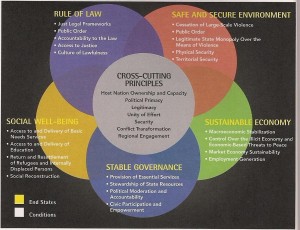 First, an overview of the contents, vastly more simple than the complex array of information presented in sub-sets of conditions, guidance, approach, and then elements.