The 2012 election is now in play, and the Republican wing of the war party is gearing up to blame President Obama for America’s failed wars (who, while not entirely blameless, is hardly the architect of defeat) and the accompanying national humiliation. This email is about an opening shot that just appeared in the Weekly Standard.
One of my closest friends, retired Marine Colonel XXX, forwarded the attached analysis of the US defeat in Iraq. (I use the word ‘analysis’ charitably) It was written by Fred Kagan, his wife, and another person, neocons all. The Kagans are among one of America’s most vocal advocates preventative war, especially the invasion of Iraq, and were “architects” of the so-called “surge” (which is Versailles-speak for a relatively modest, time-consuming escalation, whereas in traditional military parlance, the word ‘surge’ implies a massive increase, like a doubling or tripling, of effort over a very short period of time).
Occupy Wall Street Protest – An American Spring in the Fall, a 21st Century Revolution?
Occupy Wall Street describes itself as a “Leaderless Resistance Movement”. It defines itself as “anti-greed”. It is reminiscent of FDR's famous dictum: “We have always known that greed is bad morality; now we know that it is also bad economics”. From the 1930s to and through the bridge decade of the “aughts” and forward further into this New Century, FDR's words have now come hauntingly back with a powerful new resonance. Update on the “Occupy Wall Street” pheonomenon – is it a movement? is it a 21st revolution? will it or its spririt endure and how? will it create systemic change? Duncan also makes reference, among others, to Frank Rich's New York magazine article The Class Struggle has begun in the week of October 24, 2011.
Duncan's dialogue partner for this program is Charles Eisenstein, author of Sacred Economics, and a blog, which include the excellent essays “Occupy Wall Street: No Demand is Enough” and “Why the Age of the Guru is Over”.
Phi Beta Iota: Keep an open mind. This is deeply serious and directly relevant to understanding the convergence of the honest right, the honest left, and OccupyWallStreet.
What Lenin meant to convey was that the Soviets were not the ordinary class organisation, whose purpose, according to the Mensheviks and Social-Revolutionists, was to fight only for the economic demands of the working class within the framework of bourgeois society. In his opinion such Soviets would be doomed in advance. In fact, no Soviets were needed for such a purpose. In his view, the Soviets were organisations for the seizure of state power, and for transforming the workers into the ruling class. That is why he again and again told the Petrograd workers in the course of 1916: ‘Ask yourselves a thousand times whether you are prepared, whether you are strong enough; measure your cloth nine times before you cut. To organise Soviets means to declare a war to a finish, to declare civil war upon the bourgeoisie, to begin the proletarian revolution.’
The OWS formations carry such potential, albeit (likewise) in an embryonic state. Their internal democratic structures are the key to this, and that is the part that should be replicated. As assemblies of people are constituted among more and more communities (and the accomplishment of this is extremely important to insuring that the internal democracy of each group is replicated in the aggregation of all such groups, in whatever form that ultimately takes, should it develop that far), both the possibility of coordinate mass action and the potentiality of an alternative political structure that represents all segments of the population emerges. The lesson from Lenin as applied to OWS is to recognize both the positive and negative potential that it represents and to both engage it and shape it to fit the needs of all communities. In the United States in particular, given the historically dominant role of racism in the social order, that means ensuring that the construct that is springing into existence before our eyes is made to become responsive to the direction of the traditionally oppressed communities, particularly communities of color.
Assuming that the most important task is to address the racist nature of this society and to prevent this from being replicated in whatever emerges from the present activities, it would seem that, as the best defense is a good offense, the oppressed communities here (and elsewhere, as this is becoming a global phenomenon) must organize as never before, and in a way that is compatible – in form and substance – with the present model, and which will thus insure that the voices and self-determined interests of these communities will find full expression.
More from Dan DeBar: My thinking on this is not fully developed, but, if you can spare 58 minutes and suffer some of the fits-and-starts of my thought process in the process, I did go into some depth in this video – – which starts off a bit slow, but eventually gets across a good picture of my thinking on the matter. As I felt I got deflected somewhat by the host from my main point – that of the centrality of the issue of racism to any solution of the problems being articulated by, or serving as the catalyst for, the OWS “movement” – I fleshed that out a bit more in this video.
Below are two eye opening reports/analyses by two of the best counterpunchers in Alexander Cockburn's and Jeffrey St Clair's stable of bomb throwers. The subject is Greece: its political/economic crisis and the myths surrounding average Greeks being the cause of its crisis.
In the first, Destroying the Livelihoods of Thirteen Million People: The Myth of Greek Profligacy, my friend Marshall Auerback, argues that the masses of the Greek people (the bottom 80% of a highly unequal income distribution) are being set up as scapegoats to pay for a neo-liberal austerity plan that aimed producing income deflation (instead of a currency devaluation) to improve export competitiveness. Auerback explains why this is really a plan of collective punishment that is guaranteed to fail while shredding what is left of Greece's social contract.
In the second, Naxos Hangs On By Its Fingernails: How Greeks Were Driven Back to the Land, Patrick Cockburn presents the reader with a micro-case study of what is happening to average Greeks (i.e. part of the lower 80%) on the island of Naxos, the largest and my favorite island in the windy Cyclades.
Chuck Spinney
Barcelona
Destroying the Livelihoods of Thirteen Million People The Myth of Greek Profligacy
by MARSHALL AUERBACK, Counterpunch, OCTOBER 24, 2011
Phi Beta Iota: One reason why the Electoral Reform and BigBatUSA endeavors are so important NOW, is because if they succeed in the USA, where Internet connectivity, cognitive surplus, and Occupy awaking have converged, the model can be scaled globally very quickly. At root this is about secular corruption. Pope Benedict XVI had a chance to use Assisi creatively but chose the low road.
My friend Andrew Cockburn is on a roll. One week after his brilliant article on IEDs in Harpers, he has produced another hard-hitting tubesteak, this time in Counterpunch. Andrew's targets are the Banksters, whose looting continues to push the middle class into poverty and the lower income classes into a kind of debt servitude that is reminiscent of that imposed by company stores in the West Virginia coal towns in what we had hoped was a bygone era.
Andrew's essay is important, because the problem he is describing exists against the backdrop of the Great Recession, which now, three years after the banking system started to collapse, may be on the cusp of a full blown debt deflation, triggered by another, even more catastrophic banking collapse. My introductory comments are intended to help you understand that magnitude of that danger that Andrew is describing.
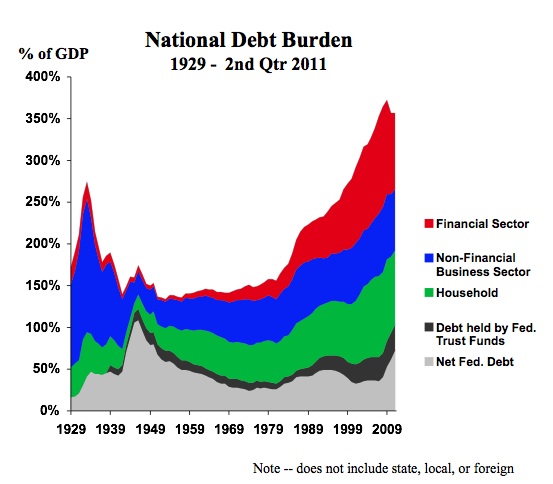
Click on Image to Enlarge
The following charts (Figures 1 & 2), based on the most recent data released by the Federal Reserve,
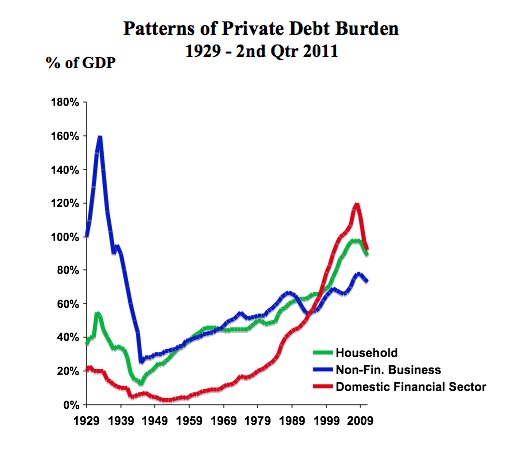
portray ratio of debt to gross domestic product over time. Figure 1 shows how the cumulative debt changed in the entire system, with debt expressed as a percentage of the GDP produced by the economy. The debt ratio for the entire economy should not be thought of as an absolute measure of debt burden but as an indexof that burden, and is an indicator of the comparative pressure of that debt regardless of the overall size of the economy.[1] Thus, one can compare
Click on Image to Enlarge
changes in earlier years to those in later years. Figure 2 plots the sector burdens separately for the components in the private sector (note: since Federal Debt is arranged in bottom position in Figure 1 it is also the same shape that would be plotted in Figure 2; other categories, like state and local debt have been ignored because over time their ratio changes have not been significant enough to the alter the pattern in the figures). What do these figures tell us?
“If the Occupiers start chanting ‘Mark to Market,’” an attorney highly conversant with the darker workings of the Wall Street-Washington complex told me, “we’ll know they’re serious.” Such a call would quickly presage the collapse of our “too big to fail” banks, for it would highlight the fact that a huge proportion of the assets of Bank of America, Wells Fargo, JP Morgan, and Citigroup consist of loans that will never be paid back and are therefore essentially worthless. The so called “recovery” of our leading financial institutions from the post-Lehman abyss has depended on a fraudulent valuation of these assets, but stripped of the fiction, the banks are insolvent.
Phi Beta Iota: The banks are on the brink–wildly fearful of a run on stocks and deposits–and the US Government knows they are on the brink–and is wildly fearful of nation-wide violence. Pissed off white people will make the Watts Riots looks like an effete tea party. There is good news. The close OccupyWallStreet gets to understanding the depth of the depravity of the government that enabled and enables Wall Street, the lack of intelligence and integrity within that government, the closer we get to being able to demand and secure the Electoral Reform Act of 2012, in our view the sole means by which a non-violent revolution might restore the integrity of the U.S. Government.
Phi Beta Iota: This is the single best reality rant we have seen, kudos to Brother John for pointing it out. No one is qualified to run for office without reading this first. No on is qualified to vote without reading this first. This is the “reset” button on reality & integrity in the USA and elsewhere.
The preposterous claim that deviations from market efficiency were not only irrelevant to the recent crisis but could never be relevant is the product of an environment in which deduction has driven out induction and ideology has taken over from observation. The belief that models are not just useful tools but also are capable of yielding comprehensive and universal descriptions of the world has blinded its proponents to realities that have been staring them in the face. That blindness was an element in our present crisis, and conditions our still ineffectual responses. Economists – in government agencies as well as universities – were obsessively playing Grand Theft Auto while the world around them was falling apart.
to which I responded
What we are up against
A refreshing reminder of the staid mechanistic approach of so-called market-efficient economics. Good for the status quo as used to explain to the world WHY the Masters of the universe are in charge. I'm not sure how many of the deans of business schools and Harvard economics professors are prime advocates. But I imagine a substantial amount remembering the interviews that Ferguson did in the documentary Inside Job. They get very well rewarded for being apologists for the current system.
But I would like to take off from this point and try 500,000 foot summary of some of the issues. I am not sure how many people really understand the nature and the reasons for our problems I have a stack of books on my porch more than 3 feet high that I've read since 2008 attempting to grasp it. It is only with the addition of the latest by Nicholas Shaxson called Treasure Islands Uncovering the Damage of Offshore Banking and Tax Havens that I feel I have made really significant progress.
Whether it is possible for the occupy movements to create among their followers and the wider public at large an understanding of the situation, I'm not sure. But I suspect that short of violent revolution which has never been a positive accomplishment–the only way forward is to formulate this broader understanding.