Date & Time:
Tuesday, March 20th, 2012
12:00 – 1:30 p.m.
How should the United States deal with the jihadist challenge and other religious imperatives that permeate today's geopolitical landscape? Religion, Terror, and Error: U.S. Foreign Policy and the Challenge of Spiritual Engagement argues that what is required is a longer‐term strategy of cultural engagement, backed by a deeper understanding of how others view the world and what important to them. The means by which that can be accomplished are the subject of this book.
This work achieves three important goals. It shows how religious considerations can be incorporated into the practice of U.S. foreign policy; offers a successor to the rational‐actor model of decision‐making that has heretofore excluded “irrational” factors like religion; and suggests a new paradigm for U.S. leadership in anticipation of tomorrow's multipolar world. In describing how the United States should realign itself to deal more effectively with the causal factors underlying religious extremism, this innovative treatise explains how existing capabilities can be redirected to respond to the challenge and identifies additional capabilities that will be needed to complete the task.
Robert Steele has for some time been saying that “The truth at any cost lowers all others costs.” He has also been focusing on the importance of intelligence with integrity. Among all governments, only Iceland appears to be serious about dealing with the financial crisis as it should be dealt with: as a criminal conspiracy enabled by all of the parties in both public and private sectors who sacrificed their integrity and betrayed the public trust.
Corporations operate under public charters. It is difficult to police the corporations when the governments have themselves become criminalized, but the tide is turning — the public is beginning to recognize that governments lack integrity and intelligence and cannot be trusted — in their present form — to manage the public interest.
When Goldman Sachs goes out of business the healing can begin. Slamming PWC is a good start.
The resolution committee of the failed Icelandic bank Old Landsbanki has subpoenaed the international auditing firm PriceWaterhouseCoopers, accusing the company of creating wrong annual accounts which misled the markets. The committee’s damages claim runs to hundreds of millions of krónur.
NATO'S most senior commander was at the centre of a major security alert when a series of his colleagues fell for a fake Facebook account opened in his name – apparently by Chinese spies.
. . . . . . .
They thought they had become genuine friends of Nato's Supreme Allied Commander – but instead every personal detail on Facebook, including private email addresses, phone numbers and pictures were able to be harvested.
Phi Beta Iota: In an “open everything” world, those raised in walled garden are actually retarded and pay the price. It is not possible to be smart in isolation. Secrecy is now a fatal cancer. Bureaucracy is now a fatal cancer. Governments (and all other forms of organization) in isolation are now fatal cancers. For a tiny fraction of what is being wasted by the US Cyber Command and the US National Security Agency, an Open Source Agency under diplomatic auspices could catapult the USA into Smart Nation status.
I asked the following question at the Berkman Center’s recent Symposium on Truthiness in Digital Media: “Should we think of truthiness in terms of probabili-ties rather than use a True or False dichotomy?” The wording here is important. The word “truthiness” already suggests a subjective fuzziness around the term. Expressing truthiness as probabilities provides more contextual information than does a binary true or false answer.
When we set out to design the SwiftRiver platform some three years ago, it was already clear to me then that the veracity of crowdsourced information ought to be scored in terms of probabilities. For example, what is the probability that the content of a Tweet referring to the Russian elections is actually true? Why use probabilities? Because it is particularly challenging to instantaneously verify crowdsourced information in the real-time social media world we live in.
There is a common tendency to assume that all unverified information is false until proven otherwise. This is too simplistic, however. We need a fuzzy logic approach to truthiness:
One thing I learned from Joan V. Bondurant's book The Conquest of Violence, is that Gandhi was in search of Truth with a capital T. But I eventually realized that it was SOCIAL Truth he was looking for. And there is no single social truth, because every person's experience is valid from a certain perspective; and every person experiences the world in a different way.
That means that there are 6 billion social truths out there; and there are even more than that, because those six billion individuals also experience reality as a couple, as a family, as a group of friends, as a neighborhood, as a community, as a nation, as a culture, as a religion, as Miles Davis fans . . . ad infinitum.
Gandhi was looking for a Truth that cut through all these differences. And that truth was Justice in a given social situation.
In other words, Truth with a capital T can only be discovered through our social interactions. And it's always relative. Always.
When it comes to Social Reality, there's never just one truth.
The Truth is this: when some people suffer through the actions of other people, it's never right or fair. It may be unintentional, but that doesn't alter the equation. Some people are suffering, and other people are causing their suffering. That was the Truth Gandhi was searching for—-justice between people. And he claimed that there's only one reliable road to that Truth.
Nonviolence.
But the above is just a small sliver of his philosophy. It's more complex than that. But at the same time it's simple. It reminds me of the line from Amadeus, where Salieri said:
” . . . music, finished as no music is ever finished. Displace one note and there would be diminishment. Displace one phrase and the structure would fall.”
Gandhi's satyagraha is like that. It's a continual effort to find balance in a given social situation. Once you understand the strategy and dynamics of his philosophy, it's very simple to understand and apply. But the social world is a very complex system. Satyagraha only works if it is continually adapted to changing circumstances. That's where the challenge lies.
But no one simplified that challenge like Gandhi. And no one simplified Gandhi like Bondurant. In fact, Bondurant explains Gandhi better than Gandhi explained Gandhi. It took someone of her superior intellect to untangle all of the sometimes confusing threads of Gandhi's unique wisdom.
Gandhi was a force of nature. Bondurant was like a quantum physicist who successfully analyzed and explained that force
The American radical right grew explosively in 2011, a third consecutive year of extraordinary growth that has swelled the ranks of extremist groups to record levels, according to a report issued today by the Southern Poverty Law Center (SPLC). The rise was led by a stunning expansion of the antigovernment “Patriot” movement.
“The dramatic expansion of the radical right is the result of our country's changing racial demographics, the increased pace of globalization, and our economic woes,” said Mark Potok, senior fellow at the SPLC and editor of the new report.
“For many extremists, President Obama is the new symbol of all that's wrong with the country – the Kenyan president, the secret Muslim who is causing our country's decline,” Potok said. “The election season's overheated political rhetoric is adding fuel to the fire. The more polarized the political scene, the more people at the extremes.”
Many Americans are enraged by what they see as America's decline, and opportunistic politicians have done their best to stoke those fears and demonize President Obama in the process. For some, the prospect of four more years under the country's first black president also is an infuriating reminder that non-Hispanic whites will lose their majority in this country by 2050.
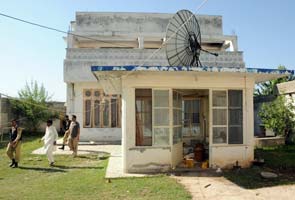
Rawalpindi (Pakistan): In his quest for the truth about his country's most notorious guest, Shaukat Qadir started where it all ended: the room where Osama bin Laden was killed.
Last August, Mr. Qadir, a retired Pakistani Army brigadier, retraced the steps of the American commandos who stormed through the corridors of Bin Laden's hide-out on May 2.
Climbing the stairs to the second floor, Mr. Qadir passed a body outline that marked the spot where Bin Laden's 22-year-old son, Khalid, was shot dead. Then he turned to a small room with a low ceiling, an empty wardrobe and a tight cluster of bullets holes in one wall, he said. Above that, on the ceiling, was a fading splash of blood that, his Pakistani intelligence escort told him, belonged to Bin Laden.
“As a former soldier, I was struck by how badly the house was defended,” Mr. Qadir said in an interview. “No proper security measures, nothing high-tech – in fact, nothing like you would expect.”