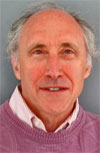
Paul Zak, a pioneer in the field of neuroeconomics, talks about the genes that can make or break a Wall Street trader, and about the chemical that helps us all get along.
Eryn Brown
Los Angeles Times, March 2, 2012
Neuroscience might seem to have little to do with economics, but over the last decade researchers have begun combining these disparate fields, mining the latest advances in brain imaging and genetics to get a better understanding of the biological basis for human behavior.
Paul Zak is a pioneer in this nascent field of neuroeconomics. In a recent paper published in the journal PLoS One, he examined genes that may predict success among traders on Wall Street. His forthcoming book, “The Moral Molecule,” will explore how a chemical in the brain called oxytocin compels cooperation in society.
Zak, director of the Center for Neuroeconomic Studies at Claremont Graduate University, discussed this work with The Times.
Phi Beta Iota: Convergence is upon us. Most universities do not get this, but a couple are struggling to change recalcitrant faculty and force the break-down of silos and the reconstitution of unified knowledge. We are at the very beginning of most interesting times.
Want to know what the future of digital activism looks like? Then follow the developments in Russia. I argued a few years back that the fields of digital activism and civil resistance were converging to a point I referred to as “digital resistance.” The pace of tactical innovation and counter-innovation in the Russia digital battlefield is stunning and rapidly converging to this notion of digital resistance.
“Crisis can be a fruitful time for innovation,” writes Gregory Asmolov. Contested elections are also ripe for innovation, which is why my dissertation case studies focused on elections. “In most cases,” says Asmolov, “innovations are created by the oppressed (the opposition, in Russia’s case), who try to challenge the existing balance of power by using new tools and technologies. But the state can also adapt and adopt some of these technologies to protect the status quo.” These innovations stem not only from the new technologies themselves but are embodied in the creative ways they are used. In other words, tactical innovation (and counter-innovation) is taking place alongside technological innovation. Indeed, “innovation can be seen not only in the new tools, but also in the new forms of protest enabled by the technology.”
While I normally don’t discuss two speakers at All School Meeting (ASM) within one month, the reality is that last week’s speaker was equally as provocative and exciting as the one two weeks before, so I will make this an “exception to the rule.”
Professor Loren J. Samons Jr. is the chair of BU’s Classics Department, a highly decorated teacher (both at BU and nationally), and a widely published scholar (his list of publications is several pages long). Perhaps most important for his impact at ASM, he has a drop-dead hilarious deadpan comic style (think “Saturday Night Life”), and he is able to bring ancient Greek topics vividly to life in terms of our own contemporary issues.
This week at ASM Professor Samons spoke to us about the ancient Greek definitions of “democracy” and “citizenship,” demonstrating how dramatically they differed from our own modern definitions. “Democracy” is the conjoined Greek words for “people power” – he joked that English speakers prefer to borrow prestigious sounding words from other languages, rather than using our own. But while we Americans tend to think of democracy as providing certain citizen “rights” by birth (voting, trial by jury), these were not at all what distinguished ancient Athens as the first city state in Greece to practice democracy; for instance, other city states allowed the vote, even if a king ruled. Rather, ancient Athenians assumed that being a citizen was a group-given privilege (not a natural right) that involved other group-expected duties. Privileges included being chosen by lottery to serve in the legislature (just think of the savings in campaign spending if that’s how Congress were selected!), and duties included serving in the army almost yearly from age 18 to 59, for instance. If you think about these two examples, you’ll notice that the very people voting to go to war were the ones having to serve in it. And since you served next to your friends and family (often a father, brother, and grandfather at your side), the realities of battle were both more personal and more demanding – flight was either not an option during battle (observed by those you loved), or once Uncle Georgios fled, you were right behind him.
While Professor Samons went on to detail the Hoplite army model of ancient Athens, his main points focused on citizenship, especially how our culture has lost its understanding of privileges combined with duties, and replaced that understanding with a sense of entitlement based on natural individual rights. Our “political will” as a society reflects this, as we see presidential debates from both parties pander to what each voter wants, rather than to the spirit of individual sacrifice for the common good. Ancient Athens might have had many troubling qualities, such as an annual draft, but its spirit of democracy is a virtue we would do well to revive. At the Academy, learning about the classics helps to do just that!
Back in 2002 while I was at a major Command, Friedman made a pitch to provide “ground truth” intelligence on contract. While some folks went gaga over his presentation, there were many small indicators that all was not well. Apparently Friedman was asked to leave LSU for reasons undetermined. Offically, according to STRATFOR ” In 1997, a small company that would eventually grow into Stratfor—called Strategic Intelligence LLC—left Baton Rouge and LSU, where its founder George Friedman had been a professor. A 1999 profile in Texas Monthly said the company “couldn't thrive” in Baton Rouge, and that's why Friedman took it to Austin, where it blossomed into a global powerhouse.”
Reasoning heard on the street by colleagues active in San Antonio, he was bankrolled by Mossad and they wanted him in an area of hightech.
I have read his comments about OSS and you specifically; his arrogance is unbelievable. His “analysts” are currently UT-Austin students with a couple of “seasoned veterans”, none of whom have an intelligence
background.
He has been described as a neocon and I think that fits. From where I sit, I think STRATFOR is finished, they are trying very hard to regain their client base….with little success…
A few days ago I shared my crude model how we go from words to trust. I strung it along: word, definition, context, grammar, meaning, concept, understanding, salience, insight, trust, reputation. I believe each prior step must be present and perceived by both partners in an interaction before the next step gets good traction.
Being in the people business of establishing technical trust – as I am – is an interesting combination of challenges: engineering, salesmanship, diplomacy, organization and administration, combined with awareness for the needs of future users of what we test and certify, and the needs and expectations of society.
Seeking a competitive edge in this usually means working without a model, or just making one up and test it, see what sticks and build on that. We might see whether we get closer to the goal. That matters. Insight into what's best comes with routine, where do we have that at the edge?
Trust is a non-negotiable essential in business. (via ingenesist blog) So, being in business is basically about trust. Establishing and verifying trust, documenting it, so it can be shared, swiflty, without every business partner having to redo what led to the trust.
To me, competitive edge is all about faster, yet secure trust building, towards more intense knowledge flows and learning from each other.
Out of self-preservation our minds are programmed to scan for suspicious signs to prevent having our trust betrayed, and if it happens, we almost automatically score the loss of trust. If it is about a product or an organization, we may drop it. If it is about people, we may react with deep emotion.
Losing trust is much faster than building it, which could be a reason for feeling that trust is eroding everywhere. What if this is a cognitive bias? What can we do to accelerate trust-building?
Phi Beta Iota: Above is about trust “in situ.” What is missing is the larger culture of trust, shared values — little things like sharing a reverence for the Constitution and a commitment to integrity at all times.
Huh? Here are Mini-Me's post-November 2012 nightmare events:
01 End of all federal grants to all universities
02 By law, all option years on all federal contracts eliminated.
03 30% federal employee Reduction in Force (RIF)
04 Industrial chemical accident of historic proportions (e.g. the really really big rusted chlorine tank above the NJ Turnpike right outside NYC blows)
05 One of NYC's two 1920's water mains blows, followed by a firestorm
06 Our own biological agent used (Forced Population Reduction) across the poorest sectors of the south (“useless eaters” according to Henry Kissinger).
07 Radiological event (dirty bomb) closes down a major transit hub for the next 20 years. Having fun yet?
We live in a world that is becoming increasingly unstable, and the potential for an event that could cause “sudden change” to the U.S. economy is greater than ever.
There are dozens of potentially massive threats that could easily push the U.S. economy over the edge during the next 12 months. A war in the Middle East, a financial collapse in Europe, a major derivatives crisis or a horrific natural disaster could all change our economic situation very rapidly.
In the list below, you will find some “sudden change” events that are somewhat likely and some that are quite unlikely. I have tried to include a broad range of potential “black swan events”, but there are certainly dozens more massive threats that could potentially be listed. (List only — links and text at the article.
01 War with Syria
02 War with Iran
03 Disorderly Greek Debt Default
04 Economic Collapse in Spain
05 Price of Gasoline
06 Student Loan Debt Bubble
07 State and Local Debt Crisis
08 Collapse of a Major US Bank
09 Derivatives Crisis (Credit Swaps Collapse)
10 Fall of the Japanese Economy (and government)
11 A Solar Megastorm (1 in 8 chance)
12 Major West Coast Earthquake and/or Volcanic Eruption
13 Tornado Damage to Major US Cities
14 Severe Drought in the United States
15 Asteroid Strike in February 2013
On disposing of religious materials, in 2009 the Chaplain Center and School at Fort Jackson, South Carolina, published a detailed Information Paper providing guidance for all major religions and denominations. The relevant paragraphs concerning the Quran are reproduced below as published in the Information Paper.
Disposing of Unusable Copies of the Qur'an
As far as old and unusable copies of the Qur'an are concerned, it is not permitted
to burn them unless there is no other way to dispose of them.
The great Hanafi Imam, Imam Ibn Abidin (may Allah have mercy on him) states:
“If a copy of the Mushaf (qur'an) becomes old and it is difficult to read from it, it should not be burnt in fire. This is what Imam Muhammad (m: student of Imam Abu Hanifa) pointed out and this is what we take.
“It will not be disliked to bury it. It should be wrapped in a pure cloth, and a Lahd grave (m: grave that has an incision in the side wall, customary in hot climate countries where the earth is solid) should be dug, because if a Shiq grave (m: grave with a straight opening, common in cold climate countries due to the earth being soft) is dug and the copy of the Qur'an is buried, it will entail the soil falling on top of the Qur'an which is a form of disrespect, unless a slab is placed as a roof. .. ” (Radd al-Muhtar, 5/271)
“In light of the above, there are two methods of disposing of an unusable copy of the Qur'an:
“(1) Wrapping it in a pure piece of cloth and burying it respectfully in a place where people (normally) do not walk about in cold climate countries (such as the UK), one may dig a Shiq grave, but a slab should be placed first and over it the soil.
“(2) Fastening the Qur'an with a heavy object like a stone and then placing it respectfully in flowing water.
“If one is able to implement the above two methods, it would not be permitted to burn the copy of the Qur'an. However, if the above two methods are difficult to carry out, then one may burn the Qur'an and bury or drown the resulting ash.
“If the pages of the Mushaf have become old and worn out and thus torn due to reciting/reading them much, for example, or it becomes non-conducive to benefit from (that particular copy), or if there are found therein mistakes due to negligence when writing it, or printing and/or publishing errors, all of which cannot be corrected; then it is permitted to bury it without burning it. It is also permitted to burn and then bury it in a place that is far removed from rubbish, trash, paths and walkways.
“(Doing this) will safeguard it from any type of degradation and debasement, as well as a protection for the Qur'an so that there does not occur any confusion, distortion or dispute due to the spreading and circulation of copies of the Qur'an that have printing and/or publishing errors. ‘
Source: The Collection of Islamic Verdicts issued by The Permanent Committee of Research & Islamic Rulings.
Director, Center for World Religions
Chaplain Center and School
Fort Jackson, SC 29229