DefDog: IAEA Veteran’s Letter “No Iran Bomb” Being Ignored

05 Iran, 08 Proliferation, 08 Wild Cards, Corruption, Government, IO Deeds of War, Knowledge, Peace Intelligence, Politics
DefDog

I know nothing about the science, but this seems credible–certainly worth considering.

World Renown Nuke Expert Nails Bibi to the Wall on Iran Bomb Threat

Jim W. Dean

EXTRACT (Letter Only, Editorial Hyperbole Detracts)

Dear Prime Minister Netanyahu:

Iran may be in your red zone, but can not score.

Sure, Iran could divert a few tons of 3.5% or a ton of 20% enriched uranium hexaflouride gas for enrichment to 90+%. But what then?

No one has ever made a nuclear weapon from gas. It must be converted to metal and fabricated into components which are then assembled with high explosives.

Iran lacks experience with and facilities for these processes which are very dangerous because of potential for a criticality accident or nuclear explosion. Iran would not jeopardize its important, fully safeguarded nuclear programs by an attempt to have a deliverable, one kiloton yield nuclear weapon ten to fifteen years later.

Continue reading “DefDog: IAEA Veteran's Letter “No Iran Bomb” Being Ignored”

DefDog: Living Under Drones – Outcomes in Pakistan

07 Other Atrocities, Corruption, Economics/True Cost, Government, Ineptitude, Knowledge, Military, Peace Intelligence, Politics
DefDog

Living Under Drones: Death, Injury and Trauma to Civilians from US Drone Practices in Pakistan

This report is the result of nine months of research by the International Human Rights and Conflict Resolution Clinic of Stanford Law School (Stanford Clinic) and the Global Justice Clinic at New York University School of Law (NYU Clinic). Professor James Cavallaro and Clinical Lecturer Stephan Sonnenberg led the Stanford Clinic team; Professor Sarah Knuckey led the NYU Clinic team. Adelina Acuña, Mohammad M. Ali, Anjali Deshmukh, Jennifer Gibson, Jennifer Ingram, Dimitri Phillips, Wendy Salkin, and Omar Shakir were the student research team at Stanford; Christopher Holland was the student researcher from NYU. Supervisors Cavallaro, Sonnenberg, and Knuckey, as well as student researchers Acuña, Ali, Deshmukh, Gibson, Salkin, and Shakir participated in the fact-finding investigations to Pakistan.

EXTRACT (One Sentence from Each Summary Paragraph):

First, while civilian casualties are rarely acknowledged by the US government, there is significant evidence that US drone strikes have injured and killed civilians

Second, US drone strike policies cause considerable and under-accounted-for harm to the daily lives of ordinary civilians, beyond death and physical injury.

Third, publicly available evidence that the strikes have made the US safer overall is ambiguous at best.

Fourth, current US targeted killings and drone strike practices undermine respect for the rule of law and international legal protections and may set dangerous precedents.

Summary Recommendations:

Continue reading “DefDog: Living Under Drones – Outcomes in Pakistan”

Yoda: Ana Cristina Pratas – Digital Bridges for Learners

04 Education, Academia, Advanced Cyber/IO, Civil Society, Cultural Intelligence, Liberation Technology
Got Crowd? BE the Force!

Digital Bridges for Learners

Ana Cristina Pratas

CristinaSkyBox, 27 September 2012

Although I have always tried to reach out individually to students, whether through their preferred learning style, topics which related to their social environment and interests,  or with activities they enjoyed in class, never has there been a point in time when the emphasis of learning was so learner-centred as now.  With the increasing implementation of mobile tech, learning is revolving around the student: with their iPads, they can work calmly through their iBooks or create their own book with materials which they choose and are relevant to both themselves and their course work.

In turn, this also has implications for the teacher – new roles in the classroom and often new approaches and patterns in teaching. However, with all the freedom of learning, there are hiccups which also occur. How willing are students to (initially) take on the responsibility for their learning, particularly when they have grown up in cultures where rote-learning was customary or where they were comfortable in shifting responsibility of their learning outcomes to teachers?

All freedom demands responsibility and accountability – characteristics which students are not always ready to take on board.

Freedom is also a learning process and bridges need to be built, put in place for both learners and teachers.

Full post and two graphics below the line.

Continue reading “Yoda: Ana Cristina Pratas – Digital Bridges for Learners”

Penguin: Bandi Mbubi at TED – Demand a Fair Trade Cell Phone

02 Diplomacy, 05 Civil War, 07 Other Atrocities, 08 Wild Cards, 11 Society, Civil Society, Commerce, Commercial Intelligence, Corruption, Government, IO Deeds of War, Liberation Technology
Who, Me?

Your mobile phone, computer and game console have a bloody past — tied to tantalum mining, which funds the war in the Democratic Republic of the Congo. Drawing on his personal story, activist and refugee Bandi Mbubi gives a stirring call to action. (Filmed at TEDxExeter.)  Bandi Mbubi would like to make sure that you are using a fair trade cell phone.

Bandi Mbubi grew up in the Democratic Republic of the Congo, formerly Zaire, experiencing first hand the political unrest and oppression which have since worsened there. As a student activist, Bandi suffered persecution and fled the country, seeking political asylum in the U.K. But Mbubi has kept his home country on his radar, noting how the mining of tantalum — a mineral used in cell phones and computers — has fueled the ongoing war there in which 5 million have died.

While Mbubi sees the cell phone as an instrument of oppression for this reason, he knows that phones can also bring great freedom. And so he has formed CongoCalling.org, a campaign to inspire both the public and companies that make electronics to pay attention to how tantalum used in consumer electronics is mined and traded.

Mbubi is also the Director of the Manna Society, a center for the homeless in South London, and a Trustee of Church Action on Poverty.

TED Video (9:22)

Eagle: Oil Lies, Oil Spills – Technology Sucks, Human Intelligence Rules

05 Energy, Commerce, Corruption, Earth Intelligence, Government
300 Million Talons…

1)  All stakeholders in the Keystone Pipeline are lying to the public.  There are THREE sucking chest wounds in the Keystone Pipeline proposal:  a)  Canada cannot afford to use clean water it is running out of, to flush tar sands no one needs; and the USA does not need any more oil.  b)  The pipeline will NOT create jobs and it will be a curse to every community anywhere near it, externalizing costs to everyone along the way.  c)  The legacy refineries are lying in order to get the public to pay the cost of delivering very dirty crude that they will refine for EXPORT.

2)  Technology does NOT work as claimed.

3)  Human intelligence rules again.  What is LACKING is integrity at all points of the compass.

Few Oil Pipeline Spills Detected by Much-Touted Technology

InsideClimate News analysis of a decade of federal data shows general public detected far more spills than leak detection technology.

EXTRACT:

Between 2002 and July 2012, remote sensors detected only 5 percent of the nation's pipeline spills, according to data from the Pipeline and Hazardous Materials Safety Administration (PHMSA).

The general public reported 22 percent of the spills during that period. Pipeline company employees at the scenes of accidents reported 62 percent.

Anthony Swift, an attorney who has spent years researching pipeline safety for the Natural Resources Defense Council, was taken aback by the findings. Swift's organization opposes the Keystone XL, and he said he had always known that leak detection systems didn't catch most of the spills. But “the fact that 19 out of 20 leaks aren't caught is surprising, and certainly runs counter to a lot of rhetoric we hear from the industry,” he said.

Read full article.

Theophillis Goodyear: 1992 Explicit Warning Ignored by USA and Others

Earth Intelligence
Theophillis Goodyear

World Scientists' Warning to Humanity (1992)

Union of Concerned Scientists

Some 1,700 of the world's leading scientists, including the majority of Nobel laureates in the sciences, issued this appeal in November 1992. The World Scientists' Warning to Humanity was written and spearheaded by the late Henry Kendall, former chair of UCS's board of directors.

INTRODUCTION

Human beings and the natural world are on a collision course. Human activities inflict harsh and often irreversible damage on the environment and on critical resources. If not checked, many of our current practices put at serious risk the future that we wish for human society and the plant and animal kingdoms, and may so alter the living world that it will be unable to sustain life in the manner that we know. Fundamental changes are urgent if we are to avoid the collision our present course will bring about.

THE ENVIRONMENT

The environment is suffering critical stress:

The Atmosphere
Stratospheric ozone depletion threatens us with enhanced ultraviolet radiation at the earth's surface, which can be damaging or lethal to many life forms. Air pollution near ground level, and acid precipitation, are already causing widespread injury to humans, forests, and crops.

Water Resources
Heedless exploitation of depletable ground water supplies endangers food production and other essential human systems. Heavy demands on the world's surface waters have resulted in serious shortages in some 80 countries, containing 40 percent of the world's population. Pollution of rivers, lakes, and ground water further limits the supply.

Continue reading “Theophillis Goodyear: 1992 Explicit Warning Ignored by USA and Others”

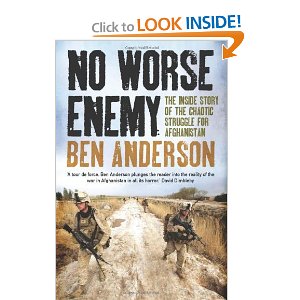
DefDog: The Truth About Afghanistan – A Book, “No Worse Enemy”

Corruption, Cultural Intelligence, Government, Media, Military
DefDog

Author Q&A

Afghanistan: “It’s Just Damage Limitation Now”

Briton Ben Anderson is a documentary filmmaker (the BBC, HBO, the Discovery Channel), but he turns to the written word in No Worse Enemy: The Inside Story of the Chaotic Struggle for Afghanistan. The book offers a gritty – and grim — assessment of the war.

Anderson embedded with U.S. and British troops for months in the southern part of the country from 2007 to 2011. He details corruption, incompetence, fear — by both allied troops and Afghan civilians — and a Groundhog Day kind of existence., where a battle fought for days has to be fought again, later. Most distressingly, he argues that the American and British publics are getting a misleading picture of progress on the ground. Battleland conducted this email chat with Anderson last weekend.

Amazon Page

Why did you write No Worse Enemy: The Inside Story of the Chaotic Struggle for Afghanistan?

I’d been travelling to Helmand for five years, first in 2007 with the Brits, then later mostly with the U.S. Marines, covering every major operation since the war in the south was taken seriously.

Despite new troops, extra resources and new polices, it kept getting worse.

It was more dangerous for me and the troops I was with, Afghan security forces didn’t seem to be improving, and perhaps most importantly, locals were not being won over but instead were complaining of civilian casualties, damage to their homes, being inconvenienced and disrespected, or preyed upon by the Afghan police.

Yet in the second half of 2010, statements from Kabul, Washington and London kept talking of progress, goals being met and the Taliban being on their last legs.

This was the exact opposite of what I had been seeing, so I felt that I had to write this book.

Read full interview.

Continue reading “DefDog: The Truth About Afghanistan – A Book, “No Worse Enemy””

noble gold