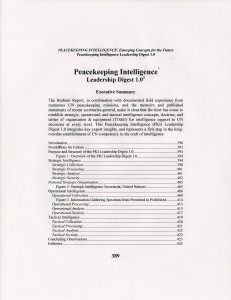
Included as a Reference in PEACEKEEPING INTELLIGENCE: Emerging Concepts for the Future, this is a stand-alone piece that captures key lessons learned across both the four levels of analysis and the varied elements of the traditional intelligence cycle, elements that are NOT secret.
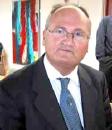
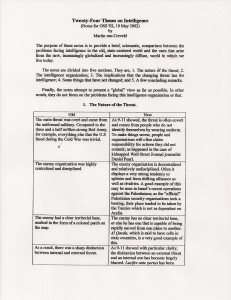
Along with Colin Gray, Steve Metz, and Max Manwaring, Martin van Creveld is among the intellectual giants of our era with respect to strategic reflection, and he stands alone at the intersection of strategy, logistics, technology, command & control, and the art of decision-making under conditions of great uncertainty.
His contribution to OSS '02 was created especially for this multinational group, and we believe it will stand the test of time as a seminal work for those who seek to transform intelligence from a bureaucracy that measures inputs to a cosmic force that determines outcomes favorable to all concerned.
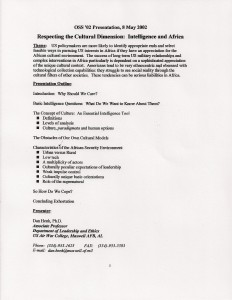
Col Dr. Dan Henk, USAF is a classical scholar-warrior, and one of the finest observers and interpreters of African realities and all of their nuances that we have encountered. He is the prototypical “class act” and a role model for what every senior analyst should be—engrossed in the subject, fluent with the mediums, open-minded, versatile, adaptive, and coherent in the articulation of who and what matters why.
Below is the outline of his contribution to OSS '02. The actual briefings, constantly updated, are replete with extraordinary photographs that make his point in compelling ways. We've found no finer briefing on regional, religious, ethnic, and tribal nuances than this officer.
When Jan Herring, former National Intelligence Office (NIO) for Science & Technology, and co-founder of the Academy of Comptetitive Intelligence, wants an information broker as a partner for a complex assignment, Ms. Bonnie Hohhof is who he turns to.
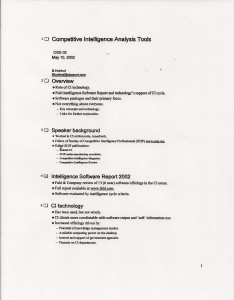
Although dated, the below presentation is a model for what analysts should be thinking about as they assemble off-the-shelf tools to make up for the severe deficiencies still extant in the world of government “cut and paste” hard-copy analytics.
Dick is President and Chief Executive Officer of Maps of Science, having founded the company in 1991. Between 1991 and 2000, he created maps of science for large pharmaceutical, chemical and physics-based firms. He completely rewrote the computer algorithms in 2000, and continues to modify them in order to generate the most accurate maps possible. Dick, and Chief Technical Officer Kevin Boyack have a strong publication record on mapping science, and are considered world leaders in this area (see bibliography). We met Dick in the 1990's when we were exploring how best to identify the top 100 experts on anything and everything, and he is still the master, aided by an exclusive total right of access to all citation analysis data owned by and generated by the Institute of Scientific Information (ISI) founded by Eugene Garfield (a small part of our Aspin-Brown Commission testimony in 1995 that persauded them the US Intelligence Community was “severely deficient” in not being able to do what OSS CEO did with six telephone calls).
Below is Dick's OSS '02 workshop on Technology Mapping, done with Brad Ashton, his co-author in producing what is still the best book on the subject, Keeping Abreast of Science and Technology: Technical Intelligence for Business.
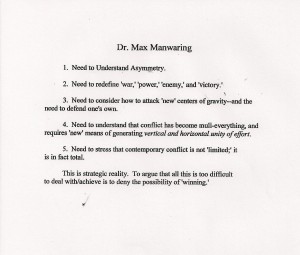
The outline below does not do justice the rich spontaneous presentation that Col Dr. Max Manwaring of the Strategic Studies Institute shared with OSS '02.
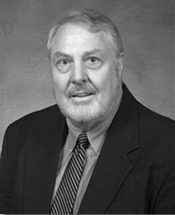
Dr. Manwaring may well be America's top authority on both “uncomfortable small wars” and on “gangs against governments.”
He is the originator of the six generations of warfare (the US still fights 4th generation warfare at best) and inspired the definition by Robert Steele of the seventh generation, Information Peacekeeping at “total war” using information and intelligence as the sole munition.
Click on the photograph to access his rich biography and many publications, most free online. Click below to read the outline.