Religion is the space between the dots, science the dots, and philosophy the mind-set that blends the two. Education, intelligence (decision-support) and research are the sources and methods for achieving integral consciousness — godliness in spirt, integrity in fact, and heaven on earth in community.
Religions can be evaluated in relation to their emphasis on dogma over behavior, compliance over innovation, and exclusiveness over inclusiveness.
Religion, along with money, is one of the greatest counter-intelligence threats to the integrity of the US Government.
Community with clarity, dignity, and integrity is displacing organized religion as a foundation for using transparency to find truth and truth to create trust.
The left in America bears as much responsibility for the loss of faith and religion as does the right for its peversion. Religion became corrupt, divorced from any focus on the public interest, and instead a tool for mobilizing political power in support of the few instead of on behalf of the many.
Here are some links that support the above generalizations:
The US exit strategy from Afghanistan is emerging …. and the picture is not pretty. Nevertheless, it is a revealing microcosm of what now passes for governance in the United States of Confusion and Disorder.
Consider please, this analysis by Dan Murphy in the Christian Science Monitor. Murphy explains why “The US war in Afganistan could turn into a pumpkin as soon as the middle of November,” because the governments of Afghanistan and Pakistan are now fighting for the favors of Al Qaeda!
Older readers may recall that we went into Afghanistan with the dual strategic aims of Regime Change — i.e., replacing the Taliban regime that had given sanctuary to Al Qaeda with a democratic government, based on human rights, that would never give sanctuary to Islamic Jihadists, as well a destroying Al Qaeda. Readers may also recall that President Obama’s decision to surge Afghan operations in 2010 was based on a fatally flawed McChrystal Plan, as I explained in the September 22 2009 and January 29-31, 2010 issues of CounterPunch.
Now, predictably, as we are leaving Afghanistan with our tail between our legs, the obscenely corrupt Karzai government that we installed and have propped up is struggling for survival by negotiating friendship agreements with some of the same Jihadis we have been trying to destroy.
While history never repeats itself, the larger story is that a remarkable parallel to the Soviet Afghan debacle and its aftermath is now emerging.
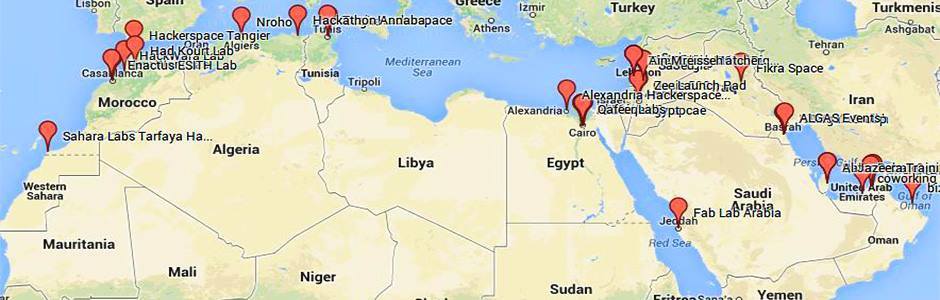
The sharing economy movement is taking a new stride in the Arab World, and many platforms have taken the initiative of implementing the methods of collaborative economy. We dig deep and scrutinize the factors and the potential which could see this industry grow bigger in the region at a quick rate. Here we offer some successful stories.
The sharing economy in the Arab World has been witnessing an ongoing shift in the trend that has envisaged owning rather than accessing. This shift has turned things around, where now the value of the product in the Arab World day after another has become one of usage- not in its outright ownership anymore; as was the case with mainstream consumer models. Used products are more fashionable, thanks to the popularity of online platforms for buying and selling used goods.
People are also adopting what could be called collaborative lifestyles, and depend on each other in circulating and spreading all what occupy their daily interests and concerns like we have seen in the turbulent upheavals of the Arab Spring where the power of social media and its effect on society have accelerated the rate at which relationships develop and information is shared.
Click on Image to Enlarge
The sharing economy movement in the Arab World has seen a positive eruption in the recent few years, especially in the last one. We’re beginning to share more and more in the Arab world —; boats (fishfishme); skills (Taskty); carpooling (Kartag); swapping goods (Swaphood ) or selling used goods (krakeebegypt, dubizzle.com, Avito.ma In Morocco, a classified ads website has become the second most-visited website in the country. and Takemine the first online marketplace for peer-to-peer goods sharing in Dubai that will open (launch) soon.
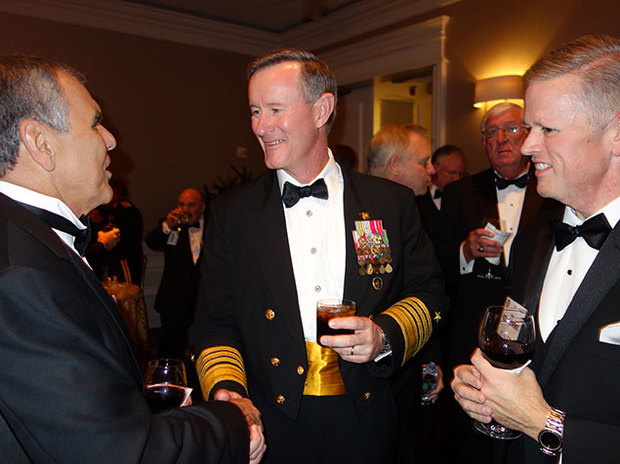
No one in the ballroom came right out and shouted, “William McRaven for elected office!” but the idea hovered like a thought bubble over the OSS Society’s William J. Donovan Award Dinner Saturday night, where the commander of US Special Operations was honored—including by President Obama—and even sounded himself a bit like a candidate.
US special operations commander, Adm. William H. McRaven, greets guests at the annual OSS Society dinner, where he was honored with the William J. Donovan Award. Photograph by Carol Ross Joynt.
The annual celebration commemorating the World War II spy agency and predecessor of the CIA—for the intelligence and special operations communities, it’s the prom and the Oscars wrapped in one—is a time for reminiscing and gossiping for both the smooth-skinned, ramrod-spined young operatives and the retired spies and warriors with more medals than hair or teeth. But McRaven, the Navy admiral who oversaw the 2011 Navy SEAL mission that resulted in the death of Osama bin Laden and who received the Donovan award, gave this year’s gathering a political edge.
President Obama addressed the audience and the honoree via taped video, his image filling three ceiling-high screens. He called McRaven “one of the finest special operators our nation has ever produced. Few Americans will ever see what you do, but every American is safer because of your service.” Also lauding him in taped messages were two other individuals who were directly involved in the bin Laden mission, former CIA director Leon Panetta and Defense Secretary Robert Gates.
A third official who was a player in that historic episode, John Brennan, now director of Central Intelligence, relived the experience in his remarks. He said the deliberations to undertake the mission were “difficult and fraught with uncertainty.” He said there was “a key moment in those deliberations when President Obama seemed to move a step closer to his final decision. It was when Adm. McRaven looked at the President and said, ‘Sir, we can get this job done.’ You could hear a pin drop. It was at that time that everyone in that room knew the decision was made and we were going forward.”
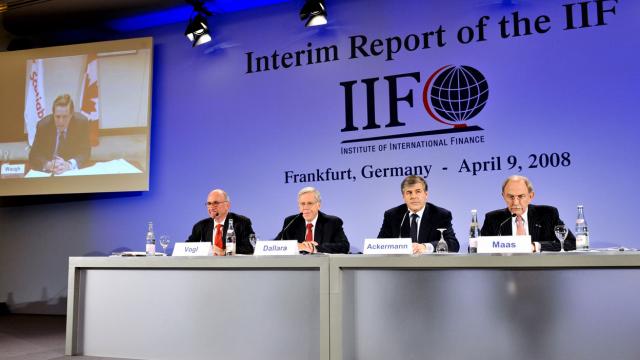
Part I: Global Power Project: Exposing the Institute of International Finance
This is the first of a series of exposés focusing on the Institute of International Finance (IIF), the very “visible hand” of financial markets. It is a continuation of the Global Power Project produced by Occupy.com. Part 1 examines the origins of the IIF.
Click on Image to Enlarge
Founded in 1983, the Institute of International Finance (IIF) describes itself as “the world’s only global association of financial institutions” with a membership that includes “most of the world’s largest commercial banks and investment banks,” along with sovereign wealth funds, asset managers, hedge funds, insurance companies, law firms, multinational corporations, development banks, multilateral agencies, credit ratings agencies and an assortment of other global financial and economic organizations. In short, the Institute of International Finance is the very visible hand of the global financial markets.
As the IIF notes on its website, its “main activities” include providing so-called “impartial analysis and research” to its members in order to “shape regulatory, financial, and economic policy issues….influence the public debate on particular policy proposals….[and work] with policymakers, regulators, and multilateral organizations… with an emphasis on voluntary market-based approaches to crisis prevention and management.”
It is also there to “provide a network for members to exchange views and offer opportunities for effective dialogue among policymakers, regulators, and private sector financial institutions.” The IIF proclaims it “is committed to being the most influential global association of financial institutions,” seeking to “sustain and enhance…. our extensive relationships with policymakers and regulators.”
The Institute of International Finance was formed at the beginning of the debt crisis of the 1980s, designed to establish a formal organization and representation for the interests of the world’s major banks and financial institutions. A meeting at Ditchley Park, England, was hosted by the National Planning Association (NPA) in May of 1982, which brought together senior representatives from major commercial banks in the industrialized Organization for Economic Co-Operation and Development (OECD) countries, as well as the Managing Director of the International Monetary Fund (IMF), Jacques de Larosiere; other top IMF and World Bank officials; the Comptroller of the Currency of the U.S., C.T. Conover; and the Head of Banking Supervision at the Bank of England, Peter Cooke, among many others. [1]
This is one of those stories that makes me think about giving up on SR because the human species is just too stupid collectivey to survive, so what's the point. I confess I do despair that we are literally killing ourselves. Our greed simply trumps all other considerations. This story just makes you want to weep.
Citizens United I believe will rank, along with the Dred Scott decision as one of the most egregiously obtuse and stupidest decisions ever made by the Supreme Court. Even the original judge who first ruled on it before it went to the Supreme Court has repudiated it. And it was followed by another truly awful decision by the conservative bloc on the Court, the gutting of the Voting Rights Act.
The 1858 Dred Scott decision played a role in the lead up to the Civil War. The two modern decisions have fundamentally changed American democracy — for the worse. It should have been obvious how bad these decisions were, so obvious in fact that one can only wonder whether these conservative activist justices don't have a political agenda. Here is an excellent assessment of what the Voting Rights Act decision has led to. The flood of money that preceded it, with Citiziens is already well-known.
The racial implications of the Voting Rights Act decision have gotten a lot of coverage. Much less discussed is the suppression of women voters, with Texas leading the way in ignominy.
Click through to see the useful map that accompanies this report.
Here is a charming story to wipe the stench of stupidity that the other stories in today's edition have left in your mind. I wish I could find more good news, but we are who we are, and I deal in facts, not fantasies. Click through to see the video.
Religion, racism, and guns, the hallmarks of the Theocratic Right. What were once just anecdotal reports has yielded to actual research data. Note the last paragraph's observation about the suppression of gun research by the government through non-funding. This in the face of the holocaust of gun deaths in the U.S.
Phi Betta Iota: Sometimes Brother Schwartz has a brain fart. Baseball bats kill more people than firearms do — firearms are no less than TENTH on the list of murderous weapons. It must also be said that governments are responsible for holocausts in which weapons play a role — not the individual “gun owners.”