Chuck Spinney: Robert Rubin, ROOT for the Collapse — With Bill Clinton as Active Enabler of Wall Street Crime — None of the “Advisors” Show Deep Integrity

07 Other Atrocities, 10 Transnational Crime, Commerce, Corruption, Government, Law Enforcement
Chuck Spinney
Chuck Spinney

Attached herewith is an important report in the Guardian.  It places the deregulation of Wall Street during the Clinton Administration into a particularly smarmy perspective by examining documents just released by the Clinton library.  Note the connections to players now in the Obama Administration.

This report paints a revealing albeit depressingly familiar portrait of how the iron triangle of individuals and money moving between government executive positions, and private sector, together with friendly legislators in Congress encourages corruption that leads ultimately to taxpayer bailouts.  Consider please the following:

1. Note how the memos make it look like President Clinton was being rushed, implying a certain degree of passivity and manipulation by advisors.  But before taking this at face value, bear in mind, Clinton was never a passive actor; quite the opposite, he was a highly energetic president.  He set the tone, and he picked these advisors; he stayed with them; and he passed many of them on to President Obama.

2. Note that the repeal of Glass Steagall — Clinton’s signature deregulation of the financial markets and perhaps the major contributor to the rise of speculation that culminated in 2008 crash — was not a last minute affair.  In fact, the memos show effort to repeal reaches bat to at least in February 1995 and May 1997 and the reference to eating the paper after you read it suggests a degree of malevolent cynicism.

3. Note the tight connection between the repeal Glass-Steagall and the pending Citigroup merger with Travelers Group, and particularly, the central the role played by Secretary of the Treasury Robert Rubin in the promotion of the of that repeal.  Rubin was Secretary of the Treasury from 11 January 1995 to 2 July 1999 — the period covered by the memos contained in the Guardian report.

4. Finally, the reader should note that four months after leaving the Treasury Department, in Oct 1999, Rubin joined Citigroup.  Here is a contemporary portrait painted by a  27 October 1999 report in the New York Times,

Mr. Rubin, 61, a former top official of Goldman, Sachs & Company, said yesterday that he had joined Sanford I. Weill and John S. Reed, the chairmen and chief executives Citigroup, in what Mr. Reed described as a ”three-person office of the chairman” that will oversee what has become the first true American financial conglomerate since the Depression.

The appointment came less than a week after the Clinton Administration and Congress agreed on a compromise bill that would overhaul the laws that regulate the financial industry, a measure that removes many of the restrictions preventing banks, securities firms and insurance companies from buying one another or engaging in one another's businesses. Both Mr. Rubin and Citigroup strongly supported the bill, which would greatly benefit the company. Mr. Rubin said he played a role in arranging the final compromise that will probably lead to the repeal of the so-called Glass-Steagall legislation. But he said that had nothing to do with his decision to join the company.” 

By 2007 Rubin was Chairman of Citigroup. And in 2008, nine years after the repeal of Glass Steagall, the worst financial crisis since the Great Depression hit Wall Street to trigger the worst and longest recession since the Great Depression.  That crisis, among other things, collapsed the stock markets, destroyed retirement nest eggs, wrecked the housing markets, and put millions of people out of work — and our nation has still not recovered.  Then the “best government money can buy” added insult to injury by bailing out of the banks that created the mess, while ducking the issue of re-regulating their behaviour with anything close to proven power of defunct Glass-Steagall Act. Some observers are now warning the government’s failure to reign in speculative behaviour is setting the stage for yet another crash (e.g., here and here)

And what about Rubin’s role? According to information in Wikipedia, on 3 December 2008, shortly after the financial collapse, the Wall Street Journal characterized Rubin’s mix of oversight and management responsibilities at Citigroup “murky.”  In an interview with the Journal, Rubin defended himself, saying: “I think I've been a very constructive part of the Citigroup environment.”But, the Journal reported that Citigroup shareholders suffered losses of more than 70 percent since Rubin joined the firm and that he encouraged changes that led the firm to the brink of collapse.[23]  Investors filed a lawsuit in December contending that Citigroup executives, including Rubin, sold shares at inflated prices while concealing the firm’s risks. A Citigroup spokesman said the lawsuit was without merit.[24].

But what happened to Rubin personally? According to a 20 September 2012 report in Bloomberg, Rubin received a total compensation of $126,000,000 from Citigroup between 1999 and 2009.  Among other things, the former eagle scout is now co-chairman of the prestigious Council on Foreign Relations.

Chuck Spinney

The Blaster

———————

Wall Street deregulation pushed by Clinton advisers, documents reveal

Previously restricted papers reveal attempts to rush president to support act, later blamed for deepening banking crisis

Continue reading “Chuck Spinney: Robert Rubin, ROOT for the Collapse — With Bill Clinton as Active Enabler of Wall Street Crime — None of the “Advisors” Show Deep Integrity”

Eagle: Will Artificial Intelligence Lead to Extinction of Humanity? Would You Trust Your Life to the Weakest Line of Code?

Academia, Commerce, Government, Idiocy, IO Impotency
300 Million Talons...
300 Million Talons…

Scientists warn the rise of AI will lead to extinction of humankind

(NaturalNews) Everything you and I are doing right now to try to save humanity and the planet probably won't matter in a hundred years. That's not my own conclusion; it's the conclusion of computer scientist Steve Omohundro, author of a new paper published in the Journal of Experimental & Theoretical Artificial Intelligence.

His paper, entitled Autonomous technology and the greater human good, opens with this ominous warning (1)

Military and economic pressures are driving the rapid development of autonomous systems. We show that these systems are likely to behave in anti-social and harmful ways unless they are very carefully designed. Designers will be motivated to create systems that act approximately rationally and rational systems exhibit universal drives towards self-protection, resource acquisition, replication and efficiency. The current computing infrastructure would be vulnerable to unconstrained systems with these drives.

Continue reading “Eagle: Will Artificial Intelligence Lead to Extinction of Humanity? Would You Trust Your Life to the Weakest Line of Code?”

G. William Domhoff: Who Rules America (1967)

Commerce, Corruption, Cultural Intelligence, Government
Amazon Page
Amazon Page

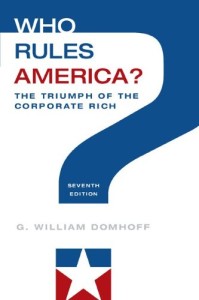
WHO RULES AMERICA? The Class-Domination Theory of Power

G. William Dornhoff

NOTE: WhoRulesAmerica.net is largely based on my book, Who Rules America?, first published in 1967 and now in its 7th edition. This on-line document is presented as a summary of some of the main ideas in that book.

Who has predominant power in the United States? The short answer, from 1776 to the present, is: Those who have the money — or more specifically, who own income-producing land and businesses — have the power. George Washington was one of the biggest landowners of his day; presidents in the late 19th century were close to the railroad interests; for the Bush family, it was oil and other natural resources, agribusiness, and finance. In this day and age, this means that banks, corporations, agribusinesses, and big real estate developers, working separately on most policy issues, but in combination on important general issues — such as taxes, opposition to labor unions, and trade agreements with other countries — set the rules within which policy battles are waged.

Click on Image to Enlarge

Contents

• Power and Power Indicators
• The Social Upper Class
• The Corporate Community
• How Government Policy Is Shaped From Outside Government
• The Power Elite
• The Power Elite and Government
• Why Business Leaders Feel Powerless
• The Weaknesses of the Working Class
• Community Power

The Weaknesses of the Working Class & Community Power Below the Line

Continue reading “G. William Domhoff: Who Rules America (1967)”

Berto Jongman: Malaysian Airlines “Rothschild Chip” Could Power Nano-Drones for Good or Evil

07 Other Atrocities, 09 Terrorism, 10 Transnational Crime, Commerce, Corruption, Government, IO Deeds of War, Military
Berto Jongman
Berto Jongman

MH370: How Fatal is the Chip That Rothschild Reportedly ‘Acquired’?

EXTRACT

How destructible could this chip be?

In a detailed report from Malaysia Chronicle dated April 8, it said that Freescale launched what could be the world's smallest microcontroller in Feb 2013 called the Kinesis KL02.

KL02 measures 1.9 mm by 2mm and contains RAM, ROM and a clock. Even with its minute size, KL02 might be the most potent next-generation war weaponry.

Whether remotely controlled or automatically programmed, KLO2 can be utilised to employ drones smaller than flies. Such small-sized drones were allegedly being used to deliver lab-cloned viruses or toxic drugs instrumental for spreading plague, virus and disease; track spy satellites or large scale and hidden weaponries.

Continue reading “Berto Jongman: Malaysian Airlines “Rothschild Chip” Could Power Nano-Drones for Good or Evil”

BREAKING: Hold on Keystone – Fracking Next?

05 Energy, 06 Family, 07 Health, 11 Society, 12 Water, Civil Society, Collective Intelligence, Commerce, Corruption, Earth Intelligence, Ethics, Government
Click on Image to Enlarge

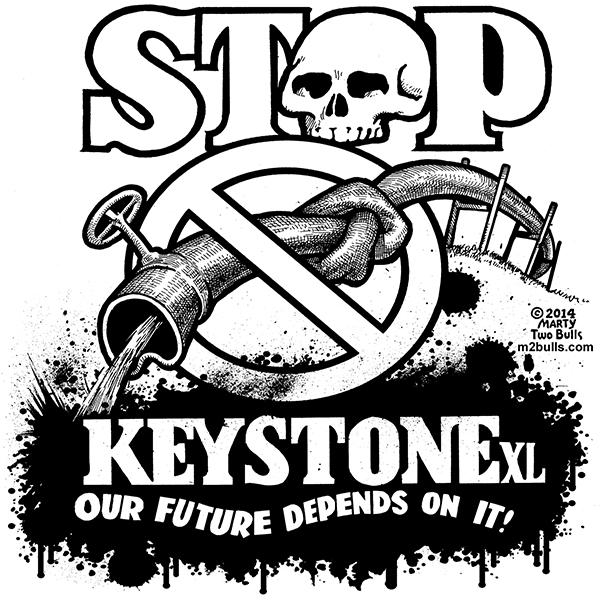
2.5 million outraged public comments and one honest state (Nebraska) — the Administration is, for the very first time, feeling the weight of collective intelligence both individual and state. Is fracking next?

US Puts off Decision on Keystone XL Pipeline

The Obama administration is putting off its decision on the Keystone XL oil pipeline, likely until after the November elections, by extending its review of the controversial project indefinitely.

In a surprise announcement Friday as Washington was winding down for Easter, the State Department said federal agencies will have more time to weigh in on the politically fraught decision — but declined to say how much longer. Officials said the decision will have to wait for the dust to settle in Nebraska, where a judge in February overturned a state law that allowed the pipeline's path through the state.

State Department Indefinitely Delays Keystone XL Pipeline Decision

“In addition, during this time we will review and appropriately consider the unprecedented number of new public comments, approximately 2.5 million, received during the public comment period that closed on March 7, 2014,” the State Department said.

Continue reading “BREAKING: Hold on Keystone – Fracking Next?”

Berto Jongman: Environmental Activists Being Systematically Murdered

03 Environmental Degradation, 07 Other Atrocities, Commerce, Corruption, Earth Intelligence
Berto Jongman
Berto Jongman

Killing Nature’s Defenders: Study Finds Global Surge in Murders of Environmental Activists

A new reports finds the killings of environmental and land rights activists worldwide has tripled over the past decade. The group Global Witness documented 147 activists who were killed in 2012, compared to 51 in 2002. The death rate is now an average of two per week. Almost none of the killers have faced charges. We air interviews with some of the late activists featured in the report, including José da Silva, a Brazilian conservationist and environmentalist who campaigned against logging and clearcutting of trees in the Amazon rainforest. In 2011, José and his wife, Maria, were murdered by masked gunmen. “This could be the tip of the iceberg in terms of the scale of the real problem,” says Global Witness campaigner Oliver Courtney, who says details about the murders were nearly impossible to locate.

Watch video and/or read transcript.

REPORT: Deadly Environment: The Dramatic Rise in Killings of Environmental and Land Defenders

Michel Bauwens: Towards the Democratization of the Means of Monetization – The Three Competing Value Models Present Within Cognitive Capitalism

03 Economy, Civil Society, Commerce, Cultural Intelligence
Michel Bauwens
Michel Bauwens

Towards the Democratization of the Means of Monetization: The Three Competing Value Models Present Within Cognitive Capitalism

The Problematic: the value crisis

In the 19th century, the counter-hegemonic forces of labour focused on the democratisation of the state as well as focusing on the redistribution of the surplus value created by labour. Both tasks are by no means obsolete given the evolution towards market state models which have hollowed out popular democracy, as well ans the increased role of debt in human exploitation1. However, what is now needed in addition, for and by 21st century social movements, is the democratisation of the means of monetization. In a contributive economy, use value becomes key, and undermines mechanisms based on labor value alone; value must therefore become pluralistic and diverse, and so must monetary means; while undoubtedly, demonetization will be a good thing in many sectors under a regime of civic domination, we will also need new forms of monetization, and restore the feedback loop between value creation and value capture. As we will argue, the current value regime, which we call ‘cognitive capitalism under the emergence of netarchical capitalism’ (see infra), is unable to redistribute value in a fair way, and is creating not just a crisis of social reproduction for working people, but also a crisis of accumulation of capital. In our article, value and money regimes are placed in the context of the evolution of the overall political economy toward an increasing importance of models based on peer production. We will look at what kind of social system and policy transition, that can solve this crisis of value.

Read full article with links and notes.

noble gold