Josh Kilbourn: 50 Economic Numbers About USA – Frightening!

03 Economy, 11 Society, Commerce, Corruption, Government, Money, Banks & Concentrated Wealth, Power Behind-the-Scenes/Special Interests
Joshua Kilbourn

50 Economic Numbers About The US That Are “Almost Too Crazy To Believe”

Tyler Durden on 12/16/2011

The Economic Collapse Blog does a terrific job of periodically putting together a compilation of the scariest data points about the US economy. Today is one such day, and the list of 50 economic numbers presented is indeed, as the author puts it, “almost too crazy to believe“… Almost. As noted: “At this time of the year, a lot of families get together, and in most homes the conversation usually gets around to politics at some point.  Hopefully many of you will use the list below as a tool to help you share the reality of the U.S. economic crisis with your family and friends.  If we all work together, hopefully we can get millions of people to wake up and realize that “business as usual” will result in a national economic apocalypse.” Or, far more likely, 99% of the population can continue watching Dancing with the Stars, as what little wealth remains is terminally transferred to those who are paying attention right below everyone's eyes.

From the Ecopnomic Collapse Blog:

The following are 50 economic numbers from 2011 that are almost too crazy to believe….

#1 A staggering 48 percent of all Americans are either considered to be “low income” or are living in poverty.

49 remaining items below the line.

Continue reading “Josh Kilbourn: 50 Economic Numbers About USA – Frightening!”

Yoda: Opus machine prints books in minutes

Advanced Cyber/IO, Civil Society, Commerce, Methods & Process
Got Crowd? BE the Force!

Opus machine prints books in minutes at Politics and Prose

The new Opus machine at Politics and Prose bookstore on Connecticut Avenue in Washington can print and bind a book that is indistinguishable from one of the professionally mass-printed books on the shelves at the same store. Public domain works, out-of-print novels, electronic books supplied via publishing houses and personal books can all be printed in minutes while customers wait.

VIDEO 2:30 Via Washington Post

Phi Beta Iota:  Price is always an issue.  HOWEVER, now that “true cost” economics is converging with Occupy and the 99%, we anticipate that publishers and Amazon are in for an eye-opener.  This will also empower authors who choose to by-pass the entire “system” and local book stores who can be liberated from inventory and publisher overhead.

Mini-Me: Comunidad de Estados Latinoamericanos y Caribeños (CELAC)

01 Brazil, 03 Economy, 08 Wild Cards, 09 Justice, 10 Security, 11 Society, Advanced Cyber/IO, Commerce, Commercial Intelligence, Counter-Oppression/Counter-Dictatorship Practices, Cultural Intelligence, Government
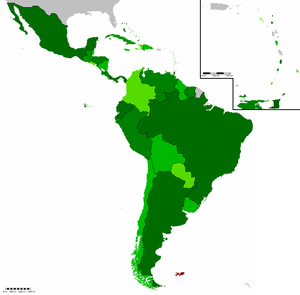
Click on Image to Enlarge

The Community of Latin American and Caribbean States (Spanish: Comunidad de Estados Latinoamericanos y Caribeños, CELAC, Portuguese: Comunidade de Estados Latino-Americanos e Caribenhos, French: Communauté des États Latino-Américains et Caribéens, Dutch: Gemeenschap van de Latijns-Amerikaanse en Caribische landen) is the tentative name[1] of a regional bloc of Latin American and Caribbean nations created on February 23, 2010, at the Rio GroupCaribbean Community Unity Summit held in Playa del Carmen, Quintana Roo, Mexico.[2][3] It consists of all sovereign countries in the Americas, except for Canada, France, the Netherlands and the United States. British and Danish dependencies in the Americas are also not represented in CELAC.

CELAC is an example of a decade-long push for deeper integration within the Americas.[4] CELAC is being created to deepen Latin American integration and to reduce the once overwhelming influence of the United States on the politics and economics of Latin America, and is seen as an alternative to the Organization of American States (OAS), the regional body organized largely by Washington in 1948, ostensibly as a countermeasure to potential Soviet influence in the region.[4][5] [6]

Continue reading “Mini-Me: Comunidad de Estados Latinoamericanos y Caribeños (CELAC)”

DefDog: Washington’s Integrity Part N to the Nth

03 Economy, 07 Other Atrocities, 09 Justice, 11 Society, Commerce, Corruption, Government, Law Enforcement, Money, Banks & Concentrated Wealth, Power Behind-the-Scenes/Special Interests
DefDog

More of the lack of integrity and the bilking of the middle class…..

Mr. Corzine Goes to Washington, With No Pull

William D. Cohan

Bloomberg.com, 11 December 2011

When it comes to shining a light on the cozy relationships between Wall Street and Washington, and how the rich and powerful get access to things the rest of us don’t, there can never be too many juicy examples.

Last month, thanks to Bloomberg Markets magazine, we were treated to the excellent story about how former Treasury Secretary Henry Paulson met with a bunch of bankers and hedge fund managers in New York during the summer of 2008 and shared with them some of his early thinking on the futures of the mortgage behemoths Fannie Mae and Freddie Mac.

Then, last week, Jon Corzine, the former chief executive officer of the defunct MF Global Inc. with a gold-plated resume — he was also a senior partner of Goldman Sachs Group Inc. and a U.S. senator and governor of New Jersey — testified before the House Agriculture Committee about his often-successful campaign to thwart the efforts of Washington regulators to enact rules that he and MF Global didn’t like.

Read full story.

See Also:

2012 Reflexivity = Integrity: Toward Earth/Life 4.0

Journal: Politics & Intelligence–Partners Only When Integrity is Central to Both

Journal: Reflections on Integrity UPDATED + Integrity RECAP

Lynn Wheeler: Why Financial Systems Demand False Complexity and Ignorance…Corruption is Merely a Bonus

03 Economy, 07 Other Atrocities, 10 Transnational Crime, 11 Society, Blog Wisdom, Commerce, Commercial Intelligence, Misinformation & Propaganda, Money, Banks & Concentrated Wealth, Power Behind-the-Scenes/Special Interests
Lynn Wheeler

Financial Cryptography

Where the crypto rubber meets the Road of Finance…

December 11, 2011

Why (my, all) financial systems fail — information complexity

I spent over a decade building the snappiest financial system around. In that time I pursued one goal of efficiency: reduction of complexity. This wasn't only goodness in an angelic sense, it was a pragmatic goal to reduce my own costs in building systems.

The result was pretty spectacular: we were settling trades in seconds and doing so with every leg firmly fastened to the ground. That is, the whole thing was running with direct concrete ties to assets.

But, the big players weren't interested. Indeed they were more than uninterested, they were highly interested in making sure this would never ever happen. Time after time, the message was delivered: Never. Other companies received the same message, so after a few years, I started to take it seriously.

At the time I hypothesised that the reason for this was insider fraud, or at least profits capture. The complexities were endemic and there were very few people who could see the whole picture. So, I theorised that those who could understand the complexities were cashing in on their advantage; from the inside. And some very few who cashed in were also driving the information agenda, as their success made them both wealthy and influential:  more complexity.

Of course such a hypothesis is unlikely to find proof. By its very nature, how do you prove such a tendency towards chaos? Here comes an alternate perspective from ZeroHedge, citing two papers (1, 2):

And the punchline: “Liquidity requires symmetric information, which is easiest to achieve when everyone is ignorant. This determines the design of many securities, including the design of debt and securitization.” Reread the last statement as it explains perhaps better than anything, the true functioning of modern capital markets and why they are terminally broken: in order to preserve the system, the banking cartel need to make everything of virtually infinite complexity so that no one has a clear understanding of what is going on!

Read full posting.

Phi Beta Iota:  In brief, finance is fraud.  As William Greider documents in his book, The Soul of Capitalism, financial instruments (incomprehensible to their own vendors) appreciated seventeen times while real assets appreciated five times.  Twelve is the fraud-complexity-corruption delta.

See Also:

Mini-Me: European-US Banking–Tangled Web — Tell Me Again, Why Shouldn’t We Default and Let the Banks Fry? + Financial Terrorism RECAP

Mini-Me: European-US Banking–Tangled Web — Tell Me Again, Why Shouldn’t We Default and Let the Banks Fry? + Financial Terrorism RECAP

03 Economy, 07 Other Atrocities, 10 Transnational Crime, 11 Society, Budgets & Funding, Commerce, Commercial Intelligence, Corruption, Government, Money, Banks & Concentrated Wealth, Power Behind-the-Scenes/Special Interests
Who? Mini-Me?

The question has to be asked: “Why shouldn't we default and let the banks fry?”

What possible benefit it there to the people of a nation whose previous leaders “sold out” the entire country on the basis of lies from the banks, notably Goldman Sachs?

Why not default and focus on full employment and resilience at home?  Why rescue German banks?

If a new financial system is emerging, anchored by the BRICS [Brazil, Russia, India, China, South Africa], why not focus on being attractive that that new ethical financial system instead of giving up what is left in the way of seed corn to the old predatory unethical system?

Banks Sit in a Tangled Web

Many European Lenders Have Sold Sovereign-Default Protection to One Another

EXTRACT:

Of the total protection that European banks have written on government bonds in Europe's five most-stressed countries, nearly one-third originated from German banks.

See Also:

Continue reading “Mini-Me: European-US Banking–Tangled Web — Tell Me Again, Why Shouldn't We Default and Let the Banks Fry? + Financial Terrorism RECAP”

John Robb: Collapse of the Western Financial “System”

01 Poverty, 03 Economy, 07 Other Atrocities, 08 Wild Cards, 11 Society, Budgets & Funding, Commerce, Corruption, Cultural Intelligence, Ethics, Government, Misinformation & Propaganda, Money, Banks & Concentrated Wealth, Power Behind-the-Scenes/Special Interests
John Robb

Here's a scenario from William Buiter (the chief economist at Citi) on what could happen if the EU collapses:

Disorderly sovereign defaults and eurozone exits by all five periphery states would drag down not just the European banking system but also the north Atlantic financial system and the internationally exposed parts of the rest of the global banking system. The resulting financial crisis would trigger a global depression that would last for years, with GDP likely falling by more than 10 per cent and unemployment in the West reaching 20 per cent or more. Emerging markets would be dragged down too.

I have a couple of additions to William's scenario:

  • We are seeing crisis and depression scenarios like this with regularity now.  They are all presented as being on the cusp of occurring.  It should be very clear to everyone by now, that something fundamental is wrong with the global system and the crisis de jour is just its symptom.  Nobody “in charge” seems to be able to diagnose the real problems with our system.
  • The solutions being proposed are either a) more confidence (through bailouts) and b) more confidence (through more deficit spending).  In other words:  the problem is merely psychological and all you and I need to do is take some anti-depressants to eradicate any lingering pessimism (why worry, let's party!).  In short: there aren't any real solutions being offered.
  • None of the bad actors that profit from the behavior that led us into this crisis, either in government or in the financial sector, are held to account.  The moral hazard here is so vast, it can (and likely will) swallow the current economic system.

WIM:  What does it Mean?

It's very simple.  It is almost a certainty that a global economic depression is on its way and there is absolutely nothing you or I can do to stop it (a ballot box solution now would be as effective as replacing the Captain of the Titanic after the ship hit the iceberg).  So, what can you and I do?  We can take control of our environment.  Our objective is to build or buy access to a community that has the resilience to not only help us survive a global depression, but thrive during it.  A resilient community that:

  • Negates the impact of inevitable supply disruptions, rationing, and price spikes.
  • Protects you from the political violence that will erupt (mobs and police states).
  • Has a functional local economy that has the potential to network with other functional local economies.
noble gold