“Kings had always been involving and impoverishing their peoples in wars, pretending generally, if not always, that the good of the people was their object. This, our Convention understood to be the most oppressive of all Kingly oppressions; and they resolved to so frame the Constitution that no one man should hold the power of bringing this oppression upon us.”–Abraham Lincoln
I recently did a series of interviews for an international venture investing newsletter called Capitalist Exploits. Here's a question I got that I thought we be of interest to GG readers. I've extended the answer a bit from the original in the interview.
Mark: Switching gears just a bit… We've watched the SOPA/PIPA controversy, now its CISPA; the “Stellar Wind” project was featured in Wired last month, and recently an NSA whistleblower, former Director William Binney, came out and said flat out that the government is lying, they intercept and store everything we do, Constitution be damned. It seems the government won't stop until it completely controls the flow of information on the Internet and has the ability to monitor and record everything we say and do online. You're a counter-terrorism expert, how much of this is hype and how much of it is really necessary to safeguard national security, in your opinion. And what about our civil liberties and right to privacy?
John: It’s a mixed bag. There’s certainly lots of concern in regards to how the NSA gathers data on US citizens. Added to what the private sector is gathering, its safe to conclude that we don’t have any privacy.
For example, nearly every new phone sold today has a GPS chip in it. It’s constantly gathering data on where that phone is and sending it to the phone company. All of that phone company data, from all of the phone companies across the world, is aggregated and provided to select governments for use in counter-terrorism. In short, the three billion people that are using cell phones are being tracked in order to help find and kill a couple hundred terrorists (its contribution is probably limited to being the primary source for neutralizing a couple of terrorists a year).
When reaching out to Alberta oil sands companies before a trip to Canada last month, I thought all of them mined oil the same way — they don't.The open mining most people think of when they picture the oil sands is just one way of extracting crude from the ground, but it is without a doubt the most dramatic. And we had to see it.
After being refused a mine tour and any type of access to a mining site or equipment, Business Insider rented a plane that I used to see everything I could of the mines on my own.
Restricted to flying no lower than 1,000 feet above the ground, I spent nearly two hours leaning out the window of a small Cessna 172 with a long lens, snapping pictures and trying to keep warm.
The oil sands hold up to two trillion barrels of oil spread over more than 54,000 square miles, making it the second largest oil deposit in the world after Saudi Arabia.
The amount of energy spent recovering that oil and the pollution created in refining it is immense and the impact on the environment profound.
When news outlets recently quoted U.S. Secretary of State Hillary Clinton claiming that State Department operatives hacked the websites of al-Qaida affiliates in Yemen, we didn’t know whether to be proud of the feds’ leet skills or appalled at the administration’s hypocrisy regarding hacking.
Turns out the hacks who wrote the stories got it wrong – though Danger Room’s David Axe, who was on the scene, got the story right the first go-around. And now, with the hyped headlines dialed back, we’re just disappointed.
Turns out the team simply purchased anti-al-Qaida ads on the websites to counter anti-American ads the sites were running.
Call it Operation AdWords, if you like.
Clinton was delivering a keynote speech at the Special Operations Command gala dinner in Tampa, Florida, when, as the Associated Press reported, she described how State Department specialists attacked sites tied to al-Qaida, which were trying to recruit new members by “bragging about killing Americans.”
“Within 48 hours, our team plastered the same sites with altered versions of the ads that showed the toll al-Qaida attacks have taken on the Yemeni people,” Clinton said, according to the AP. “We can tell our efforts are starting to have an impact because extremists are publicly venting their frustration and asking supporters not to believe everything they read on the internet.”
The latter story included new quotes from a State Department official clarifying that the specialist didn’t actually hack the sites. Instead, he said, they challenged extremists in open forums.
s our political system sputters, a wave of innovative thinking and bold experimentation is quietly sweeping away outmoded economic models. In ‘New Economic Visions', a special five-part AlterNet series edited by Economics Editor Lynn Parramore in partnership with political economist Gar Alperovitz of the Democracy Collaborative, creative thinkers come together to explore the exciting ideas and projects that are shaping the philosophical and political vision of the movement that could take our economy back.em>
Just beneath the surface of traditional media attention, something vital has been gathering force and is about to explode into public consciousness. The “New Economy Movement” is a far-ranging coming together of organizations, projects, activists, theorists and ordinary citizens committed to rebuilding the American political-economic system from the ground up.
The broad goal is democratized ownership of the economy for the “99 percent” in an ecologically sustainable and participatory community-building fashion. The name of the game is practical work in the here and now-and a hands-on process that is also informed by big picture theory and in-depth knowledge.
Thousands of real world projects — from solar-powered businesses to worker-owned cooperatives and state-owned banks — are underway across the country. Many are self-consciously understood as attempts to develop working prototypes in state and local “laboratories of democracy” that may be applied at regional and national scale when the right political moment occurs.
The movement includes young and old, “Occupy” people, student activists, and what one older participant describes as thousands of “people in their 60s from the '60s” rolling up their sleeves to apply some of the lessons of an earlier movement.
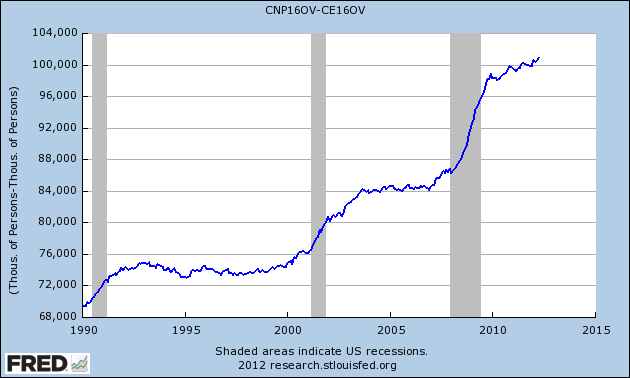
The national unemployment rate gets lots of attention, and lately more attention has been paid to the workforce participation rate since more Americans have given up looking for a job, but we can also see that an astounding 100 million Americans don’t have jobs.
Specifically, these are people who are part of the civilian over-16 non-institutional population who are either unemployed or not part of the workforce. According to the April jobs report, the number of jobless American stood at 100.9 million.
That’s an all-time record and it’s an increase of 26.2 million over the last 12 years. It’s as if we absorbed the entire adult population of Canada and not a single person had a job.
The numbers are staggering. The jobs-to-population ratio peaked 12 years ago. If we were to have the same ratio today, we would need 15.3 million more jobs, or 23.7 million fewer people.
(Note: The chart above is the Civilian Over-16 Non-Institutional Population minus the seasonally adjusted Civilian Workforce.)
For six weeks in early 2012 I ran for the office of President of the United States of America. I was accepted by the Reform Party (one of six accredited national parties completely shut out of the political process in the US), was listed at Politics1, participated in a WikiNews interview and got my views posted at On the Issues. I created We the People Reform Coalition, and I wrote letters to every single candidate for President including Rocky Anderson and Buddy Roemer, throwing in Dennis Kucinich for grins. This is my report — there are no winners.
Preamble
I was shocked into paying attention by Al Gore's playing dead in 2000 (despite Greg Palast outing the Bush family scheme to disenfranchise 50,000 people of color, doing so three months in advance of election day). I was radicalized by 9/11 — a clear false-flag operation in which elements of our own government were complicit — and infuriated with the ease by which this nation was taken to war on the strength of 935 now-documented lies — lies that no serving officer — including Colin Powell — was willing to confront. Then I lost everything in the 2008 economic crash described so well by Matt Taibbi in GRIFTOPIA — it took two years for my company to go out of business — and along came Occupy. Occupy failed. This is their story and mine. If this story moves you, I believe we have 90 days from today to take seven steps that can bury the two-party tyranny and install an honest coalition government.