Relying on a UN Security Council Resolution, but without asking Congress or the American people, President Obama attacked Libya on 19 Mar 2011. He finally got around to explaining his actions on 28 March 2011 in a nationally televised speech given at the National Defense University. Attached below are two analyses of that speech:
Story 1 by Ed Felien appeared in The Rag Blog on April 5, a spunky left-leaning website based in the hinterlands of Austen Texas. It is harshly critical of the speech by comparing Obama's assertions to conditions in Libya and the tensions within Libya that have created a civil war.
Story 2 by Anne Marie Slaughter appeared in the the New York Review of Books blog on 20 March 2011. The New York Review of Books appeals to a far more high-falutin readership than The Rag Blog, and is a kind of a forum for the panjandrums in what's left of the American Left. Dr. Slaughter gushes over Obama's speech, saying it made an “important contribution to the Libya debate.” She bases her conclusion (“let us protect the Libya's civilians by any means necessary”) by analyzing (a word I use charitably) some impenetrable comparisons of interests versus interests to interests versus values, but curiously, she says nothing about actual conditions in Libya, or who is fighting whom, or why they are fighting.
The contrast between information and puffery in these two essays is stunning and says a lot about what's wrong with the American Left.
Phi Beta Iota: Dr. Slaughter means well, but has drunk the kool-aid. No one in Washington appears capable of reconnecting with reality and using clarity, diversity, and integrity to actually understand how far the US Government has diverged from core values of the Republic, and the public interest. The right/neo-conservatives have cost the US tens of trillions of dollars in fraud, waste, and abuse–Dick Cheney and the Iraq/Afghanistan faux wars on terror being the current classic–but so also has the left/Demopublicans so intent on keeping their own money flowing they have completely lost sight of basic principles of governance. These are all good people trapped in a bad system–all it takes to fix this is ONE LEADER committed to transparency, the truth, and trust. Barack Obama is clearly NOT that leader.
This is the TOP SECRET OSCAR SIERRA Intelligence Analysis Orientation created to deal with the shared problem of CIA and DIA. It is so real it scares the most hardened veterans years after retirement.
Short Video
This one is funny sad. For funny hysterical see the colliding sexual fantasies between pilots and intelligence officers:
Since the Libyan regime was established by a coup d’état in 1969, Americans and Europeans — with a three-year intermission from 1986 to 1988 — found it acceptable enough to recognize it, sell it arms and buy its petroleum. In that one interval, on April 15, 1986, the American government under President Ronald Reagan attempted to kill Colonel Muammar Qaddafi by bombing his residence and did wound his wife and kill about 75 Libyans including his adopted daughter. Two years later, Qaddafi retaliated by bombing an American airliner. That attack killed 270 people including 190 Americans among whom were at least four intelligence officers. These were just the major events; there were many others. Of course, Americans and Libyans took very different views of them. But both sides eventually smoothed over their angers, and relations again became profitable and “correct” on both sides, as they remained until early this year.
So, what is the basis of those attitudes and the causes of those actions? Who are the Libyans anyway? And what is the position of Qaddafi among them? What motivates the Libyans? What governs their action? And what is likely to be the outcome of the revolt, the regime’s resistance to it and the Western intervention?
With the prejudice of a historian, I find that seeking answers to these questions requires at least a glance at the past. That is the aim of this essay.
Alec Ross on subversive technologies, Libya, Wikileaks, and the future of digital diplomacy.”We're willing to make mistakes of commission,” he tells Fast Company, “rather than omission.”
In the turbulent center of the Venn diagram involving President Obama's multilateral foreign policy, open government mandates, and Middle-East unrest is Alec Ross, the Senior Advisor for Innovation to Secretary of State Hillary Clinton. From asking Twitter to delay down-time maintenance during the 2009 student uprising to courting programmers for Africa, Ross's office has been tasked with coordinating the monumental logistics of a new philosophy that embraces global interdependence. Ross spoke with Fast Company about the meaning of the highly controversial “global citizenship” concept, the diplomatic difficulties in supporting subversive technologies, and the future of transparency.
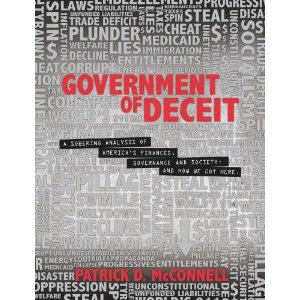
• The “entitlement programs” have an unfunded liability of greater than $104 trillion. Your share is $367,000. (Every man, woman and child owes the same.)
• At the end of 2009, $3.2 trillion of the $12.9 trillion National Debt was spent, but never on the government's general budget. Where did 3.2 Trillion dollars go?
• In 2010, the federal government is borrowing 52 cents of every dollar that it spends on general operations. Just to balance the budget, spending will have to be cut by 52%.
• Over the next four years, the federal government needs to borrow at least $3.9 trillion and the world is basically running out of money for us.
Washington, meanwhile, doesn't want to sound the economic alarm. The White House and most Democrats want Americans to believe the economy is on an upswing.
Republicans, for their part, worry that if they tell it like it is Americans will want government to do more rather than less. They'd rather not talk about jobs and wages, and put the focus instead on deficit reduction (or spread the lie that by reducing the deficit we'll get more jobs and higher wages).
I believe the Bowles Simpson recommendations represent, to too large an extent, a set of unprincipled political compromises that would lead to a weaker America — with slower growth and a more divided society.
We now have an economy in which five banks control over 50 percent of the entire banking industry, four or five corporations own most of the mainstream media, and the top one percent of families hold a greater share of the nation’s wealth than any time since 1930. This sort of concentration of wealth and power is a classic setup for the failure of a democratic republic and the stifling of organic economic growth.
The government has nearly convinced the public they have everything under control, when that’s far from the case. In fact, everything could go downhill fast. Here are ten all-too-likely scenarios I look at in my book, It Takes a Pillage:
1. The actual bailout has quietly ballooned to $16 trillion dollars (not including over $3 trillion set aside for money market funds), most of it given out with no strings attached. Wall Street firms could continue to tout the myth that ‘talent’ must be paid for – now with stupid sums of bonus money, funded by the American People.
2. The stock market, which has rallied substantially since the government started giving out free money to the banking industry, could tank on the realization that if that money needed to be paid back any time soon, the banks wouldn’t be good for it.
3. Because bigger is better still seems to be Fed policy, JPM Chase could acquire Bank of America – Merrill Lynch, creating one of the largest, federally subsidized banking firms in the world.
4. Because the bigger just can’t help getting badder, JPM Chase could also acquire Citigroup, and we’d be living with a monopoly economy.
5. We could sink into the delusion that the Obama administration has actually done something to restrain Wall Street, lulling us into a false sense of security. Then the remaining big banks will screw us again.
6. Congress could continue to ignore history and never reinstate the Glass-Steagall Act. That act made banks smaller, more specialized, easier to regulate and less expensive to bail out. Repealing it lead to this mess, and there’s barely a whisper heard in Washington of bringing it back.
7. As a Fed approved bank holding company, Goldman Sachs could buy a lot of small banks just to get access to all the money in savings and checking accounts to gamble with. Plus they’d have that great $250,000 FDIC guarantee they get per account. This would make them the biggest bank in the country.
8. Every bank and government agency with access to some aspect of a federal bailout could max out their subsidies chips at once – pushing the full bailout cost to over $26 trillion.
9. Many mid-sized and smaller banks didn’t need a bailout and have been better at allowing consumers access to credit. The largest banks, flush with federal funding and a poor record of helping average Americans, could buy them all up.
10. The Fed could continue to operate in secrecy, despite multiple moves by Congress to push for a full audit of its largesse. Right now, only the Fed knows what the real worst case scenarios might actually be.
Phi Beta Iota: A young man sought advice on whether to join the US secret intelligence world despite its many ethical issues and poor leadership. Below is the answer as provided to us by Robert Steele, to whom the email was addressed. The inquiring email is below the line.
To Anonymous:
This is simple. Continue with your plans to apply for a position with the US Government in secret intelligence. The easiest is via the military as an officer, and frankly, I recommend that because it gives you a unique grounding as a young leader, an understanding of the military mind-set, world travel, etcetera. Joining CIA directly if they take you (they are moderately desperate) has its prospects, but on balance, I would recommend that you invest four years as an officer on active duty, followed by four to eight years at CIA. Treat it as FUN, and a reality learning experience.
As simply as possible, as bad as they are, there is no substitute for the real experience and it is a privilege to work in secret intelligence, completely irrespective of how unethical and reality stupid its leaders might be.
I do NOT recommend the FBI, nor do I recommend the private sector. Think in terms of a 30-40 year career. Getting the clearances is much easier if you go in to government first, and they are worth $20K a year above and beyond normal salaries, should you choose to stay in the secret world.
Two key points:
1) One day we will create a Smart Nation, and those who fully understand both the benefits and the pathologies of secret intelligence will have an important role to play.
2) If you keep your own integrity, and treat this as a learning and observation experience, the loss of integrity by the US intelligence community leaders should not dissuade you from undertaking what is sure to be one of the most satisfying experiences of your life. Illusions and pathologies aside, secret intelligence is as cool as it gets, you will learn a great deal, and it will make you stronger for the future.
Happy to answer any additional questions. As long as you keep it in perspective, if you can get in, you should.
Wars cannot be won with precision bombings alone. NATO's air war against Serbia is often touted as a success, but even that took longer than predicted and the cease-fire terms were unchanged.
By Andrew Cockburn
No one following the record of air power as an instrument of national whim should be surprised that Moammar Kadafi's army remains apparently uncowed, even driving Libyan rebels back in headlong retreat despite an onslaught of NATO bombs and missiles. In fact, history is repeating itself in more ways than one.
The very first bombing raid ever occurred almost 100 years ago on Nov. 1, 1911, when an Italian airman hand-dropped four 4.5-pound bombs on forces defending Tripoli against Italian invaders. This momentous event went down well with the press: “Italian Military Aviator Outside Tripoli Proves War Value of Aeroplane,” headlined the New York Times. But it had little effect on the fighting, thus commencing a pattern of disappointment that has recurred with monotonous regularity in subsequent conflicts, irrespective of advances in technology. Precision bombing, touted as an instrument of victory in World War II and Vietnam, turned out to be anything but, leaving the wars to be decided by foot soldiers on the ground.