Kudos should be given to the UN’s Counter Terrorism Committee Executive Directorate (CTED) for producing what is perhaps the most comprehensive and frank assessments to date of the international community’s implementation of Security Council Resolution 1373 and the measures adopted to combat international terrorism. Their report was presented to the Security Council by CTED Executive Director Mike Smith on December 16th and provides detailed information on what is actually being done, on the vulnerabilities, and on the technical assistance required. It provides a thematic overview of the laws and actions taken in the areas of enforcement, border control, countering the financing of terrorism, and international cooperation as well as a region by region assessment. Human rights considerations are also addressed. The report should be read closely.
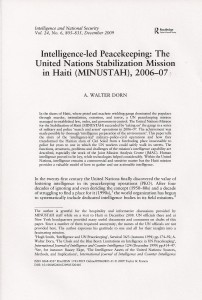
Phi Beta Iota: Dr. Walter Dorn is one of a tiny handful of truly authoritative academic observers of UN intelligence, a pioneer in his own right, and perhaps the only person who has followed UN intelligence from the Congo in the 1960's to the creation of new capabilities in Haiti and elsewhere in the 21st Century. He is the dean of UN intelligence authors. See also Who’s Who in Peace Intelligence: Walter Dorn.
I doubt it, but hope springs eternal could this be a significant development? To date, Simon Johnson has been a very astute observer of the financial meltdown and has been crusading for breaking up the mega banks …
For most the past 12 months, Paul Volcker was sitting on the policy sidelines. He had impressive sounding job titles – member of President Obama’s Transition Economic Advisory Board immediately after last November’s election, and quickly named to head the new Economic Recovery Board.
But the Recovery Board, and Volcker himself, have seldom met with the President. Economic and financial sector policy, by all accounts, has been made largely by Tim Geithner at Treasury and Larry Summers at the White House, with help from Peter Orszag at the Office of Management and Budget, and Christina Romer at the Council of Economic Advisers.
With characteristic wry humor, Volcker denied in late October that he had lost clout within the administration: “I did not have influence to start with.”
But that same front page interview in the New York Times [10/21/09] contained a well placed shock to then prevailing policy consensus.
Volcker, legendary former chairman of the Federal Reserve Board with much more experience of Wall Street than any current policymaker, was blunt: We need to break up our biggest banks and return to the basic split of activities that existed under the Glass-Steagall Act of 1933 – a highly regulated (and somewhat boring) set of banks to run the payments system, and a completely separate set of financial entities to help firms raise capital (and to trade securities).
Contrary to popular belief, the US actually has 189,000 personnel on the ground in Afghanistan right now—and that number is quickly rising.
by Jeremy Scahill
A hearing in Sen. Claire McCaskill's Contract Oversight subcommittee on contracting in Afghanistan has highlighted some important statistics that provide a window into the extent to which the Obama administration has picked up the Bush-era war privatization baton and sprinted with it. Overall, contractors now comprise a whopping 69% of the Department of Defense's total workforce, “the highest ratio of contractors to military personnel in US history.” That's not in one war zone-that's the Pentagon in its entirety.
In Afghanistan, the Obama administration blows the Bush administration out of the privatized water. According to a memo [PDF] released by McCaskill's staff, “From June 2009 to September 2009, there was a 40% increase in Defense Department contractors in Afghanistan. During the same period, the number of armed private security contractors working for the Defense Department in Afghanistan doubled, increasing from approximately 5,000 to more than 10,000.”
At present, there are 104,000 Department of Defense contractors in Afghanistan. According to a report this week from the Congressional Research Service, as a result of the coming surge of 30,000 troops in Afghanistan, there may be up to 56,000 additional contractors deployed. But here is another group of contractors that often goes unmentioned: 3,600 State Department contractors and 14,000 USAID contractors. That means that the current total US force in Afghanistan is approximately 189,000 personnel (68,000 US troops and 121,000 contractors). And remember, that's right now. And that, according to McCaskill, is a conservative estimate. A year from now, we will likely see more than 220,000 US-funded personnel on the ground in Afghanistan.
Haider Mullick is a Senior Fellow at the US Joint Special Operations University and a research fellow at the Institute for Social Policy and Understanding.
The Diplomat speaks with South Asia analyst Haider Mullick about Pakistan’s counter-insurgency efforts, conspiracy theories and the prospects for stability in Afghanistan.
You’ve recently returned from a trip to India and Pakistan. How have perceptions of the United States settled since US Secretary of State Hillary Clinton visited?
You’ve written recently about how the US needs to market itself in Pakistan. In a nutshell, what does it need to be doing differently?
Clinton was critical of Pakistan’s failure to capture top al-Qaeda leaders. Broadly speaking, how do you rate Pakistan’s counter-insurgency efforts?
How effective has the Pakistani leadership been in rallying public support for its counter-insurgency efforts?
Looking across the border at Afghanistan, what do you make of the recent US announcement to send 30,000 more troops. Was President Barack Obama right to set out a timeline for withdrawal?
Are you optimistic about the prospects for long-term stability in Afghanistan?