Infopolicy – Christian Engström: The NSA has asked Linus Torvalds to inject covert backdoors into the free and open operating system GNU/Linux. This was revealed in this week’s hearing on mass surveillance in the European Parliament. Chalk another one up of the United States NSA trying to make information technology less secure for everyone.
The father of Linus Torvalds, Nils Torvalds, is a Member of the European Parliament for Finland. This week, Nils Torvalds took part in the European Parliament’s hearing on the ongoing mass surveillance, and brought a revelation:
The United States security service NSA has contacted Linus Torvalds with a request to add backdoors into the free and open operating system GNU/Linux.
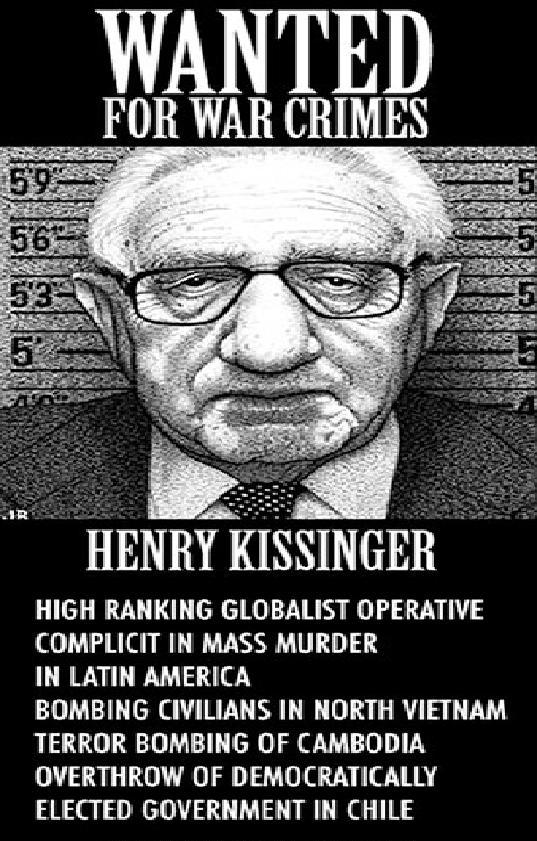
Two months ago, hundreds of thousands of Chileans somberly marked the 40th anniversary of their nation’s September 11th terrorist event. It was on that date in 1973 that the Chilean military, armed with a generous supply of funds and weapons from the United States, and assisted by the CIA and other operatives, overthrew the democratically-elected government of the moderate socialist Salvador Allende.
Click on Image to Enlarge
Sixteen years of repression, torture and death followed under the fascist Augusto Pinochet, while the flow of hefty profits to US multinationals – IT&T, Anaconda Copper and the like – resumed. Profits, along with concern that people in other nations might get ideas about independence, were the very reason for the coup and even the partial moves toward nationalization instituted by Allende could not be tolerated by the US business class.
Henry Kissinger was national security advisor and one of the principle architects – perhaps the principle architect – of the coup in Chile. US-instigated coups were nothing new in 1973, certainly not in Latin America, and Kissinger and his boss Richard Nixon were carrying on a violent tradition that spanned the breadth of the 20th century and continues in the 21st – see, for example, Venezuela in 2002 (failed) and Honduras in 2009 (successful).
Where possible, such as in Guatemala in 1954 and Brazil in 1964, coups were the preferred method for dealing with popular insurgencies. In other instances, direct invasion by US forces such as happened on numerous occasions in Nicaragua, the Dominican Republic and many other places, was the fallback option.
The coup in Santiago occurred as US aggression in Indochina was finally winding down after more than a decade. From 1969 through 1973, it was Kissinger again, along with Nixon, who oversaw the slaughter in Vietnam, Cambodia and Laos.
Click on Image to Enlarge
It is impossible to know with precision how many were killed during those four years; all the victims were considered enemies, including the vast majority who were non-combatants, and the US has never been much interested in calculating the deaths of enemies.
Estimates of Indochinese killed by the US for the war as a whole start at four million and are likely more, perhaps far more. It can thus be reasonably extrapolated that probably more than a million, and certainly hundreds of thousands, were killed while Kissinger and Nixon were in power.
In addition, countless thousands of Indochinese have died in the years since from the affects of the massive doses of Agent Orange and other Chemical Weapons of Mass Destruction unleashed by the US. Many of us here know (or, sadly, knew) soldiers who suffered from exposure to such chemicals; multiply their numbers by 1,000 or 10,000 or 50,000 – again, it’s impossible to know with accuracy – and we can begin to understand the impact on those who live in and on the land that was so thoroughly poisoned as a matter of US policy.
Studies by a variety of organizations including the United Nations also indicate that at least 25,000 people have died in Indochina since war’s end from unexploded US bombs that pocket the countryside, with an equivalent number maimed. As with Agent Orange, deaths and ruined lives from such explosions continue to this day. So 40 years on, the war quite literally goes on for the people of Indochina, and it is likely it will go on for decades more.
Near the end of his time in office, Kissinger and his new boss Gerald Ford pre-approved the Indonesian dictator Suharto’s invasion of East Timor in 1975, an illegal act of aggression again carried out with weapons made in and furnished by the US.
Some weeks ago I wrote Carriers Of The Pacific, a comparison of the U.S. fleet vs. other countries, prompted by the U.S. “pivot to the east”.
One Chart Shows The Magnitude Of U.S. Naval Dominance provides an infographic that makes things crystal clear. Two thirds of all carriers belong to the U.S. Seven of the other twelve belong to our NATO allies, three of the others belong to nations with whom we have good diplomatic relations.
Thirty one carriers in good working order belong to NATO, three are in the hands of nations that have good relations with NATO, leaving just two in the hands of others. Russia’s Admiral Kuznetsov is functional, China has not fully commissioned its sister ship, which they’ve named Liaoning.
Japan, also a U.S. ally, is currently building two ships they refer to as “helicopter destroyers”, vessels the U.S. navy would call assault ships. We have twelve of them in the 40,000 ton displacement range, Japan’s ships will be half that size.
During World War II the U.S. built 24 Essex class carriers, all of which survived the conflict, and two of our three Yorktown class ships were lost, leaving only our most decorated ship, U.S.S. Enterprise CV-6 to finish the war. We had 120 lesser ships, most numerous were the fifty Casablanca class escort carriers.
Click on Image to Enlarge
The Cold War has been over for twenty years. We have two thirds of the world’s aircraft carriers, three times more than all of our allies combined. Our only plausible geopolitical rivals have one operational carrier and one that is being slowly commissioned. Our finances, our environment, and our energy supplies can not support maintaining a fleet ready for two wars when we have no plausible geopolitical rival that could start a conflict where they would be required.
The United States has global commitments which we can and should honor, but continuing to maintain a massive fleet when there is no foreseeable purpose for it does not enhance our security, it takes resources away from preventative measures best executed by the State Department and USAID.
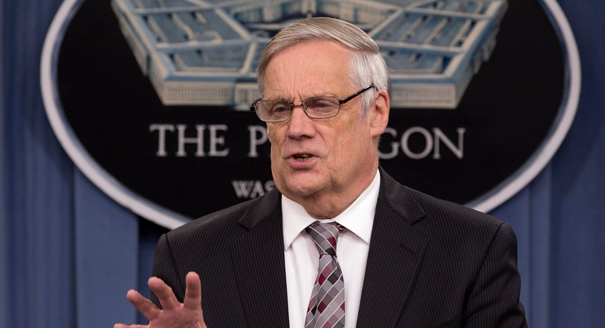
“Frankly, I am nervous,” says Robert Hale, the Pentagon’s comptroller. And with reason.
A month and half into the new fiscal year, Congress can’t seem to decide between what are three, wildly different scenarios for Hale’s world in 2014. The House endorsed most of President Barack Obama’s $527 billion request for the Defense Department in July. Last month’s stopgap CR went back to $496 billion. And DOD will drop by another $21 billion in mid-January if lawmakers do nothing to stop sequestration.
“We still don’t know what fiscal ’14 is, which is an extraordinary situation,” Hale told POLITICO. Making it worse, perhaps, is a growing acceptance—even callousness— in the Capitol toward the level of disorder sequestration brings.
Robert Hale
The first round of cuts that began on March 1 already forced DOD to implement $37 billion in reductions in the space of six months. Why should another $21 billion –spread over more than eight months—be any harder?
Indeed, this equation is now fundamental to the politics of the House-Senate budget talks which resume Wednesday. A significant faction of Republicans have come to embrace the lower post-sequestration caps set under the Budget Control Act in 2011. And the real-life math for the military has become submerged in the tit-for-tat politics over Obama’s healthcare reforms.
The next two weeks running up to Thanksgiving are pivotal if Congress is to have any chance of restoring some order for the Pentagon and a broken appropriations process. But what’s most remarkable is how lawmakers seem to be backing into decisions without first having a full debate over what level of defense the U.S. needs going forward.
The Department of Defense budget for research and procurement of unmanned aerial systems (UAS), or drones, is on a distinctly downward slope.
The FY 2014 budget request included $2.3 billion for research, development, and procurement of unmanned aerial systems, a decrease of $1.1 billion from the request for the fiscal year 2013.
“Annual procurement of UAS has gone from 1,211 in fiscal 2012 to 288 last year to just 54 in the proposed FY14 budget,” according to a recently published congressional hearing volume.
Among the questions for the record published in the new hearing volume, DoD officials were asked: “Who is responsible for developing privacy protections for military UAV operations inside the United States?”
Some other noteworthy new doctrinal and congressional defense-related publications include the following.
First SOF Truth, equally applicable to every single element of the Joint Force, has been forgotten: HUMANS ARE MORE IMPORTANT THAN HARDWARE. First SOF Truth, repeat after me, Mr. Secretary: HUMANS ARE MORE IMPORTANT THAN HARDWARE.
Troops and families — carriers of the rifles and the rucksacks and standers of the night watches — rather than contractors will bear the burden.
– – – – – – –
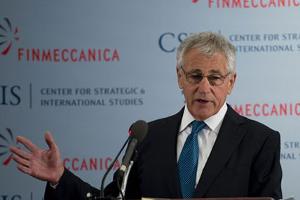
Defense Secretary Chuck Hagel warned Tuesday that troops and their families will be asked to sacrifice on pay and benefits to preserve readiness in an era of tighter budgets.
SecDef Chuck Hagel
Hagel listed politically-charged changes to compensation and personnel policy as one of his top six priorities in reforming the military following the wars in Iraq and Afghanistan as the department gears up to meet new challenges.
“This may be the most difficult” to achieve among his six priorities, Hagel said of proposals to trim pay increases, overhaul TRICARE and review retirement benefits while adapting to cuts in personnel.
“Without serious attempts to achieve significant savings in this area, which consumes roughly half of the DoD budget and is increasing every year, we risk becoming an unbalanced force,” Hagel said.
The alternative was to have a military that is “well-compensated, but poorly trained and equipped, with limited readiness and capability,” Hagel said in a keynote address to a Global Security Forum 2013 sponsored by he Center for Strategic and International Studies.