Open Source Hardware Association (OSHWA) is thrilled to announce we have just received our official non-profit status!
OSHWA aims to be the voice of the open hardware community, ensuring that technological knowledge is accessible to everyone. We encourage the collaborative development of technology that serves education, environmental sustainability, and human welfare.
A hazard facing mass movements is the NGO-ization of resistance. It will be easy to twist what I’m about to say into an indictment of all NGOs. That would be a falsehood. In the murky waters of fake NGOs set up or to siphon off grant money or as tax dodges (in states like Bihar, they are given as dowry), of course, there are NGOs doing valuable work. But it’s important to consider the NGO phenomenon in a broader political context.
In India, for instance, the funded NGO boom began in the late 1980s and 1990s. It coincided with the opening of India’s markets to neoliberalism. At the time, the Indian state, in keeping with the requirements of structural adjustment, was withdrawing funding from rural development, agriculture, energy, transport and public health. As the state abdicated its traditional role, NGOs moved in to work in these very areas. The difference, of course, is that the funds available to them are a minuscule fraction of the actual cut in public spending.
Most large-funded NGOs are financed and patronized by aid and development agencies, which are, in turn, funded by Western governments, the World Bank, the UN and some multinational corporations. Though they may not be the very same agencies, they are certainly part of the same loose, political formation that oversees the neoliberal project and demands the slash in government spending in the first place.
Commentary: An overwhelming number of crises means the international community cannot respond well.
WASHINGTON — Humanitarian crises in the world today — Syria, Iraq, Central African Republic, South Sudan and now Gaza — all demand immediate and massive humanitarian response.
The crises are not only large-scale, affecting millions, but the conflicts also are complex, each with unique political realities and on-the-ground difficulties.
They are not alone among crises competing for our attention. They are simply the biggest, pushing off the front pages other crises where human needs remain urgent: Darfur, Central America, Pakistan, Côte d’Ivoire, Democratic Republic of the Congo, Somalia.
Aid agencies say South Sudan at ‘tipping point' as ethnic violence puts millions of people at risk of starvation and disease
It is happening again. Twenty years after the genocide in Rwanda, 30 years after the famine in Ethiopia, Africa‘s twin scourges are back. This time it is a single country facing a double disaster. South Sudan, the world's newest nation, not yet three years old, is on the brink of catastrophe.
Here in Melut, on the banks of the Nile, close to the oilfields and the border with Sudan, the signs of impending disaster are impossible to miss. This week the world's richest nations will have one last chance to make good their promises of help.
Nearly 20,000 people have fled to the refugee camps in Melut since fighting between rival government factions broke out last December. In total, more than a million people have fled from their homes and, with the rainy season starting, more than a third of the population – 3.7 million people – are already facing emergency and crisis levels of hunger.
“There is no food here,” a man tells me as we sit in the dust beneath an acacia tree in one of Melut's makeshift camps. “No food. We eat leaves from the trees and the women go out to collect firewood. But when the rain comes, it will be still worse. We will starve – and then we will die.”
Relief agencies are fighting a desperate battle to alert the outside world to the scale of the impending disaster. Last week Oxfam warned that the crisis has reached a “now or never moment” to avoid catastrophic levels of hunger and suffering. Chief executive Mark Goldring said: “The crisis is at a tipping point. We either act now or millions will pay the price. We need a massive and rapid global surge in aid … We cannot afford to wait, and we cannot afford to fail.”
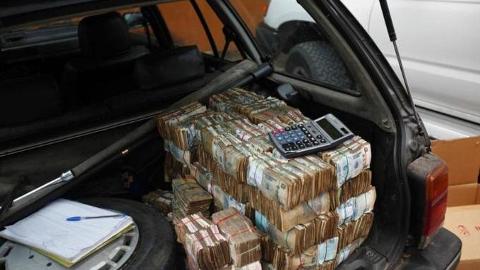
Almost $2 trillion has left Africa illicitly since 1970, thwarting poverty reduction and economic growth.
This is far more than the external aid the continent received over the same period, and almost five times its current external debt. According to researchers, the continent also loses at least $100bn a year in this financial haemorrhage.
Click on Image to Enlarge
African leaders convened this week in the Ethiopian city of Bahar Dar to discuss illicit financial flows and what can be done to staunch them. A study commissioned by the Tana High Level Forum on African Security, which organised the conference, found that illicit flows from Africa grew at an average rate of 12.1 percent per year since 1970, and that capital flight from West and Central African countries accounted for most of the illicit flows from sub-Saharan Africa.
Illicit financial flows consist of money earned illegally and then transferred for use elsewhere. The money is usually generated from criminal activities, corruption, tax evasion, bribes and smuggling. Yet the numbers tell only part of the story – a story that exposes how these highly complex and deeply entrenched practises have flourished, with a devastating impact on Africans' efforts to extricate themselves from grinding poverty.
Those caught in conflict and natural disasters are part of growing trend exemplified by Syria, South Sudan and the Philippines
David Miliband
The Guardian, 28 February 2014
For the first time the UN has declared three simultaneous crises – in South Sudan, Syria and the Philippines – as level 3, the highest band of emergency. So this is a period of intense activity for NGOs such as the International Rescue Committee. But it is also a good time to reflect on the goals and working methods of the humanitarian system.