NIGHTWATCH: Israel & It’s US Enabler Uniting Muslims

04 Inter-State Conflict, 05 Civil War, 06 Genocide, 07 Other Atrocities, 08 Wild Cards, 11 Society, Corruption, Government, Military, Officers Call

Special Comment: Feedback from brilliant Readers conveys concern that Israel is presented as justified in its retaliation and not as the instigator of the latest round of attack exchanges.

In the NightWatch experience, causality takes about 20 years to determine with any confidence. Survival in the neighborhood requires that the intelligence and special operations forces of all parties constantly are at work all the time. Thus, escalation is always a political decision, often related to political maneuverings and calculations in Hamas, the Palestinian Authority, Iran or Israel that cannot be known from open source channels.

Both sides of this conflict are fighting as they must or can. Hamas, Palestinian Islamic Jihad and others Palestinian groups have no weapons to attack Israel except rockets. As for Israel, the day it fails to fight asymmetrically, that is the day it submits to national suicide. Asymmetrical tactics have nothing to do with justice.

Conflicts often bring clarity to political struggles. The US has unequivocally backed Israel's right of self-defense, which implies endorsement of the Israeli interpretation of events. However, a look into the exchanges of attacks in September and October and earlier clouds the determination of who shot first.

For NightWatch that question is less interesting than what comes next. This is the first major combat action between Arabs and Israelis since the Arab Spring uprisings changed governments in Tunisia, Egypt and, arguably, Libya. New Arab governments will be judged on their reaction to it.

It contains ominous portents because Hamas would have been reluctant, if not unable, to engage Israel in this fashion were Mubarak still in power in Egypt. It has rallied Muslims of all sects and ethnicities, and as far away as Malaysia and Indonesia to denounce Israel and state their support for the Palestinian Arabs in Gaza.

Thus one ripple effect of this fighting is that it shows that hostility to Israel can unite Muslims across national, ethnic and sectarian divides. The emergence of pro-Islamist governments in previously secular states always has contained the potential for the emergence of a greater threat to Israel than has been the case in many decades.

Another ripple effect is that the US outreach to Muslim countries has been undermined by the decision to take sides, supporting Israel as acting in self-defense. Arabs do not agree with that view of events and will distrust US diplomats in the future. Some Arab commentators have criticized the US for not restraining Israel.

A third ripple effect is that the Israel-Gaza crisis has displaced the Syria crisis as the headline news item around the world. International attention on Syria has been refocused on Gaza. The fight in Syria is less consequential than the fighting in Gaza because the Gaza fight risks regional conflict in ways Syria does not.

This does not appear to be accidental and appears to benefit Iran. At this point, however, Iranian instrumentality in provoking a proxy fight between Hamas and Israel remains only a working hypothesis.

Continue reading “NIGHTWATCH: Israel & It's US Enabler Uniting Muslims”

Berto Jongman: Global Shadow Banking Monitoring Report 2012

03 Economy, Commerce
Berto Jongman

Global Shadow Banking Monitoring Report 2012

45 pages, PDF

The “shadow banking system” can broadly be described as “credit intermediation involving entities and activities outside the regular banking system”. Although intermediating credit through non-bank channels can have advantages, such channels can also become a source of systemic risk, especially when they are structured to perform bank-like functions (e.g. maturity transformation and leverage) and when their interconnectedness with the regular banking system is strong. Therefore, appropriate monitoring and regulatory frameworks for the shadow banking system needs to be in place to mitigate the build-up of risks.

DuckDuckGo / “Shadow Banking”

Mini-Me: Why Are US and France Invading Mali?

04 Inter-State Conflict, 05 Civil War, 07 Other Atrocities, 08 Wild Cards, DoD, Government, IO Deeds of War, Military, Office of Management and Budget
Who? Mini-Me?

Huh?

US, France assemble coalition to confront Islamists in Mali

By CJ Radin

The Long War Journal, November 18, 2012

The Islamist takeover of two-thirds of Mali this year has spurred the West as well as concerned neighboring countries in Africa to find a way to restore Mali to its democratic path and drive out jihadist elements. Islamist groups in Mali currently include Ansar Dine, the Movement for Oneness and Jihad in West Africa (MUJAO), and al Qaeda in the Islamic Maghreb (AQIM), which is considered one of the most dangerous of al Qaeda's affiliated groups.

Read full article

Continue reading “Mini-Me: Why Are US and France Invading Mali?”

SmartPlanet: 1 Earth-Changing Idea, 9 Other Ideas

Communities of Practice, Earth Intelligence, True Cost

Scientific American’s list of 10 ideas about to change the world

6. A single sustainability index for products

How do you compare the environmental impact of, say, a bottle of laundry detergent versus an LCD screen? The Sustainability Consortium, a group of 10 universities, non-profits and 80 international companies including Walmart and Coca-Cola, are creating an index that includes every step of the supply chain. The group has already released the measure it will use to evaluate its first 100 products.

Right now, a similar rating system, Good Guide, is based solely on public information. The new system would take into account “emissions, waste, labor practices, water usage and other sensitive factors that will become available only as large corporate players exert pressure on suppliers to disclose them,” says Scientific American.

Read full article with 9 Other Ideas

Continue reading “SmartPlanet: 1 Earth-Changing Idea, 9 Other Ideas”

SchwartzReport: US Spends Tens of Billions Abroad–Better Spent at Home?

Government, Ineptitude, Military

Where Does Milllons in Pentagon Contracts Go?

NICK TURSE – Mother Jones

While American children are going to bed hungry, and their schools all too often are falling apart, we have squandered untold billions on the infrastructure and schools of the countries where we have created wars, producing astonishing profits for war contractors, and little else. It is such an upside down policy that it is amazing to me that American voters have so quietly sat still for it. This last election, for the first time, sug! gests they are now fed up. This report gives good reasons why that is a reasonable position.

A billion dollars from the federal government: that kind of money could go a long way toward revitalizing a country's aging infrastructure. It could provide housing or better water and sewer systems. It could enhance a transportation network or develop an urban waterfront. It could provide local jobs. It could do any or all of these things. And, in fact, it did. It just happened to be in the Middle East, not the United States.

Read full article.

Continue reading “SchwartzReport: US Spends Tens of Billions Abroad–Better Spent at Home?”

SchwartzReport: Big Sugar Does a Big Tobacco — True Cost of Sugar to Society

03 Economy, 06 Family, 07 Health, 11 Society, Communities of Practice, Corruption, IO Impotency, Lessons

Does Sugar Kill? How the Sugar Industry Hid the Toxic Truth

For decades, the industry kept scientists from asking: Does sugar kill?

GARY TAUBES and CRISTIN KEARNS COUZENS – AlterNet (U.S.)

November 15, 2012 |

This article first appeared in Mother Jones Magazine. Get your magazine  subscription here.

Click on Image to Enlarge

ON A BRISK SPRING Tuesday in 1976, a pair of executives from the Sugar Association stepped up to the podium of a Chicago ballroom to  accept the Oscar of the public relations world, the  Silver Anvil  award for excellence in ” the forging of public opinion. ” The trade group had recently pulled off one of the greatest turnarounds in PR history. For nearly a decade, the sugar industry had been buffeted by crisis after crisis as the media and the public soured on sugar and scientists began to view it as a likely cause of obesity, diabetes, and heart disease. Industry ads claiming that eating sugar helped you lose weight had been  called out  by the Federal Trade Commission, and the Food and Drug Administration had  launched a review  of whether sugar was even safe to eat. Consumption had declined 12 percent in just two years, and producers could see where that trend might lead. As John “JW” Tatem Jr. and Jack O'Connell Jr., the Sugar Association's president and director of public relations, posed that day with their trophies, their smiles only hinted at the coup they'd just pulled off.

Continue reading “SchwartzReport: Big Sugar Does a Big Tobacco — True Cost of Sugar to Society”

Eagle: Rolling Jubilee — Occupy Buying and Forgiving Debt at 4% — 96% Discount!!!

03 Economy, 06 Family, 09 Justice, 11 Society, Civil Society, Commerce, Ethics
300 Million Talons…

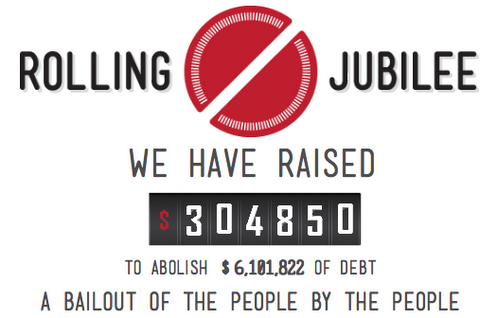
The Rolling Jubilee is just getting started and so far it has raised over $6 Million, which will be used to wipe out medical debt for random Americans. Cutting debt while helping those in need, now there's something everyone can agree on.

For more information and to donate, visit http://rollingjubilee.org

Phi Beta Iota:  What we find utterly fascinating here is the discount rate on personal debt in the USA:  4%.  They have bought and dismissed $6 million in debt for a cost of $304,850.  4% — at a time when most Americans are being hounded by debt collectors, and nothing is being done to help the average person.  How hard would it be for the President to sponsor a Jubilee Bill at this rate — instead of trillions for the banks, a billion or less, at 4% [96% leverage] wipes out all individual and small business debt in the USA.  A big idea.  Mr. President?

Click on Image to Enlarge
noble gold