“Still Left in the Dark? How People in Emergencies Use Communication to Survive — And How Humanitarian Agencies Can Help” is an excellent report pub-lished by the BBC World Service Trust earlier this year. It is a follow up to the BBC’s 2008 study “Left in the Dark: The Unmet Need for Information in Humanitarian Emergencies.” Both reports are absolute must-reads. I highlight the most important points from the 2012 publication below.
Every day, as you move about in the world, your brain is chugging along with you. Just like any other engineer, or organ, as it works, millions of neurons firing and guiding you around, the brain builds up waste products. But for a long time it wasn’t clear where that waste went. Now, scientists think they know the answer.
They’re calling the draining pipes the “the glymphatic system” – after the glial cells that control it and the lymphatic system that it resembles. The system works like a series of pipes to funnel waste away from the brain. A new paper in Science Translational Medicine describes the system as they observed it in mice.
Researchers knew about a slower system to remove waste. A fluid called the cerebrospinal fluid (CSF) moves through the brain and carries away waste through diffusion. But this new system works much faster. Senior author on the paper Maiken Nedergaard describes how the system works in the press release:
“It’s as if the brain has two garbage haulers – a slow one that we’ve known about, and a fast one that we’ve just met,” said Nedergaard. “Given the high rate of metabolism in the brain, and its exquisite sensitivity, it’s not surprising that its mechanisms to rid itself of waste are more specialized and extensive than previously realized.”
But how was there an entire structure for draining in the brain, without us knowing about it? The press release explains:
Damon Horowitz, a philosophy professor and “serial entrepreneur,” recently joined Google as an In-House Philosopher/Director of Engineering. Prior to his work at Google, Horowitz co-founded Aardvark, Perspecta, and a number of other tech companies. In this talk at Stanford University’s 2011 BiblioTech conference on “Human Experience,” Horowitz explains why he left a highly-paid tech career, in which he sought the keys to artificial intelligence, to pursue a Ph.D. in Philosophy at Stanford (the text of the talk is available here).
Horowitz offers fellow techies a formidable challenge, but a worthwhile one. In saying so, I must confess a bias: As a student and teacher of the humanities, I have watched with some dismay as the culture becomes increasingly dominated by technicians who often ignore or dismiss pressing philosophical and ethical problems in their quest to build a better world. It is gratifying to hear from someone who recognized this issue by (temporarily) giving up what he admits was a great deal of power and societal privilege and headed back to the classroom.
Horowitz describes his intellectual journey from “technologist” to philosopher with passion and candor, and concludes that as a result of his academic inquiry, he “no longer looks for machines to solve all of our problems for us,” and no longer assumes that he knows what’s best for his users. This kind of humility and intellectual flexibility is, ideally, the outcome of a higher degree in the humanities, and Horowitz uses his own trials to make a case for better critical thinking, for a “humanistic perspective,” in the tech sector and elsewhere. For examples, see Horowitz’s TED talks on a “moral operating system” and “philosophy in prison.” Complicating Google’s well-known, unofficial slogan “don’t be evil,” Horowitz, drawing on Hannah Arendt, believes that most of the evil in the world comes not from bad intentions but from “not thinking.”
Robin Good: Slices is a news discovery app that allows you to find the news that interest you by “slicing” the Twitter timeline into topic-specific categories, making it much easier to find what you are looking for.
From Pandodaily official review: “Slices offers 21 searchable categories – humor, technology, sports, and so on – that lead you to people and lists to follow. Included among those top-level categories is the “Live Events” option, which allows you to select an event – a football match, say, or a TV show – and follow Tweets from a curated list.
Also of note: “…it synchronizes between mobile devices and the Slices website (slices.me), which means it knows which Tweets you’ve already read, no matter where you access it from.
…The “Timeline Slicer” also outdoes Twitter’s Lists as a way to organize the people you follow into specific categories. They’re easier to set up and easier to access, …”
Flash floods in Beijing have killed over 70 people and forced the evacuation of more than 50,000 after destroying over 8,000 homes and causing $1.6 billion in damages. In total, some 1.5 million people have been affected by the floods after Beijing recorded the heaviest rainfall the city has seen in more than 60 years.
The heavy rains began on July 21. Within hours, users of the Guokr.com social network launched a campaign to create a live crisis map of the flood’s impact using Google Maps. According to TechPresident, “the result was not only more accurate than the government output—it was available almost a day earlier. According to People’s Daily Online, these crowd-sourced maps were widely circulated on Weibo [China's version of Twitter] the Monday and Tuesday after the flooding.” The crowdsourced, citizen-generated flood map of Beijing is available here and looks like this:
Tired of high cost mobile phones? Feel guilty that while you’ve got a paper thin phone, it’s hard to recycle elements are destroying the planet ? Turns out, you don’t need Samsung or LG to stay in touch with those you love.
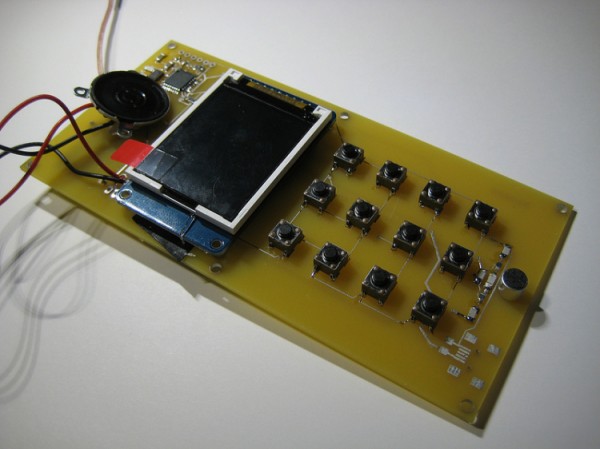
David A. Mellis, from MITs High-Low Tech group, has created a DIY mobile phone out of easily obtained electronic parts and a little bit of plywood. It may not have the internet connectivity or giant touchscreen of your current mobile phone, but it’s a completely self-made, operational phone, which means it’s low impact and free from the constraints of mass production.
Click on Image to Enlarge
According to Mellis, the initial prototype combines a custom electronic circuit board with a laser-cut plywood and veneer enclosure. The phone accepts a standard SIM card and works with any GSM provider. Cellular connectivity is provided by the SM5100B GSM Module, available from SparkFun Electronics. The display may only be about 1.8″ across, but it does offer color images. Currently, the software supports voice calls, but the folks at High-Low Tech say SMS and other functionality could be added with the same hardware. Altogether the prototype contains about $150 in parts.
Click on Image to Enlarge
“By creating and sharing open-source designs for the phone’s circuit board and case, we hope to encourage a proliferation of personalized and diverse mobile phones,” say the designers. Want to give it a try? The source code, circuit design files (Eagle), and case design files (Inkscape) are hosted in the damellis/cellphone repository on GitHub.
Phi Beta Iota: Combined with OpenBTS and Open Spectrum, this puts the stake in the heart of both governments and corporations seeking to create scarcity instead of infinite access.