Patrick Meier: Truth in the Age of Social Media: A Social Computing and Big Data Challenge

Advanced Cyber/IO, Collective Intelligence, Earth Intelligence, Ethics, Geospatial, Knowledge
Patrick Meier

Truth in the Age of Social Media: A Social Computing and Big Data Challenge

I have been writing and blogging about “information forensics” for a while now and thus relished Nieman Report’s must-read study on “Truth in the Age of Social Media.” My applied research has specifically been on the use of social media to support humanitarian crisis response (see the multiple links at the end of this blog post). More specifically, my focus has been on crowdsourcing and automating ways to quantify veracity in the social media space. One of the Research & Development projects I am spearheading at the Qatar Computing Research Institute (QCRI) specifically focuses on this hybrid approach. I plan to blog about this research in the near future but for now wanted to share some of the gems in this superb 72-page Nieman Report.

In the opening piece of the report, Craig Silverman writes that “never before in the history of journalism—or society—have more people and organizations been engaged in fact checking and verification. Never has it been so easy to expose an error, check a fact, crowdsource and bring technology to bear in service of verification.” While social media is new, traditional journalistic skills and values are still highly relevant to verification challenges in the social media space. In fact, some argue that “the business of verifying and debunking content from the public relies far more on journalistic hunches than snazzy technology.”

I disagree. This is not an either/or challenge. Social computing can help every-one, not just journalists, develop and test hunches. Indeed, it is imperative that these tools be in the reach of the general public since a “public with the ability to spot a hoax website, verify a tweet, detect a faked photo, and evaluate sources of information is a more informed public. A public more resistant to untruths and so-called rumor bombs.” This public resistance to untruths can itself be moni-tored and modeled to quantify veracity, as this study shows.

Full post less two graphics below the line.  Original post.

Continue reading “Patrick Meier: Truth in the Age of Social Media: A Social Computing and Big Data Challenge”

Michel Bauwens: Collective Presencing: A New Human Capacity

Advanced Cyber/IO, Civil Society, Collective Intelligence, Earth Intelligence, P2P / Panarchy
Michel Bauwens

Collective Presencing: A New Human Capacity

This is the first in a series of articles introducing the phenomenon and practice of Collective Presencing, a new capacity evolving in humanity at this time. Great thinkers have foreseen its coming—we recognise it in Aurobindo’s descent of the supramental and Teilhard de Chardin’s noosphere. But what exactly do those terms mean? Where these gifted individuals intuited and envisioned the birth of this new collective capacity at the dawn of the last century, we are now starting to be able to describe it from experience.

Click on Image to Enlarge

While many might recognise the phenomenon from transpersonal group work and other such practices, so far as we are aware, this is the first attempt to articulate it as a path and a set of capacities that can be intentionally developed…

this is one of the best and finest descriptions I have read in a long time. Thanks Helen…AC

Via Anne Caspari

Steve Wheeler: Learning with ‘e’s – Education funnels and webs of learning

04 Education, Advanced Cyber/IO, Knowledge, Liberation Technology, Mobile, P2P / Panarchy
Steve Wheeler

Learning with ‘e's: Education funnels and webs of learning

There has been a lot of discussion recently about the personalisation of education. The sticking point is that most education is publicly funded, the state has a major stake in how it's conducted, and therefore dictates what should be taught in schools. […]
by Steve Wheeler

Education funnels and webs of learning

There has been a lot of discussion recently about the personalisation of education. The sticking point is that most education is publicly funded, the state has a major stake in how it's conducted, and therefore dictates what should be taught in schools. Because of lack of space, time and resources (you will always have this problem when the state intervenes) there is little latitude for personalised approaches and creativity is stifled. Every child gets the same content, and every child is tested in the same, standardised way. The result: children become disenfranchised and demotivated, teachers are exhausted and demoralised, schools are positioned unfairly in league tables, and governments measure success not through human achievement or creativity, but through cold, hard statistics. This is universal education, and if one size does not fit all … tough. Shame no-one has told the powers that be that universal education is unachievable.

Ivan Illich railed against this mindset way back in 1970 in his anarchical, visionary critique of the school system. In Deschooling Society, Illich called for personal learning through informal learning networks, and rejected the funnelling approach of mass, unidirectional, instructivist education systems. More recently, powerful modern day visionaries such as Stephen Heppell and Sir Ken Robinson are saying the same thing. They ask how we can sustain a factory model of education ‘production', where children are ‘batch processed' according to their age groups. It's obvious to any teacher or parent that children develop at different rates, and all have different talents and interests. I suppose we have Jean Piaget and his fellow ‘stage theory' psychologists to thank for that kind of constrained thinking.

Continue reading “Steve Wheeler: Learning with ‘e's – Education funnels and webs of learning”

Patrick Meier: Become a (Social Media) Data Donor and Save a Life

Advanced Cyber/IO, Civil Society, Cultural Intelligence, Geospatial
Patrick Meier

Become a (Social Media) Data Donor and Save a Life

I was recently in New York where I met up with my colleague Fernando Diaz from Microsoft Research. We were discussing the uses of social media in humanitarian crises and the various constraints of social media platforms like Twitter vis-a-vis their Terms of Service. And then this occurred to me: we have organ donation initiatives and organ donor cards that many of us carry around in our wallets. So why not become a “Data Donor” as well in the event of an emergency? After all, it has long been recognized that access to information during a crisis is as important as access to food, water, shelter and medical aid.

Read full post.

Phi Beta Iota:  This has very provocative and inspiring implications for redefining (or restoring) what it means to be human — the art of sharing information to help the community, the collective, survive and prosper.  We are honoring Dr. Meiers original idea by including Data Donor as a permanent search term for the Open Source Everything Highlights.

See Also:

Continue reading “Patrick Meier: Become a (Social Media) Data Donor and Save a Life”

Worth a Look: The People’s Congress (USA)

Advanced Cyber/IO, Civil Society, Ethics, Government, Worth A Look

The People’s Congress

United to exercise the self-evident sovereignty of the American people over our government

Peoplescongress.org is calling for a week long event in which We the People pass specific amendments and legislation which, if enacted by Congress, would put an immediate end to the corporate take-over of our government, revitalize and re-democratize elections,  allow for a more responsible and open media, and end the secrecy in policy making. Until we reform these institutions and the laws governing them, our goals for a just and sustainable world will remain elusive at best. An earnest national dialog about our future cannot happen until we re-balance the wheels of democracy. It is the intention of the People’s Congress to secure that change directly in accordance with the will of the People and the principles established by our Constitution.

Continue reading “Worth a Look: The People's Congress (USA)”

Patrick Meier: Enhanced Messaging for the Emergency Response Sector (EMERSE)

Advanced Cyber/IO, Collective Intelligence, Geospatial, Mobile, P2P / Panarchy
Patrick Meier

Enhanced Messaging for the Emergency Response Sector (EMERSE)

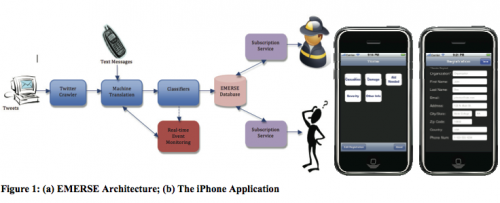
My colleague Andrea Tapia and her team at PennState University have developed an interesting iPhone application designed to support humanitarian response. This application is part of their EMERSE project: Enhanced Messaging for the Emergency Response Sector. The other components of EMERSE include a Twitter crawler, automatic classification and machine learning.

. . . . . . . .

The iPhone application developed by PennState is designed to help humanitarian professionals collect information during a crisis. “In case of no service or Internet access, the application rolls over to local storage until access is available. However, the GPS still works via satellite and is able to geo-locate data being recorded.” The Twitter crawler component captures tweets referring to specific keywords “within a seven-day period as well as tweets that have been posted by specific users. Each API call returns at most 1000 tweets and auxiliary metadata […].” The machine translation component uses Google Language API.

Click on Image to Enlarge

Read full post.

Steven Lubar: Scholarly Research and Writing in the Digital Age

Advanced Cyber/IO, Knowledge
Steven Lubar

Scholarly Research and Writing in the Digital Age

EXTRACT:

Along the way, I kept track of my process, to help me think about a talk I’ll be giving in October. I send students off to write research papers, and so I should be reflexive about my own work, in order to better teach them how to do research. And I was curious to see how new digital tools would change the way I work, and especially if they would change the questions I might ask and answer in my research. The answers I found: Yes, I could ask and answer different questions, especially about museum visitors. Yes, a research plan is still necessary; serendipitous Googling is not enough. No, digital is not enough; it’s still necessary to visit libraries. And a good reminder: research is only the first part of writing a scholarly paper. It’s also about knowing the big picture, puzzling out connections and making sense of relationships, and most of all, creating meaning. That part hasn’t changed.

Discovery is perhaps the stage of scholarship that’s seen the largest change. Scholars of 19th century American history have a remarkable amount of material available to them online. Newspapers, books, journals, all of them word-searchable. These sources would have been all but impossible to use earlier – I might have read on microfilm the newspapers closest to the Navy Yard, for those days where I knew something had happened. But now it’s easy to simply check out a few hundred newspapers, or a few million books, with a few clicks.

This comes with some challenges.

Read full post.

Phi Beta Iota:  What is really remarkable is that despite wild spending by the secret world (now $80 billion a year) and huge spending by Google (generally $10 in stockholder income for every $1 in earnings–not a paying proposition in the long run), both machine processing and computer-aided tools for the analysis of all information in all languages all the time continue to STINK.  No one has been held accountable for mandating geospatial attributes for every datum in every discipline and domain; no one has been held accountable for failing to break down the barriers to information-sharing and sense-making across the eight communities (academic, civil society, commerce, government, law enforcement, media, military, and non-governmental/non-profit) that each have a separate piece of the total picture on anything.  We all knew the requirements in 1985-1989.  Still today no government and no corporation and no international organization has gotten their act together.  Proprietary does not scale, is not agile, does not work well with others, and is generally full of both security holes and end-user disrespect.  At the same time, NSA and other US Government authorities have been severely remiss–if not in outright betrayal of the public trust–in failing to heed the many warnings and specific recommendations of many of us (four of us in the below 1994 letter) with respect to getting cyber-security and cyber-education right from the early days.

See Also:

1989 Webb (US) CATALYST: Computer-Aided Tools for the Analysis of Science & Technology

1994 Sounding the Alarm on Cyber-Security

Worth a Look: 1989 All-Source Fusion Analytic Workstation–The Four Requirements Documents

noble gold