
Patrick Meier: Communication with Disaster Affected Communities –

Advanced Cyber/IO
Patrick Meier

Communicating with Disaster Affected Communities

Would be great to see how this type of search data compares to data from Tweets. Take this analysis of tweets following the earthquake in Chile, for example.

RT @UNFPA: Professional systems are being replaced by consumer tools says @Google Crisis Response #commisaid

And as a result, crisis-affected communities are increasingly becoming digital as I note in this blog post.<

Closed systems closed data will be left behind and unused:crisis response is social and collaboration is empowering @CDACNetwork #commisaid

RT @catherinedem: Crisis response is #social – online social collaboration spikes during and after disaster @spangledrongo #commisaid

we don't empower communities by giving them info,they empower themselves by giving us info that we can act on-@komunikasikan #commisaid

RT @ushahidi: “In a crisis, the mobile internet stays most resilient, even more than SMS.” #commisaid Nigel Snoad

RT @jqg: Empower local communities to generate their own tools and figure out their own solutions #commisaid

Through #Mission4636 SMS system, radio presenter @carelpedre was able to communicate directly with affected people in Haiti #commisaid

Tools shouldn't own data. RT @whiteafrican: “It's not about the platform being open, it's about the data being open”- @jcrowley #commisaid

Cutting edge is to get the #crowd & the #algorithm to filter each other in filtering massive overload of information in a crisis #commisaid

So best of luck to those who wish to regulate this space! As my colleague Tim McNamara has noted “Crisis mapping is not simply a technological shift, it is also a process of rapid decentralisation of power. With extremely low barriers to entry, many new entrants are appearing in the fields of emergency and disaster response. They are ignoring the traditional hierarchies, because the new entrants perceive that there is something that they can do which benefits others.”

Phi Beta Iota:  The reluctance of honest senior individuals in the US Government to actually learn is quite troubling.  When combined with the abject corruption of many other senior individuals, there is no question but that the greatest threat to the United States of America is internal — what Lawrence Lessig calls “systemic corruption” and Robert Steele calls “lack of integrity.
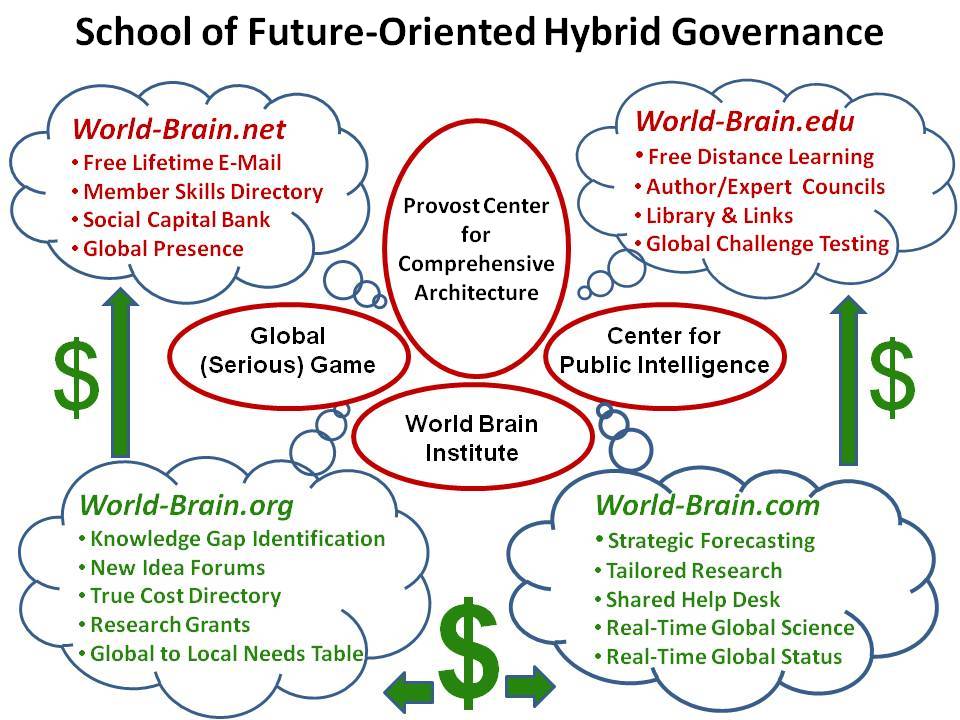
 

Graphic: School for Future-Oriented Hybrid Governance with World Brain Institute, Global Game, and Prototype Center for Public Intelligence

Advanced Cyber/IO, Collaboration Zones, Ethics, Hacking, Key Players, Mobile, Policies, Real Time, Serious Games, Threats, Topics (All Other), True Cost, Worth A Look
Click on Image to Enlarge

Creative Commons license applies — no financial exploitation without permission.  Robert Steele owns three of the four world-brain urls (net, org, com) and is looking for a university with the gravitas to understand why this concept needs to be implemented in full, soonest.

See Also:

Director of articles & chapters leading to this graphic

Director of briefings & lectures leading to this graphic

Books leading to this graphic

Reviews of books by others leading to this graphic (negative)

Reviews of books by others leading to this graphic (positive)

Personal web page of Robert Steele

Worth a Look: Human-Centered Knowledge Buckets

Advanced Cyber/IO, Worth A Look
KBucket - Knowledge Buckets | Infotention | Scoop.it

“KBucket as a platform is designed to be a search site for curated content. Each search term will give you tens of possible curated and researched pages on the topic of your interest. Our vision for KBucket is a Wikipedia type platform curated and clustered by humans . This video explains our vision.”

Brought to you by Optimal Access, Inc.  From their About page:

The following statement by Geoff Tothill form FirstAssist – a client that has been using our desktop product for many years – perfectly describes the challenge they face and how our product has helped them solve the problem of Context Management and information access personalization.

“The problem with the traditional concept of a web portal is that structure and direction is ‘designed into' the portal and the addition of new material, or the personalization of this information for use in a restricted part of an operation can be very time consuming.

Using Optimal Desktop as a universal client we have solved many of the traditional problems associated with the structuring of information which is derived from multiple sources. We have built individual panels (cabinets) for each of our teams, with information grouped together logically in groups (drawers). This has allowed a large amount of information to be deployed in a coherent and understandable way.”

Phi Beta Iota:  Something very interesting is starting to happen — push-back and proven superiority of humans over algorithms.  Human-centered curation is joining M4IS2 as a focal point for creating the World Brain.

Patrick Meier: Twitter, Early Warning, Small Data Matters More

Advanced Cyber/IO
Patrick Meier

Twitter, Crises and Early Detection: Why “Small Data” Still Matters

My colleagues John Brownstein and Rumi Chunara at Harvard University's HealthMap project are continuing to break new ground in the field of Digital Disease Detection. Using data obtained from tweets and online news, the team was able to identify a cholera outbreak in Haiti weeks before health officials acknowledged the problem publicly. Meanwhile, my colleagues from UN Global Pulse partnered with Crimson Hexagon to forecast food prices in Indonesia by carrying out sentiment analysis of tweets.

I had actually written this blog post on Crimson Hexagon four years ago to explore how the platform could be used for early warning purposes, so I'm thrilled to see this potential realized.

There is a lot that intrigues me about the work that HealthMap and Global Pulse are doing. But one point that really struck me vis-a-vis the former is just how little data was necessary to identify the outbreak. To be sure, not many Haitians are on Twitter and my impression is that most humanitarians have not really taken to Twitter either (I'm not sure about the Haitian Diaspora). This would suggest that accurate, early detection is possible even without Big Data; even with “Small Data” that is neither representative or indeed verified. (Interestingly, Rumi notes that the Haiti dataset is actually larger than datasets typically used for this kind of study).

In related news, a recent peer-reviewed study by the European Commission found that the spatial distribution of crowdsourced text messages (SMS) following the earthquake in Haiti were strongly correlated with building damage. Again, the dataset of text messages was relatively small. And again, this data was neither collected using random sampling (i.e., it was crowdsourced) nor was it verified for accuracy. Yet the analysis of this small dataset still yielded some particularly interesting findings that have important implications for rapid damage detection in post-emergency contexts.

While I'm no expert in econometrics, what these studies suggests to me is that detecting change-over–time is ultimately more critical than having a large-N dataset, let alone one that is obtained via random sampling or even vetted for quality control purposes. That doesn't mean that the latter factors are not important, it simply means that the outcome of the analysis is relatively less sensitive to these specific variables. Changes in the baseline volume/location of tweets on a given topic appears to be strongly correlated with offline dynamics.

What are the implications for crowdsourced crisis maps and disaster response? Could similar statistical analyses be carried out on Crowdmap data, for example? How small can a dataset be and still yield actionable findings like those mentioned in this blog post?

Robert Steele: Private World Brain for Top 200 People

Advanced Cyber/IO
Robert David STEELE Vivas

Vivek Ranadive may be a very clever man using the top 200 rich to finance a system that could rapidly be “flipped” to empower the bottom up.  Or he may be a very evil person who is planning to empower the top 200 in the same way that he empowered Goldman Sachs. If the top 200 are selecting those to be in the loop, this will accelerate their destruction of the Earth.  If instead this can be used to subtly educate the top 200 on “true costs” and show them how to achieve profit while doing good, it could be revolutionary.  If it can be rapidly scaled to be bottom-up in nature, it could be revolutionary.  Only time will tell.

The Private Social Network For The Extremely Rich and Powerful

An Esquire piece on $4 billion software company Tibco discusses its latest, perhaps most significant project:

TopCom is a private communications platform for the 200 most powerful people in the world. It is being officially launched in late January at the annual meeting of the World Economic Forum in Davos, Switzerland. It is basically a customized, ridiculously secure version of tibbr, a platform developed as a kind of combination Facebook, Twitter, e-mail, texting, and Skype. It is a private social network, essentially — in this case, for world leaders.

Because the World Economic Forum has a hierarchy, so does TopCom: The top two hundred WEF members — basically, the people who run the world — can speak to one another on a given subject, and then they can choose to loop in members from lower tiers (experts, academics, etc.) as needed, widening the pool of knowledge on whatever problem is on the table.

Esquire Article

See Also:

Virgin Truth One Page Final 1.1

World_Brain_Institute_1.6 pdf

Hacking Intelligence to Hack the Earth

Michel Bauwens: The New Rules of Innovation – Bottom-Up Solutions to Top-Down Problems

03 Economy, 11 Society, Advanced Cyber/IO, Civil Society, Cultural Intelligence, Ethics, Methods & Process, microfinancing
Michel Bauwens

The New Rules Of Innovation: Bottom-Up Solutions To Top-Down Problems

In his new book, Vijay Vaitheeswaran argues that we’re thinking about worldchanging innovation all wrong: It’s not going to come from where we expect it.

Arnie Cooper

www.fastcoexist.com, 19 March 2012

The world is currently standing “on the cusp of a post-industrial revolution.” So writes Vijay Vaitheeswaran in his new book, Need, Speed and Greed: How the New Rules of Innovation Can Transform Businesses, Propel Nations to Greatness and Tame the World’s Most Wicked Problems, out March 13. Vaitheeswaran, a 20-year veteran correspondent for The Economist and adviser to the World Economic Forum, wrote the book, he says, as a way to inspire bottom-up solutions to top-down problems like resource depletion, climate change, and growing income inequality. We spoke with Vaitheeswaran about the importance of disruptive technologies, social entrepreneurship, and embracing China’s rise.

Co.Exist: As you point out in your book, modern humanity has arrived at the first phase of an unprecedented “innovation revolution,” yet many are being left behind. Why is that and what are we gonna do about it?

Vijay Vaitheeswaran: First, I think it’s a wonderful time to be alive. Shockingly, this might be the best time to be in the bottom billion because of transformations like mobile telephony and micro-credit. But it’s getting much harder to be in the middle class in places like America. The principal reason for this, I think, is that educational systems are increasingly out of touch with the needs of the ideas economy. The current education system that our and other countries developed was suited to the industrial revolution, a one-size-fits-all model for education that treats people as commodities. But we’re in an innovation age where creativity, individual initiative, willingness to think out of the box and disrupt established business or even lifestyle patterns is much more important than simple manual tasks that produce the next widget. So I think the great challenge for developed economies like the U.S. is to reinvent education. The challenge for each one of us is to keep relearning how to learn.

Continue reading “Michel Bauwens: The New Rules of Innovation – Bottom-Up Solutions to Top-Down Problems”

Berto Jongman: 50 Mostly Free Social Media Tools for 2012

Advanced Cyber/IO, Collective Intelligence
Berto Jongman

50 (mostly) free social media tools you can’t live without in 2012

18th March 2012 by

A couple years ago, Jay Baer wrote a great blog post called ‘The 39 social media tools I’ll use today’ which was an all-in-one toolkit for social media marketers (and still is).

A lot has changed in the two years since that post was published so here is a ’2012 remix’ featuring 50 (mostly free) tools you can use on a daily basis.

Whether you are just starting out in the social media arena or have been at it for a few years, this will hopefully be a handy resource. So, let’s serve ‘em up!

Listening / Research

The foundations for any social media marketing activity start with listening and in-depth research, ranging from influencer identification to campaign planning.

General listening tools

Continue reading “Berto Jongman: 50 Mostly Free Social Media Tools for 2012”

noble gold