Low-cost sensors, clever software and advancing computer firepower are opening the door to new uses in energy conservation, transportation, health care and food distribution. The consumer Internet can be seen as the warm-up act for these technologies.
The concept has been around for years, sometimes called the Internet of Things or the Industrial Internet. Yet it takes time for the economics and engineering to catch up with the predictions. And that moment is upon us.
. . . . . .
The role of sensors — once costly and clunky, now inexpensive and tiny — was described this month in an essay in The New York Times by Larry Smarr, founding director of the California Institute for Telecommunications and Information Technology; he said the ultimate goal was “the sensor-aware planetary computer.”
. . . . . .
GLOBAL PULSE is a new initiative by the United Nations to leverage data from the consumer Internet for global development. So-called sentiment analysis of messages in social networks and phone text messages — using natural-language deciphering software — can help predict job losses or lower spending in a region, or disease outbreaks.
Opus machine prints books in minutes at Politics and Prose
The new Opus machine at Politics and Prose bookstore on Connecticut Avenue in Washington can print and bind a book that is indistinguishable from one of the professionally mass-printed books on the shelves at the same store. Public domain works, out-of-print novels, electronic books supplied via publishing houses and personal books can all be printed in minutes while customers wait.
Phi Beta Iota: Price is always an issue. HOWEVER, now that “true cost” economics is converging with Occupy and the 99%, we anticipate that publishers and Amazon are in for an eye-opener. This will also empower authors who choose to by-pass the entire “system” and local book stores who can be liberated from inventory and publisher overhead.
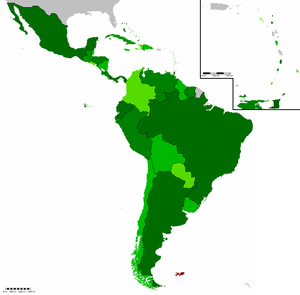
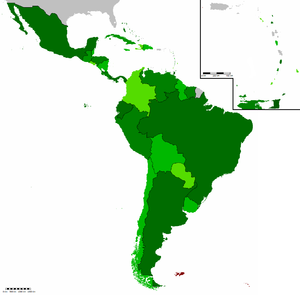
TheCommunity of Latin American and Caribbean States (Spanish: Comunidad de Estados Latinoamericanos y Caribeños, CELAC, Portuguese: Comunidade de Estados Latino-Americanos e Caribenhos, French: Communauté des États Latino-Américains et Caribéens, Dutch: Gemeenschap van de Latijns-Amerikaanse en Caribische landen) is the tentative name[1] of a regional bloc of Latin American and Caribbean nations created on February 23, 2010, at the Rio Group–Caribbean CommunityUnity Summit held in Playa del Carmen, Quintana Roo, Mexico.[2][3] It consists of all sovereign countries in the Americas, except for Canada, France, the Netherlands and the United States. British and Danish dependencies in the Americas are also not represented in CELAC.
CELAC is an example of a decade-long push for deeper integration within the Americas.[4] CELAC is being created to deepen Latin American integration and to reduce the once overwhelming influence of the United States on the politics and economics of Latin America, and is seen as an alternative to the Organization of American States (OAS), the regional body organized largely by Washington in 1948, ostensibly as a countermeasure to potential Soviet influence in the region.[4][5][6]
Feminist and anti-oppression activists, the human potential movement, and other ongoing organizers and movements for human betterment have played important roles in the emergence and nature of the Occupy movement. (The articles below are just a few examples.) Such movements have been organizing demonstrations, communities and networks and transforming people's consciousness and behavior in one form or another for hundreds of years. They've been training and empowering people and exposing them to the dark side of the social systems they live in and the possibilities for a better world, even as they themselves have become more experienced, aware, and skilled at new ways of living and being together.
Many people became leaders and practitioners of these organizing and transformational skills, forming a dispersed pool of resources for disparate transformational activities over the last many decades. The high purpose, tremendous passion, propitious timing, evocative non-specificity and intense community of OWS attracted a wide variety of these folks to its various centers of activity – the Occupations themselves – and into diverse support, leadership, and teaching roles. And then much was learned, experienced, created, modified… Had there been no past movement activities generating this pool of experience and skill, the Occupy movement would have looked very different indeed. And now the Occupy movement itself has become part of that ongoing learning, deepening, evolving collective experience…
As Occupy encampments are broken up by authorities, various commentators wonder if the movement is falling apart. They forget that through the activities of OWS in the last several months, tens of thousands of people have not only been inspired but have also taken leaps in awareness, experience and skill and that new leaders have emerged and new networks and groups have formed and new questions are being asked by newly focused and empowered citizens. The fact that this development is diffuse and nonlinear does not mean it does not exist. It only means that mainstream eyes will not necessarily recognize the new forms in which it will surface, over and over and over, expanding and adapting as it goes.
As one OWS sign insightfully said – in words whose significance not everyone will grasp – “This is a movement, not a protest.”
I have a feeling we ain't seen nothin' yet…
Blessings on the Journey. It has been a long time.
Big changes are coming. How you fare will be a function of the choices you make.
The threat is the ongoing breakdown of the global economic and political system. Things are already bad for many of us, and they will get worse for nearly everyone as the decades wear on. In almost all cases, if you stick with the current economic system: you and your family will suffer.
The opportunity is to build something new at the local level. A networked resilient community that produces most of what it needs and shares/sells/buys the rest virtually. An economic and political environment that you can have a say in.
One of the key parts of this opportunity for networked resilient communities? Local fabrication. The ability to make locally, using simple/inexpensive machines and designs downloaded from the Internet, the products we currently buy from China. This is a big idea. It's hard to get your head around. Once you do, it will change the way you think about the future. Here are three attempts to explain the idea (start with the video first).
Discussed this the other day with a couple of like minded folks, one noted that his Apple devices are synched when he walks into the house, his son's is synched with all his school work when he enters a classroom. There is little use of Word or like minded products, the school uses YouTube, Twitter, etc.
With the advent of iPad into the business market (the Air Force just
jettisoned its paper flight manuals for pilots and replaced them with
iPads)…..
Blue screen of death fades into the sunset. Enjoy.
Please join me for the retirement party for the productivity software suite.
Our good friend word/spreadsheet/presentation has been an exemplary employee, even as he gained a few pounds as contact management, calendaring, and all sorts of other bits and pieces of the office routine were piled on. And while we can have fun arguing about which was the first such software product (Framework in 1984, Lotus Symphony at about the same time), we can all agree that Microsoft Office started occupying the corner office in 1989. So thank you very much for your service. Here's your gold watch. Now go play some golf.
It's hard to believe that a nearly 30-year-old product is still synonymous with office productivity during a period that has included the rise of the Internet, smartphones, cloud computing, and Facebook. So with the retirement party over, what's the shape of the new office suite?
Phi Beta Iota: Microsoft is now officially brain-dead. The departure of Ray Ozzie was its final heart attack. OpenBTS, Twitter, Hypothes.is, and Wiki-think Wiki-work are all moving in interesting directions. Microsoft was an industrial-era “stand-alone” approach to human productivity, and it retarded the world for decades because of its hostility to third-party vendors and its constant mutation of Application Program Interfaces (API) as predatory toll-booths.
While much of the world is in crisis and protests are erupting throughout Europe and the United States, Latin American and Caribbean nations are building consensus, advancing social justice and increasing positive cooperation in the region. Social, political and economic transformations have been taking place through democratic processes in countries such as Venezuela, Bolivia, Ecuador, Nicaragua, Uruguay, Argentina and Brazil throughout the past decade, leading to a massive reduction in poverty and income disparity in the region, and a substantial increase in social services, quality of life and direct participation in political process.
One of the major initiatives of progressive Latin American governments this century has been the creation of new regional organizations that promote integration, cooperation and solidarity amongst neighboring nations. Cuba and Venezuela began this process in 2004 with the founding of the Bolivarian Alliance for the Peoples of Our America (ALBA), that now includes Bolivia, Ecuador, Nicaragua, Dominica, St. Vincent’s and the Grenadines and Antigua and Barbuda. ALBA was initially launched in response to the US government’s failed attempt to impose its Free Trade Agreement of the Americas (FTAA) throughout the region.
Click on Image to Enlarge
Today ALBA is a thriving multilateral organization with member nations that share similar political visions for their countries and for the region, and includes numerous cooperation agreements in economic, social and cultural areas. The fundamental basis of trade amongst ALBA nations is solidarity and mutual benefit. There is no competition, exploitation or attempt to dominate amongst ALBA states. ALBA even counts on its own currency, the SUCRE, which allows for trade between member nations without dependence on the US dollar.
In 2008, the Union of South American Nations (UNASUR) was formally established as a regional body representing South American states. While ALBA is much more consolidated as a unified political voice, UNASUR represents a diversity of political positions, economic models and visions for the region. But UNASUR members share the common goal of working towards regional unity and guaranteeing the resolution of conflicts through peaceful and diplomatic means. UNASUR has already played a key role in peacefully resolving disputes in Bolivia, particularly during an attempted coup against the government of Evo Morales in 2008, and has also successfully moderated a severe conflict between Colombia and Venezuela, leading to the reestablishment of relations in 2010.
Two hundred years ago, South American Independence hero Simon Bolivar, a native of Venezuela, dreamed of building regional unity and creating a “Patria Grande” (Grand Homeland) in Latin America. After achieving independence for Venezuela, Bolivia, Ecuador and Colombia, and fighting colonialists in several Caribbean nations, Bolivar attempted to turn this dream of Latin American unity into reality. His efforts were sabotaged by powerful interests opposing the creation of a solid regional bloc, and eventually, with the aid of the United States, Bolivar was ousted from his rule in Venezuela and died isolated in Colombia several years later. Meanwhile, the US government had proceeded to implement its Monroe Doctrine, a decree first declared by President James Monroe in 1823 to ensure US domination and control over the newly-freed nations in Latin America and the Caribbean.
Nearly two hundred years of invasions, interventions, aggressions, coup d’etats and hostilities led by the US government against Latin American nations shadowed the 19th and 20th centuries. By the end of the 20th century, Washington had successfully imposed governments in every Latin American and Caribbean nation that were subordinate to its agenda, with the exception of Cuba. The Monroe Doctrine had been achieved, and the US felt confident in its control over its “backyard”.
The unexpected turn at the beginning of the 21st century in Venezuela, formerly one of Washington’s most stable and subservient partners, came as a shock to the US. Hugo Chavez had been elected President and a Revolution had begun. A coup d’etat attempt in 2002 failed to subvert the advancement of the Bolivarian Revolution and the spread of revolutionary fever throughout the region. Soon Bolivia followed, then Nicaragua and Ecuador. Argentina, Brazil and Uruguay elected socialist presidents, two of them former guerrilla fighters. Major changes began to occur throughout the region as the peoples of this vast, diverse and rich continent assumed power and made their voices heard.
Social transformations in Venezuela that gave voice to people’s power became exemplary for others in the region, as did President Chavez’s defiance of US imperialism. A powerful sentiment of Latin American sovereignty and independence grew stronger, even reaching those with governments aligned with US interests and multinational control.
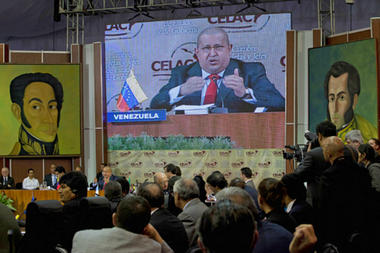
On December 2-3, 2011, the Community of Latin American and Caribbean States (CELAC) was born and the overwhelming force of a continent nearly 600 million strong, achieved a 200-year dream of unity. The 33 member nations of CELAC all agree on the unquestionable necessity to build a regional organization that represents their interests, and that excludes the overbearing presence of the US and Canada. While CELAC will take time to consolidate, the exceptional commitment evidenced by the 33 states present at its launching in Caracas, Venezuela, cannot be underestimated.
CELAC will have to overcome attempts to sabotage and neutralize its expansion and endurance, and the threats against it and intents to divide member nations will be numerous and frequent. But the resistance of the peoples of Latin America and the Caribbean who have resumed this path of unity and independence after nearly two hundred years of imperialist aggression, demonstrates the powerful force that has led this region to become an inspiration for those seeking social justice and true freedom around the world.
Phi Beta Iota: Emphasis added. This is largely a Cuban G-2 puff-piece, but it also represents real potential. A great deal will depend on whether Cuba and Venezuela get serious about creating the M4IS2 capabilities needed to harmonize internal spending while shutting out predatory external influences. We would not be surprised to find CIA Stations shut down across Central and South America in the next few years, as these governments stop tolerating incompetent but active spy units operating from official installations.